Photography, Painting, or Sculpture? Why Categories No Longer Hold
As contemporary artists move beyond medium-specific practice, photography, painting and sculpture no longer function as stable categories. Instead, artworks operate across forms, demanding new ways of seeing, interpreting and understanding visual culture today.


For much of art history, categories functioned as both guide and constraint. Painting, sculpture and, later, photography were not neutral descriptors but organising principles that shaped artistic production and critical reception. These distinctions helped audiences situate works within technical and historical lineages.
Yet these frameworks were always more fragile than they appeared. Even in earlier periods, artists pushed against the limits of medium. What has changed today is the extent to which those limits have dissolved altogether. The most significant contemporary practices no longer fit within a single category, nor do they attempt to.
From Medium to Idea
A defining shift in contemporary art is the move from medium-led practice to idea-led practice. Artists increasingly begin with a concept rather than a material. The choice of medium follows from the demands of the idea rather than from allegiance to a discipline.
This approach renders traditional categories secondary. A single body of work may include photographic images, painted surfaces and sculptural elements, all working in tandem. In many cases, these elements are inseparable, making classification not only difficult but irrelevant.
Photography Beyond the Image
Photography has undergone a significant transformation in this expanded field. Once associated with documentation and indexical truth, it now operates as a constructed and often highly manipulated form.
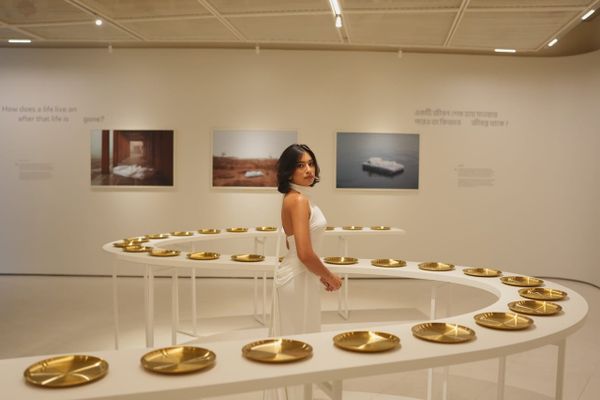
Contemporary photographic works frequently incorporate staging, digital intervention and material experimentation. Prints are mounted on unconventional surfaces, combined with objects, or integrated into installations. The photograph is no longer a self-contained image but part of a larger structure.
This shift moves photography closer to both painting and sculpture, not by imitation but through shared concerns with surface, space and material presence.
Painting as Object and Space
Painting, too, has moved beyond its traditional boundaries. The canvas is no longer treated solely as a flat support for illusion. Instead, it is often handled as a physical object.
Artists cut, fold, layer and extend painted surfaces into space. In doing so, they blur the distinction between painting and sculpture. The work may retain painterly qualities, yet its impact is spatial rather than purely visual.
Such practices challenge the long-standing notion of painting as a window. Instead, it becomes a constructed entity that occupies and alters its environment.
Sculpture Without Permanence
Sculpture has experienced perhaps the most radical redefinition. Historically associated with mass and permanence, it now frequently embraces temporality and immaterial elements.
Light, sound, video and digital processes are integral to many sculptural works. Installations may exist only for the duration of an exhibition or take form in virtual environments. The emphasis shifts from object to experience.
This expansion complicates any attempt to define sculpture in purely physical terms. The category persists, but its boundaries are increasingly unstable.
The Role of the Digital
Digital technology has accelerated the convergence of mediums. The processes of capturing, editing and presenting images are now interconnected. A single work may move seamlessly between screen, print and physical space.
This fluidity undermines the idea of medium as a fixed identity. Instead, it highlights the adaptability of images and objects across contexts. The same material can function differently depending on how and where it is encountered.
Implications for Viewers
For audiences, the erosion of categories demands a more active mode of engagement. Traditional cues no longer provide reliable guidance. A photograph may not be primarily about photography, and a sculptural installation may depend on image-based elements.
Viewers are required to consider relationships rather than labels. Meaning emerges through the interaction of materials, forms and contexts rather than through adherence to a single medium.
Institutional Shifts
Museums and galleries are gradually responding to these changes. While many institutions still retain medium-based departments, exhibitions increasingly adopt thematic or conceptual frameworks.
Works are grouped according to ideas rather than categories, reflecting the reality of contemporary practice. This approach allows for more nuanced dialogues between artworks that might previously have been separated.
Education and Practice
Art education has also moved towards cross-disciplinary approaches. Students are encouraged to experiment across mediums and to treat material as a tool rather than a defining feature of their identity as artists.
This has produced a generation of practitioners for whom distinctions between photography, painting and sculpture carry limited weight. Their work reflects a fluid understanding of form and process.
Why Categories Still Matter
Despite these developments, categories retain analytical value. They provide a historical framework through which we can trace artistic developments and understand technical traditions.
The challenge is to use these categories without allowing them to restrict interpretation. They should function as reference points rather than boundaries.
Beyond Classification
The most compelling works today do not simply reject categories. They engage with them, drawing on their histories while reconfiguring their possibilities. A work that combines photographic and painterly elements gains depth through this interaction.
Rather than collapsing distinctions entirely, contemporary art often operates within a network of relationships between mediums. These relationships generate meaning in ways that fixed categories cannot.
A More Open Framework
What emerges is not the disappearance of categories but a shift in how they function. They become flexible and provisional, capable of accommodating hybrid practices.
The question is no longer what an artwork is, but how it operates. How does it use material, space and image? How does it position itself within a broader field of references?
Conclusion
Photography, painting and sculpture continue to exist, but they no longer define the limits of artistic practice. Contemporary art moves across and between these categories, drawing on each without being confined to any. For a discerning audience, this shift invites closer attention. It requires an engagement that goes beyond classification, focusing instead on the relationships and ideas that shape each work.