Anish Kapoor Returns to Venice with a Monumental Exhibition at Palazzo Manfrin
An ambitious new exhibition at Palazzo Manfrin sees Anish Kapoor transform sculpture into architecture, bringing together monumental installations, unrealised projects, pigment voids, mirrors, and immersive environments during the 61st La Biennale di Venezia.

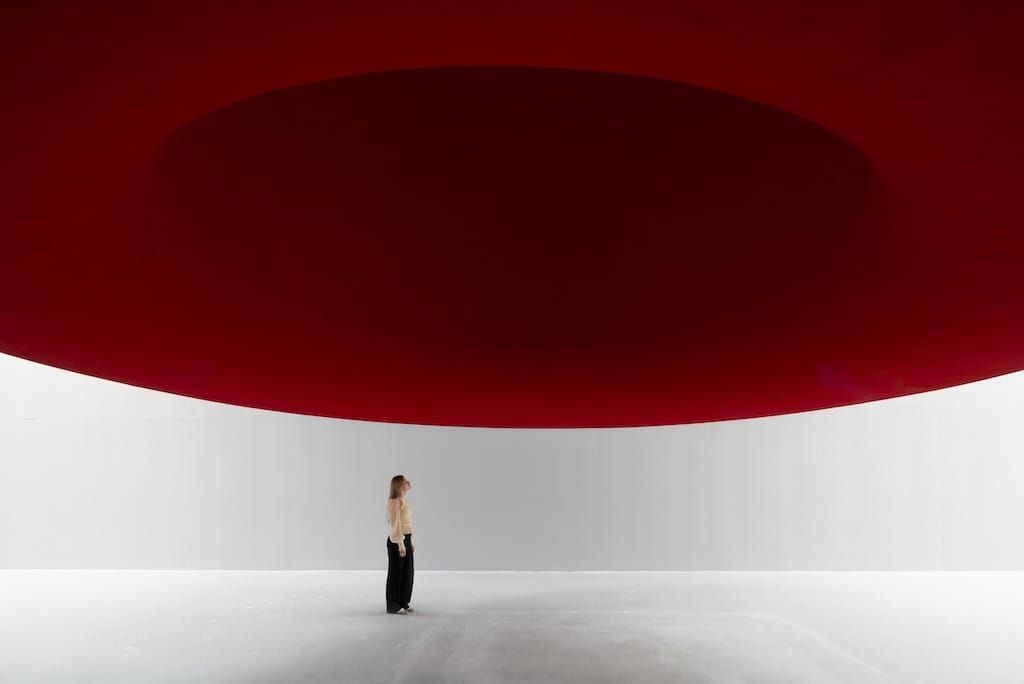
During the 61st edition of La Biennale di Venezia, Anish Kapoor unveils one of the most ambitious presentations of his career at Palazzo Manfrin. Titled Anish Kapoor: Palazzo Manfrin, the exhibition transforms the 16th-century Venetian palace into an expansive meditation on sculpture, architecture, perception, and the metaphysical possibilities of space.
Open until 9 August 2026, the exhibition marks the second public presentation staged at Palazzo Manfrin since the historic building became home to Kapoor’s foundation. Set within Venice’s Cannaregio district, the exhibition arrives at a moment when the city once again becomes the focal point of the international art world.
Rather than offering a conventional retrospective, Kapoor presents a deeply immersive survey of ideas that have shaped his practice over the last five decades. Around 100 architectural models — including realised projects and speculative proposals — are shown alongside monumental installations, reflective stainless-steel works, pigment sculptures, and immersive environments. Together, they reveal the artist’s longstanding fascination with sculpture not merely as object, but as a generator of new spatial and psychological experiences.
As Kapoor notes:
“For a long time I’d been thinking of my work as potential architecture. I’ve always been convinced by the idea that to create new art you have to create new space.”
Sculpture as Architecture, Architecture as Sculpture
Throughout his career, Kapoor has consistently blurred the boundaries between sculpture and architecture. The exhibition traces this trajectory through models and studies connected to some of his most ambitious projects, from Taratantara (1999), the enormous stretched-PVC installation created for the Baltic Centre for Contemporary Art in Gateshead, to Ark Nova (2013), the world’s first inflatable concert hall developed in collaboration with architect Arata Isozaki.
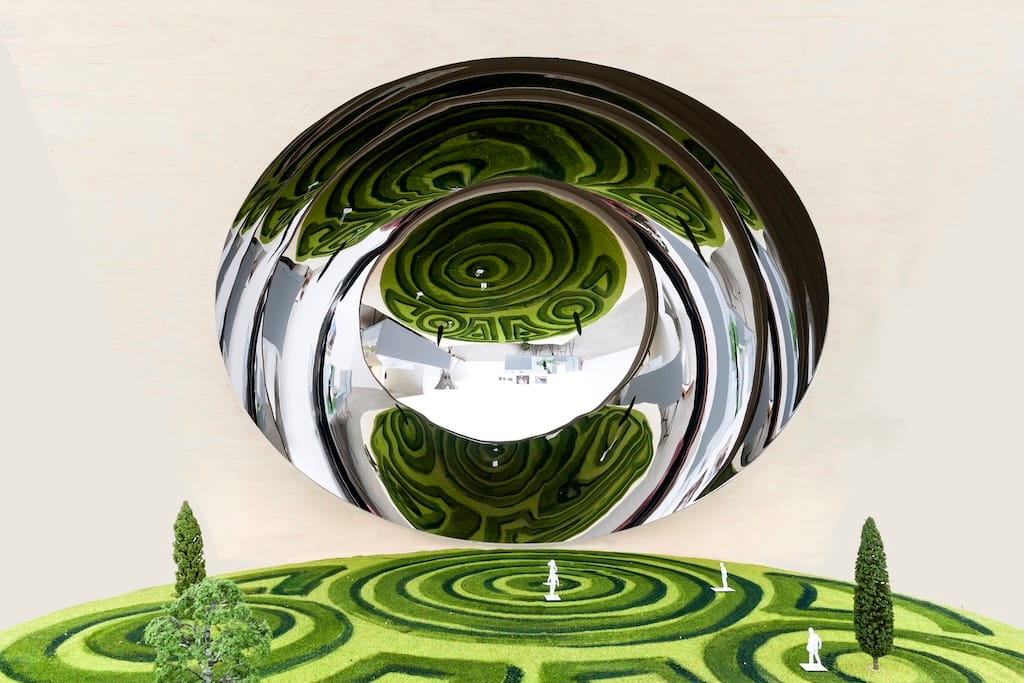
The presentation also includes material connected to the recently opened Monte Sant’Angelo Metro Station in Naples, further demonstrating Kapoor’s ability to merge public architecture with sculptural imagination.
What makes these models particularly compelling is their status as both artworks and records of thinking. Many exist as unrealised propositions, preserving moments of experimentation that remain charged with possibility. In Kapoor’s practice, the sketch and the maquette are not preparatory footnotes but essential sites of invention.
Entering the “Non-Object”
Visitors entering Palazzo Manfrin are immediately confronted by a monumental new iteration of At the Edge of the World (1998), an eight-metre-wide black pigment work suspended from the ceiling. Characteristically, Kapoor destabilises the viewer’s perception of depth and form, producing an encounter that feels simultaneously material and immaterial.
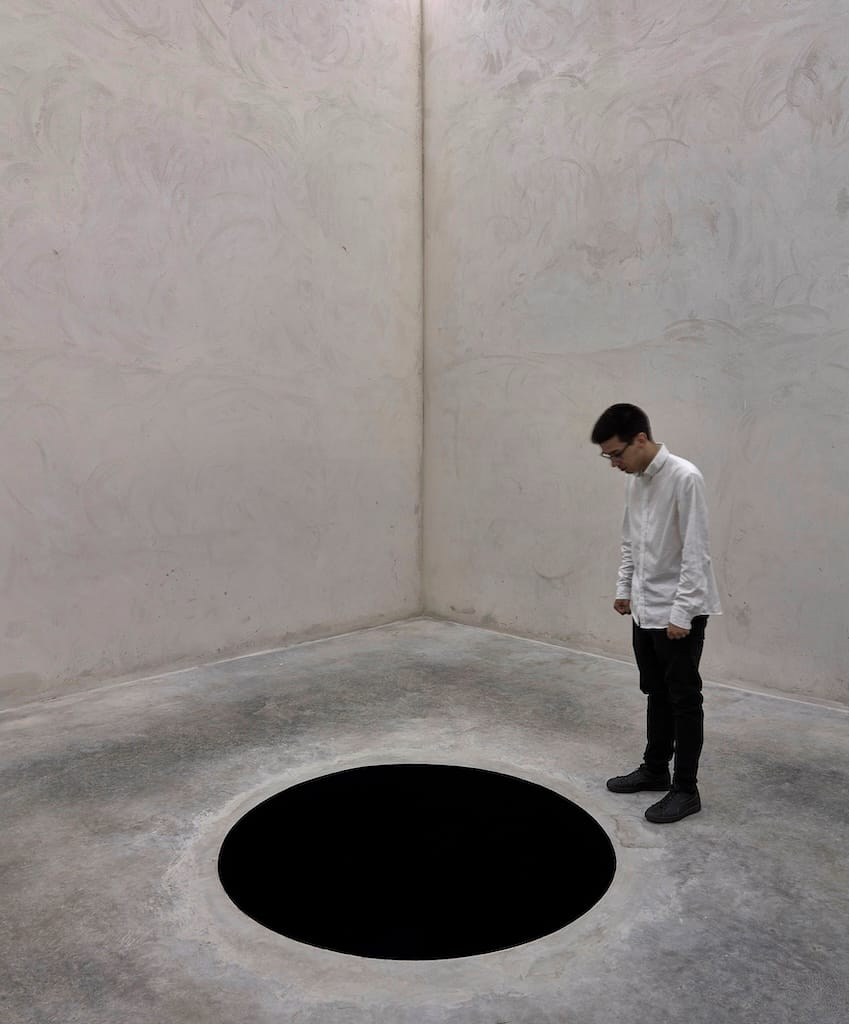
Nearby, the iconic Descent into Limbo (1992) continues Kapoor’s exploration of voids and perceptual uncertainty. Few contemporary artists have manipulated concavity, reflection, and darkness with such philosophical intensity. Kapoor’s works frequently challenge the viewer’s trust in vision itself, drawing audiences into what he has often described as the realm of the “non-object” — a condition in which sculpture exceeds physical boundaries and becomes experiential, psychological, even existential.
Large mirror works further intensify this destabilisation. Their polished surfaces warp architecture and bodies alike, turning the viewer into part of the sculpture’s constantly shifting field.
Matter, Abjection, and Transformation
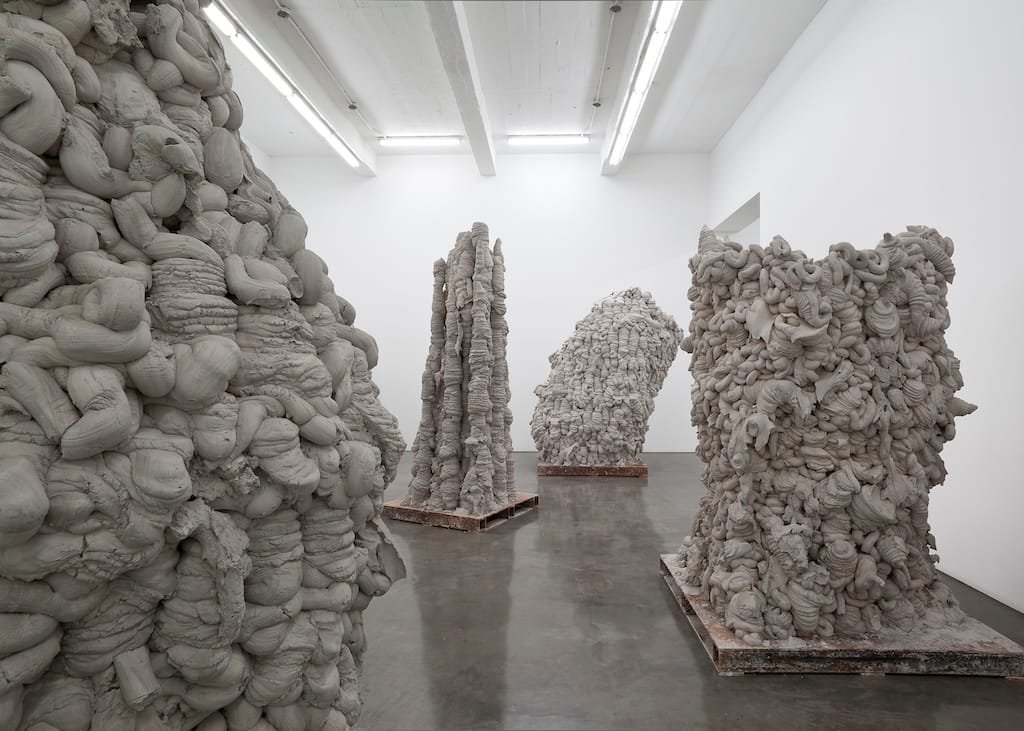
While Kapoor is often associated with sublime abstraction, the exhibition also foregrounds the visceral and corporeal dimensions of his work. The cement extrusions of Ga Gu Ma (2012) occupy a striking position within the show, oscillating between industrial production and bodily excess. These works possess a grotesque materiality that stands in deliberate tension with the immaterial voids elsewhere in the exhibition.
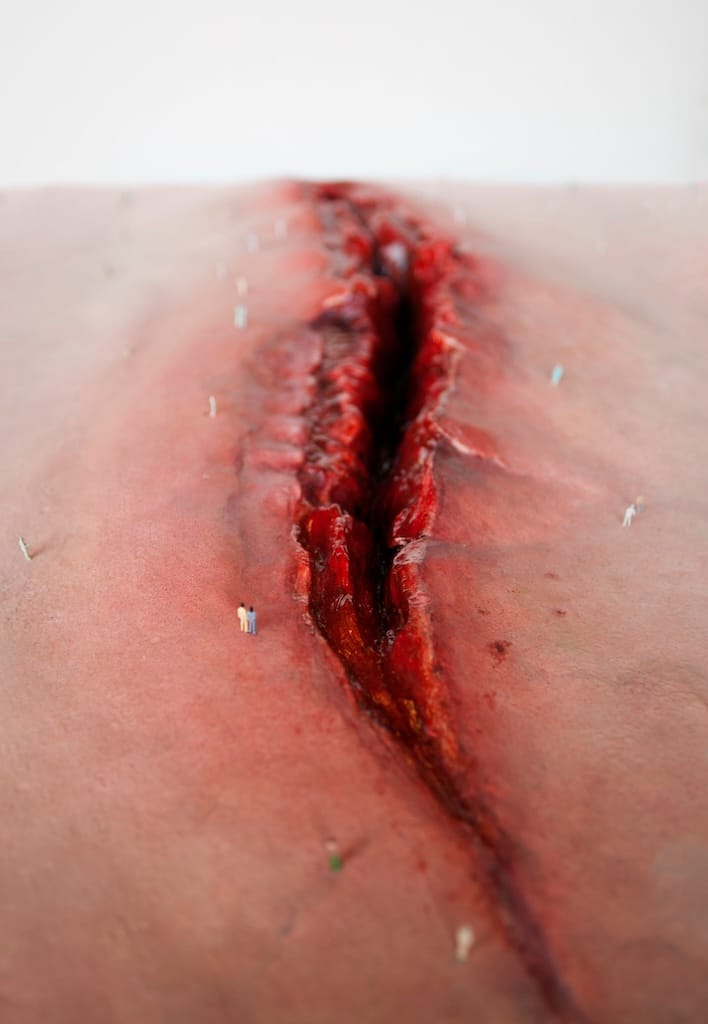
An immersive room composed of silicone and paint extends this bodily sensibility into Kapoor’s current painting practice, collapsing distinctions between sculpture, surface, and environment. Here, material appears unstable and alive, continuously shifting between creation and dissolution.
Colour remains another central concern. The luminous monochromatic work Violet Pearl over Burple (2013) demonstrates Kapoor’s enduring engagement with pure pigment as a vehicle for transcendence and spatial ambiguity. The exhibition also revisits Kapoor’s celebrated Vantablack sculptures, created using the ultra-light-absorbing nano-material that seemingly erases three-dimensional form altogether. These works continue Kapoor’s investigation into disappearance, void, and the limits of visual comprehension.
Venice as a Natural Setting
There is perhaps no city more suited to Kapoor’s sensibility than Venice. A city built upon reflections, illusions, thresholds, and unstable spatial relationships, Venice amplifies the conceptual concerns that have defined his work for decades. Palazzo Manfrin itself becomes more than a venue; it functions as an active participant in the exhibition, its historic interiors continually disrupted and reimagined through Kapoor’s interventions.
The exhibition also reinforces Kapoor’s longstanding relationship with Venice. In 1990, he represented Britain at the Venice Biennale with Void Field, earning the Premio Duemila award for Best Young Artist before receiving the Turner Prize the following year. More than three decades later, Kapoor returns not as an emerging artist, but as one of the defining sculptors of the contemporary era.
Born in Mumbai in 1954 and based between London and Venice, Kapoor’s practice continues to evolve across sculpture, painting, architecture, and public art. Yet the essential questions remain remarkably consistent: how does form shape perception? Where does object end and experience begin? And how can art create entirely new ways of inhabiting space?
At Palazzo Manfrin, those questions unfold on a monumental scale.