Barbara Hepworth in Colour: The Courtauld Reconsiders a Modern Master
The Courtauld’s 'Hepworth in Colour' reconsiders Barbara Hepworth through her lifelong engagement with colour, bringing together painted sculptures, drawings, and rare works that reveal how deeply colour shaped the emotional and spatial language of her modernism.

This summer, The Courtauld turns attention toward an aspect of Barbara Hepworth that has long remained overshadowed by discussions of form, carving, and abstraction. Hepworth in Colour, opening 12 June 2026 at The Courtauld Gallery, is the first exhibition devoted entirely to the artist’s use of colour across sculpture, drawing, and painting. Bringing together around 20 sculptures and 30 works on paper, the exhibition promises not only a fresh perspective on Hepworth’s practice, but also a reassessment of one of the defining figures of twentieth century British art.
Barbara Hepworth Beyond Monochrome
Hepworth is often remembered through the language of material and landscape. Her pierced abstract forms, carved directly into wood or stone, are inseparable from the coastlines and geological textures of Cornwall, where she settled in 1939. Discussions of her work frequently emphasise her commitment to “truth to materials” and her belief in direct carving as a deeply intuitive process. Yet colour occupied an equally important place in her artistic thinking throughout her life, even if it has rarely been given sustained scholarly attention.
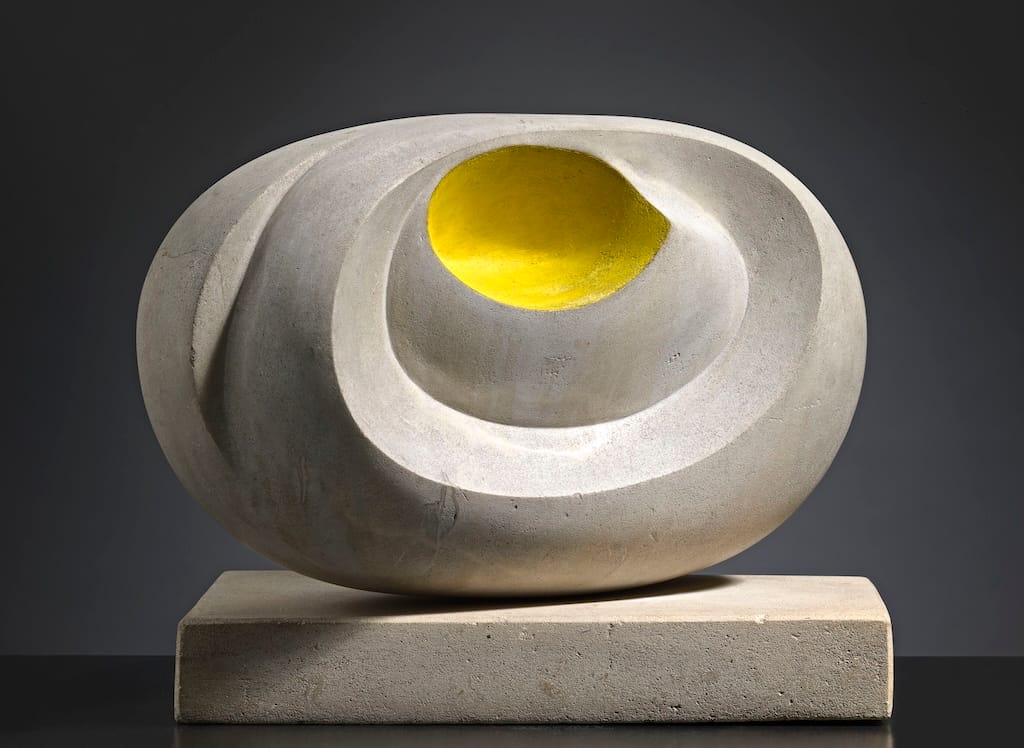
Hepworth herself recognised this gap in understanding. Reflecting on the reception of her work in conversation with the art historian Sir Alan Bowness, she observed: “In a way my colour has been accepted but never understood.” The Courtauld’s exhibition takes this statement as both a challenge and an invitation.
Cornwall and the Discovery of Colour
The exhibition traces Hepworth’s engagement with colour back to the mid-1930s, when she and Ben Nicholson were deeply connected to the European avant-garde. At the time, abstraction across Europe was increasingly exploring relationships between geometry, spirituality, and colour theory. For Hepworth, colour became not decorative embellishment but an extension of sculptural feeling and spatial experience.
When Hepworth left London for Cornwall on the eve of the Second World War, she carried with her a single coloured sculpture study. That move would prove transformative. The Cornish landscape, with its shifting skies, sea light, caves, cliffs, and changing tides, opened new emotional and visual possibilities within her work. Colour became a means of evoking atmosphere and sensation. Rather than sitting on the surface of sculpture, it seemed to activate inner space.
Sculpting Atmosphere Through Paint and String
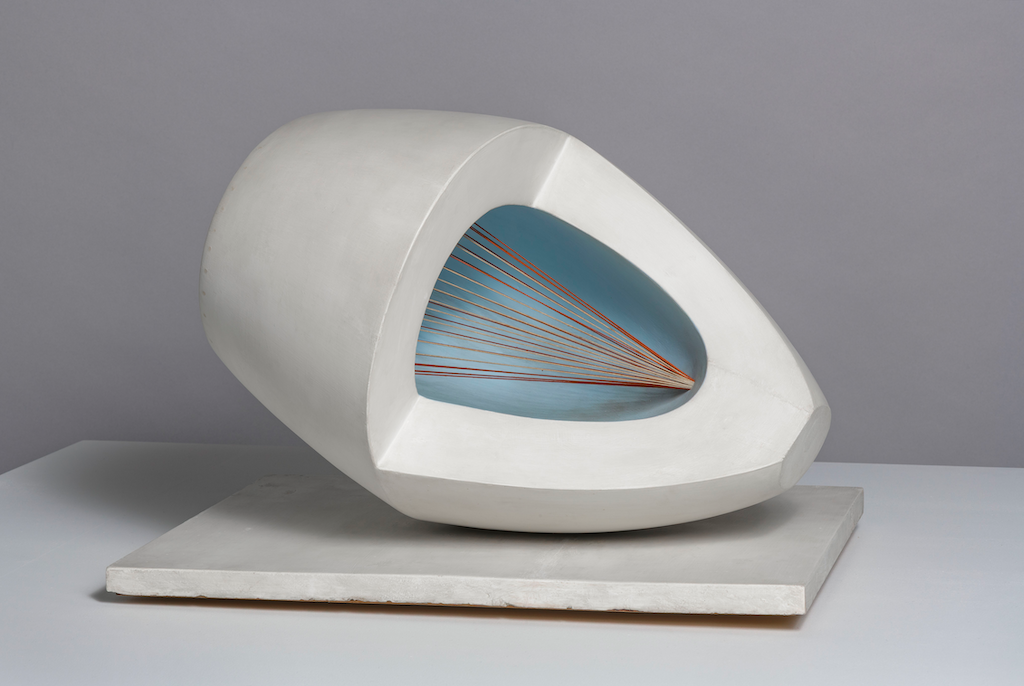
At the centre of the exhibition is the remarkable group of painted sculptures Hepworth produced between 1940 and 1948. These works reveal an artist experimenting boldly with painted surfaces and taut strings that traverse hollowed forms. Hepworth later described these sculptures as expressions of immersion in nature itself, recalling how “the colour in the concavities plunged me into the depths of water, caves or shallows.”
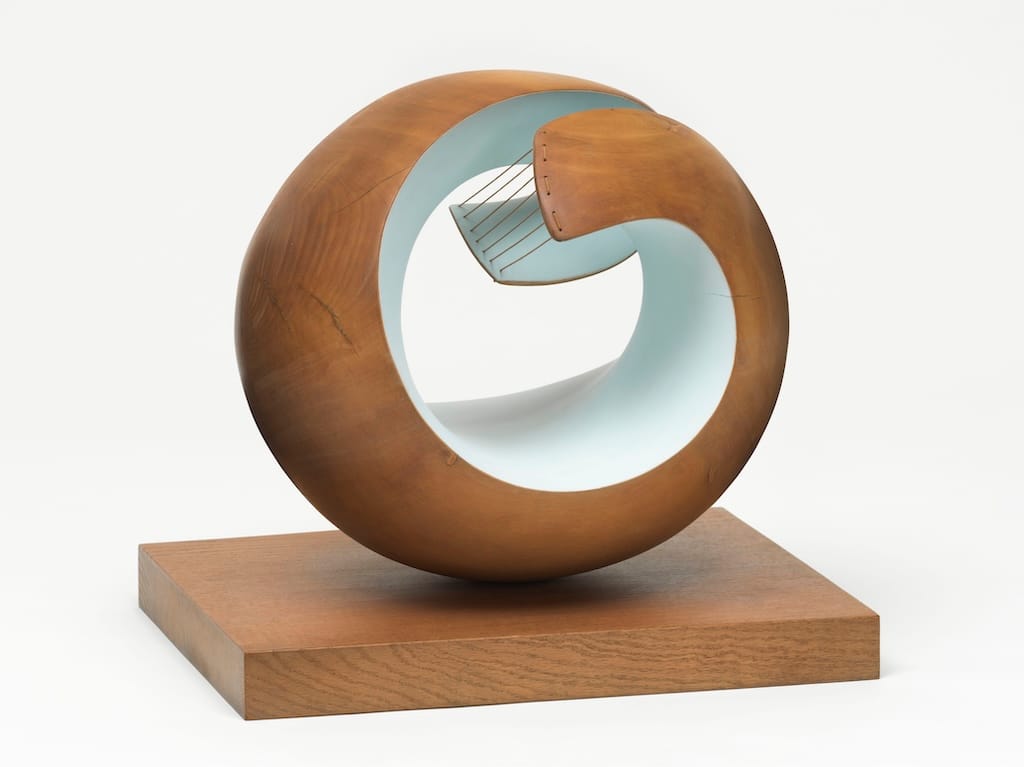
Among the most significant works included is Sculpture with Colour (Oval Form), Pale Blue and Red (1943), now part of the collection of The Hepworth Wakefield after a major public fundraising campaign in 2025. Rarely exhibited and previously held in private hands, the sculpture marks a breakthrough moment in Hepworth’s career. Combining string and colour with increasing sophistication, the work introduces the pale blue tones that would become closely associated with the skies and coastlines of Cornwall.
The Breakthrough of Oval Form, Pale Blue and Red
The sculpture’s return to London carries particular resonance. Not only does it highlight the renewed institutional commitment to Hepworth’s legacy, it also reveals how radical these works must have appeared in the 1940s. The strings stretched across the carved openings create tensions that are both visual and emotional. Hepworth once described them as representing “the tension I felt between myself and the sea, the wind or the hill.” In these works, sculpture ceases to be static mass and instead becomes an instrument for sensing movement, distance, and atmosphere.
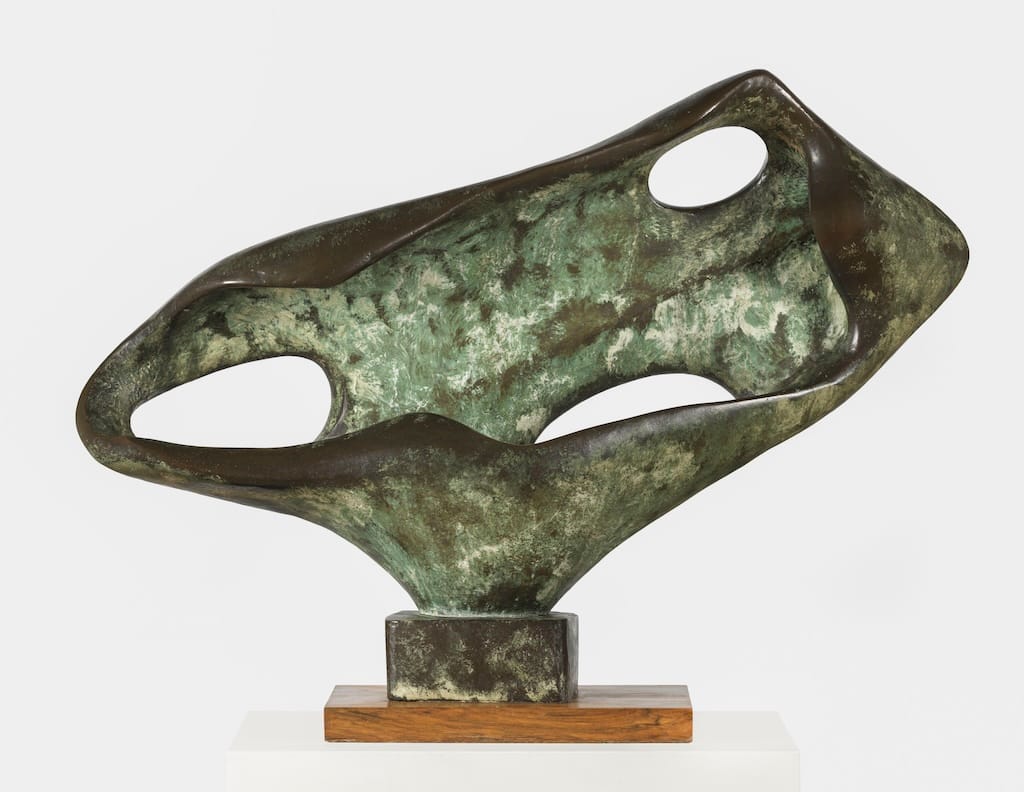
Other major sculptures in the exhibition include Wave (1943–44) from National Galleries of Scotland and Pelagos (1946) from Tate. Inspired by the bay at St Ives, Pelagos remains one of Hepworth’s most celebrated works, translating the rhythms of sea and landscape into spiralling carved form. Seen within the context of colour, however, these sculptures gain new dimensions. Their painted interiors and carefully balanced tonal relationships emerge not as secondary details, but as central components of meaning.
Reuniting the Deep Blue and Red Sculptures
One of the exhibition’s most intriguing achievements will be the reunion of the six progressively larger versions of Sculpture with Colour (Deep Blue and Red) from both private and public collections. Exhibiting these works together offers audiences a rare opportunity to observe Hepworth’s iterative process and the evolving relationship between scale, colour, and spatial tension.
Wartime Drawings and New Experiments
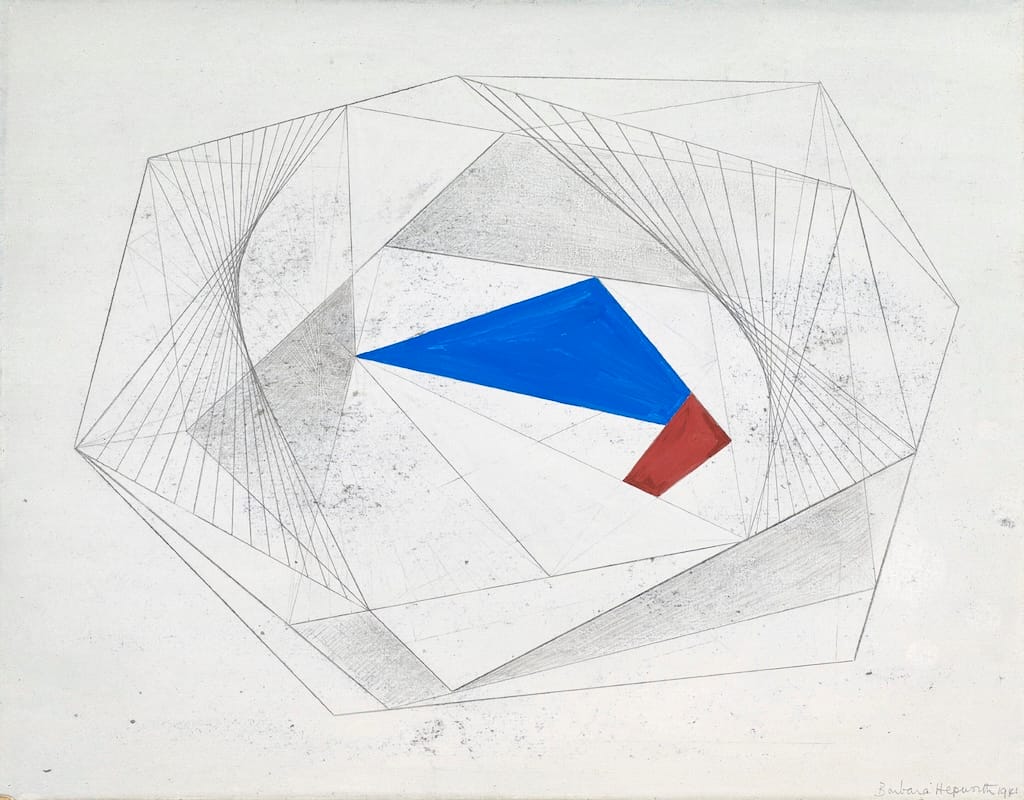
The exhibition also gives substantial attention to Hepworth’s wartime drawings, an area often treated separately from her sculpture. During the early years of the war, shortages of materials and limitations on studio work made large scale carving difficult. Drawing became a vital experimental space where Hepworth could continue developing sculptural ideas.

These “drawings for sculpture” are among the most striking works in the exhibition. Filled with crystalline structures and geometric tensions, they pulse with saturated blues, reds, greens, and yellows. Rather than functioning merely as preparatory sketches, the drawings stand as autonomous explorations of rhythm, colour, and energy. They reveal an artist thinking simultaneously through line, volume, and hue.
Importantly, Hepworth in Colour extends beyond the wartime decade into the 1950s and 1960s, demonstrating that colour remained central to Hepworth’s artistic imagination throughout her career. Her later painted marbles, patinated bronzes, and expressive paintings show how she continued to push the emotional and material possibilities of colour in different media.
The Hampstead Studio Years
Running alongside the exhibition is a complementary display in the Courtauld’s Project Space devoted to photographs of Hepworth and Nicholson’s shared Hampstead studio. Taken by the German photographer Paul Laib between 1932 and 1936, these images capture a defining moment in British modernism. They reveal not only the physical environment in which the artists worked, but also the close dialogue between their practices. The photographs offer viewers a valuable glimpse into the collaborative and intellectual atmosphere that shaped Hepworth’s early experiments with abstraction and colour.
Rethinking Hepworth’s Legacy Through Colour
The timing of Hepworth in Colour feels significant. In recent years, museums and scholars have increasingly sought to complicate familiar narratives surrounding twentieth century modernism, especially by revisiting artists whose work has been narrowed through repetition and canonisation. Hepworth’s reputation has long rested on the purity of carved form and her relationship to landscape. This exhibition suggests a more layered story, one in which colour played a profound conceptual and emotional role.
By foregrounding colour, the Courtauld does not overturn Hepworth’s legacy so much as deepen it. The exhibition invites audiences to encounter her work anew, not simply as monumental abstraction, but as an art of sensation, atmosphere, and emotional resonance. It reveals Hepworth as an artist who understood colour not as ornament, but as space, tension, memory, and feeling. For contemporary audiences accustomed to thinking about modernist sculpture in austere monochrome terms, Hepworth in Colour may prove genuinely revelatory.