Madhvi and Manu Parekh's Artistic Worlds Meet the Textile Traditions of Chanakya School at Bihar Museum
First presented at the 60th Venice Biennale in 2024, Cosmic Garden brings together the artistic practices of Madhvi Parekh, Manu Parekh, Karishma Swali and the Chanakya School in an exploration of painting, embroidery, cultural memory and collective making.

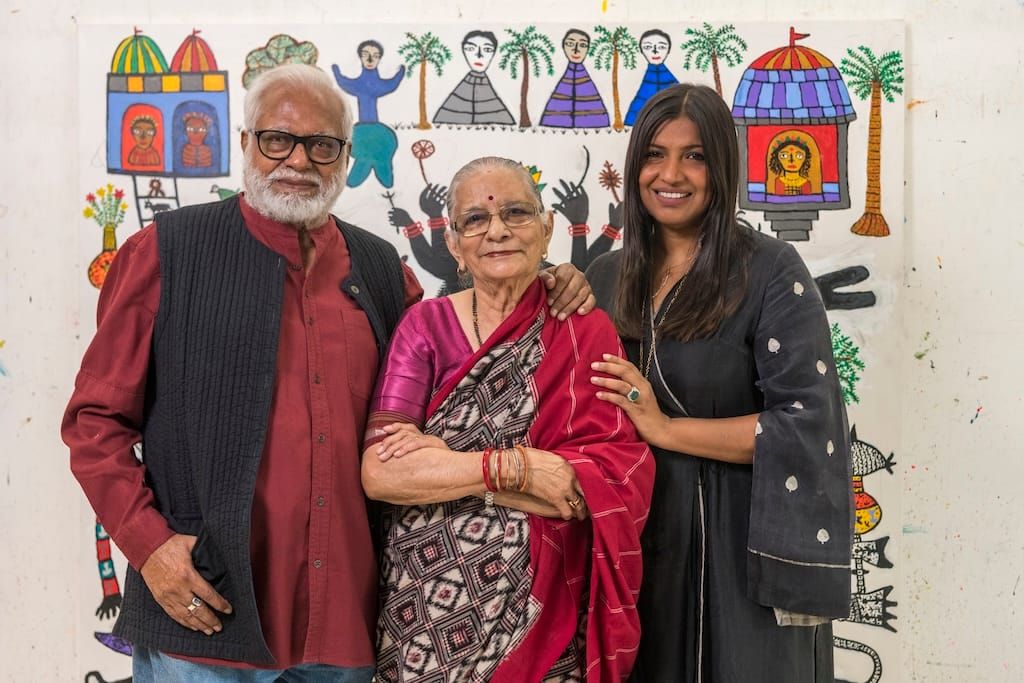
The relationship between art and craft has long been a subject of artistic enquiry, particularly in India, where inherited traditions of making continue to inform contemporary visual culture. Exploring this intersection, Cosmic Garden, presented by the Bihar Museum in collaboration with the Chanakya Foundation, brings together the works of artists Madhvi Parekh and Manu Parekh with the interdisciplinary textile practice of Karishma Swali and the Chanakya School. The exhibition, which was first presented as a Collateral Event of the 60th International Art Exhibition at La Biennale di Venezia in 2024, arrived in Patna in October 2026, bringing its exploration of artistic exchange and material traditions to a new institutional setting.
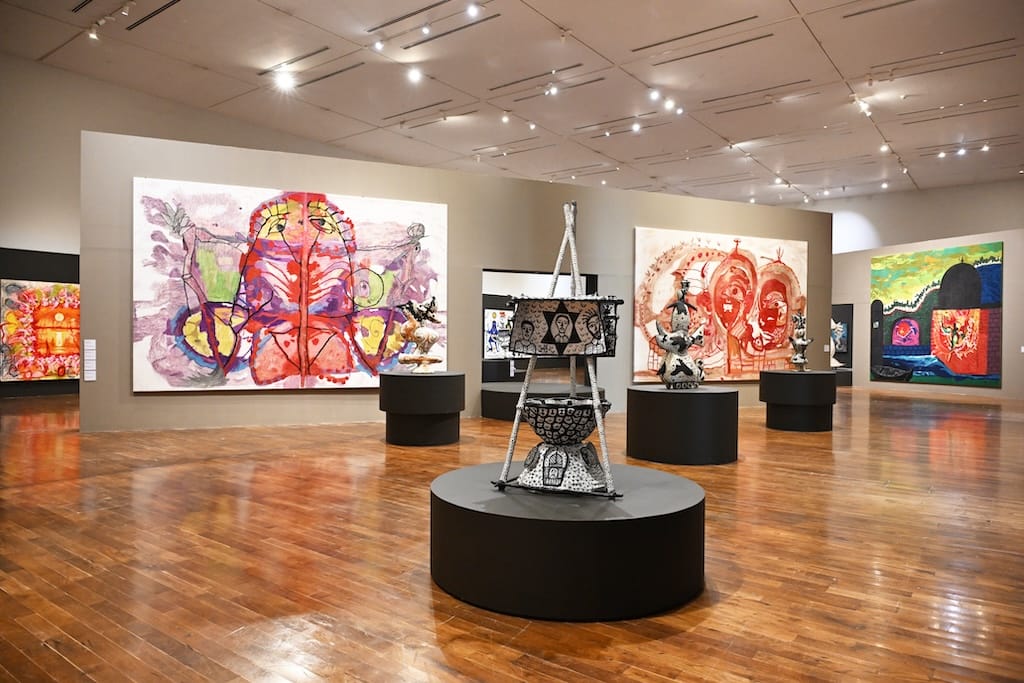
Curated by Maria Alicata and Paola Ugolini, the original presentation at Salone Verde, Art & Social Club, Venice, examined the possibilities of dialogue between painting, sculpture and textile-based practices. At its centre is an ongoing exchange between distinct artistic vocabularies, in which images and ideas move across generations, materials and methods of making. Paintings and sculptures by Madhvi and Manu Parekh, dating from the late 1970s to 2023, are placed alongside large-scale interdisciplinary textile works developed with Karishma Swali and the Chanakya School. The resulting body of work considers how an individual artistic vision can be reinterpreted through collective knowledge and the accumulated skills of traditional craftsmanship.
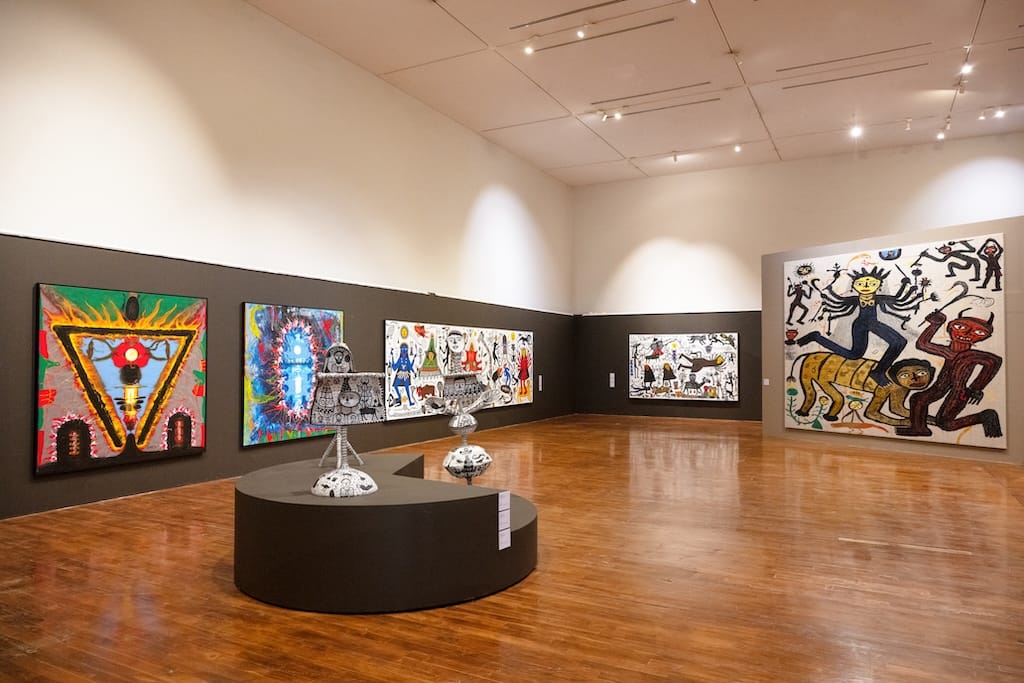
Madhvi Parekh's artistic language draws upon childhood memories, Indian mythology, folk traditions and the imaginative possibilities of abstraction. Born in Gujarat in 1942, the self-taught artist has developed a distinctive visual vocabulary populated by goddesses, celestial beings, symbolic figures and dreamlike characters. Her compositions frequently bring together the familiar and the fantastical, drawing upon memories of the landscapes and cultural traditions of her childhood. Mythological narratives and spiritual references coexist with everyday experiences, creating pictorial worlds in which the real and the imaginary continually intersect. Her engagement with vernacular visual traditions has remained central to a practice that moves between figuration, symbolism and abstraction.
Manu Parekh, born in Gujarat in 1939, approaches the relationship between Indian cultural traditions and modernist expression through a different visual vocabulary. His paintings are characterised by energetic lines, recurring crosses, flowers, spirals and germinating forms, through which he explores ideas of nature, fertility, transformation and spiritual energy. His engagement with Indian vernacular traditions developed partly through his association with the Weaver's Service Centre and the Handicrafts and Handlooms Export Corporation of India, where he encountered diverse forms of traditional making across the country. Influenced by modernist approaches as well as Indian philosophical and cultural references, his work frequently engages with the idea of shakti, the feminine life force, as a source of creative energy.
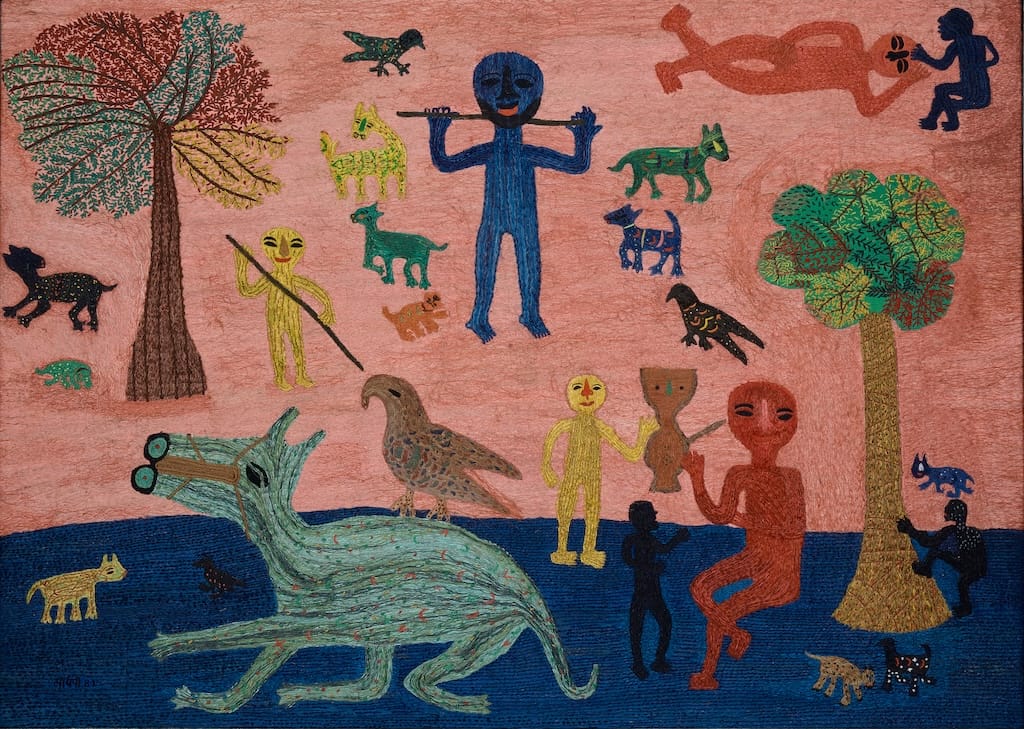
Although their artistic practices are distinct, Madhvi and Manu Parekh share an interest in memory, spirituality, nature and the symbolic dimensions of everyday life. It is these overlapping concerns that provide the foundation for the textile interpretations developed through Cosmic Garden.
Under the artistic direction of Karishma Swali, the Chanakya School translates elements of the Parekhs' visual languages into an expansive vocabulary of stitch, fibre, texture and surface. Images and motifs become starting points for new works, in which drawing is reimagined through thread and gesture takes on a tactile dimension. The resulting textile compositions extend the possibilities of embroidery, presenting it as a medium for artistic expression, material experimentation and conceptual exploration.
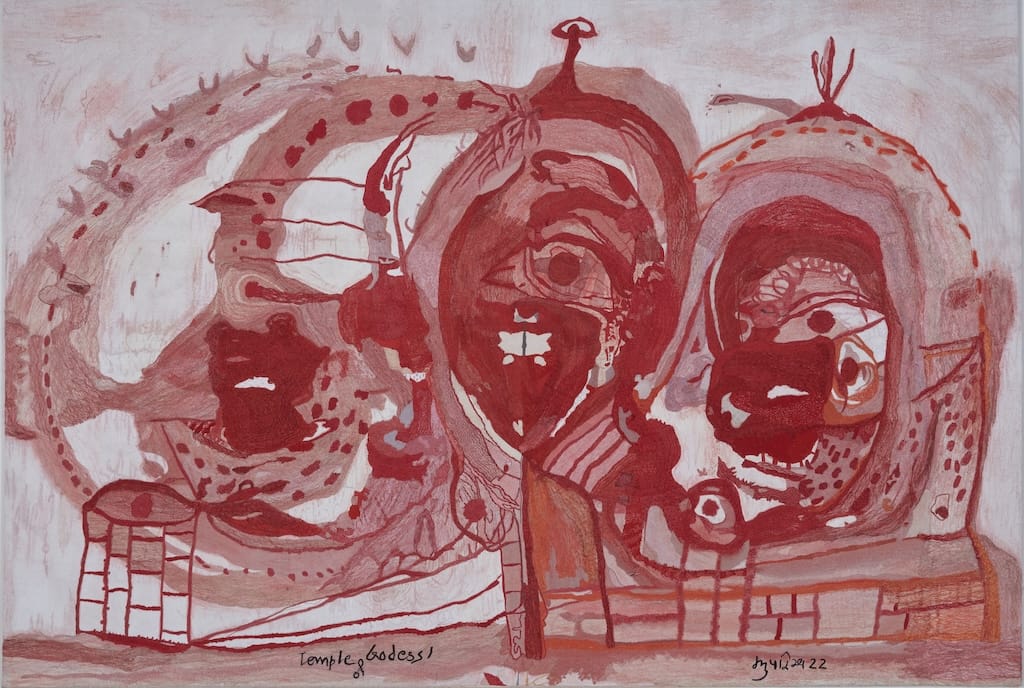
This approach also invites a reconsideration of embroidery's historical position within the visual arts. Frequently associated with domestic practice and women's labour, embroidery has often occupied a peripheral position in conventional discussions of contemporary art. In Cosmic Garden, however, it becomes a central artistic language, capable of engaging with the scale, complexity and conceptual concerns of painting and sculpture. The transformation of line into thread and image into textured surface demonstrates how traditional techniques can acquire new meanings through contemporary artistic collaboration.
The Chanakya School's involvement also brings questions of authorship and collective practice into focus. The textile works emerge through the participation of artisans whose specialised knowledge and technical abilities shape the final compositions. Individual artistic vision is thus placed in conversation with shared labour, inherited skills and the intelligence of the hand. The process recognises craftsmanship as an evolving form of knowledge, one that can be preserved while continually adapting to new artistic contexts.
Founded by Karishma Swali, the Chanakya Foundation was established in 2015 to advance cultural sustainability, education and the preservation of India's artisanal heritage. The Chanakya School followed in 2016 as a non-profit institution and artist collective based in Mumbai, working across pedagogy, research and material experimentation. Drawing upon more than 300 embroidery and weaving traditions, the School brings together practitioners working across textiles, lacemaking, stone carving and ceramics. Its educational programme has trained more than 1,400 women since its establishment, creating opportunities for the transmission and development of traditional skills.
At the heart of its work is the recognition of women as practitioners, custodians and transmitters of cultural knowledge. Through its educational and artistic activities, the School seeks to establish craft as an active part of contemporary cultural production, while creating opportunities for women to develop greater autonomy through their skills. Its collaborations with artists including Judy Chicago, Faith Ringgold, Mickalene Thomas and Barthélémy Toguo further demonstrate the possibilities of bringing traditional craftsmanship into dialogue with international contemporary art practices.
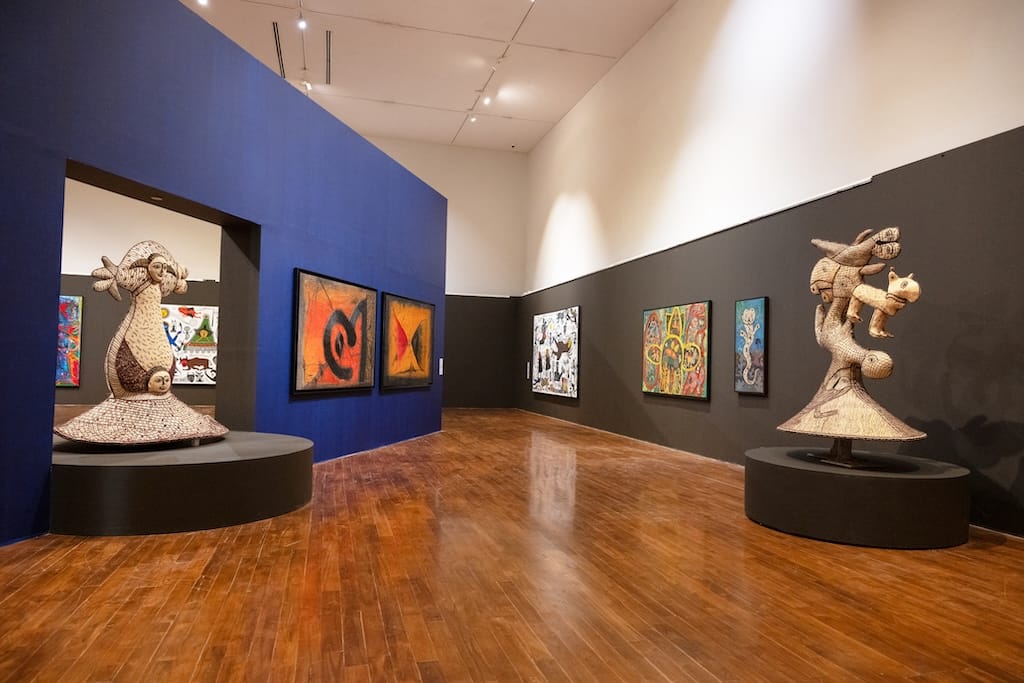
The presentation at the Bihar Museum marks another chapter in the exhibition's journey. Having first brought these artistic practices together in Venice, Cosmic Garden now enters the cultural landscape of Bihar, where its exploration of Indian artistic traditions and material knowledge acquires a new geographical and institutional context. The Bihar Museum, one of India's foremost cultural institutions, has consistently sought to create opportunities for audiences to engage with the country's diverse artistic and cultural heritage.
Commenting on the presentation, Shri Anjani Kumar Singh, Director General of the Bihar Museum, said, "The exhibition particularly celebrates the creativity and craftsmanship of women artisans." He added that the museum remains committed to "bringing internationally significant exhibitions to Bihar, offering our audiences opportunities to explore and appreciate the diverse dimensions of Indian art and culture."
Cosmic Garden is on view at the Bihar Museum, Patna, from 22 October to 15 November 2026.