Vinod Balak's 'Dis.em.Bodied H.ours' at Galerie Mirchandani + Steinruecke
Balak's richly detailed paintings bring everyday objects, fragmented bodies and unsettling domestic scenes into focus, revealing the hidden histories of consumption, labour, ownership and social inequality that shape our collective experience.

A trophy fashioned from discarded cigarette butts, a cabinet filled with peculiar representations of human anatomy and hundreds of disembodied hands emerging from a garden: the world of Vinod Balak is at once colourful, meticulously detailed and deeply unsettling. In Dis.em.Bodied H.ours, the artist brings together familiar objects and fragmented representations of the human body to examine the relationships between consumption, possession, labour and social hierarchies.
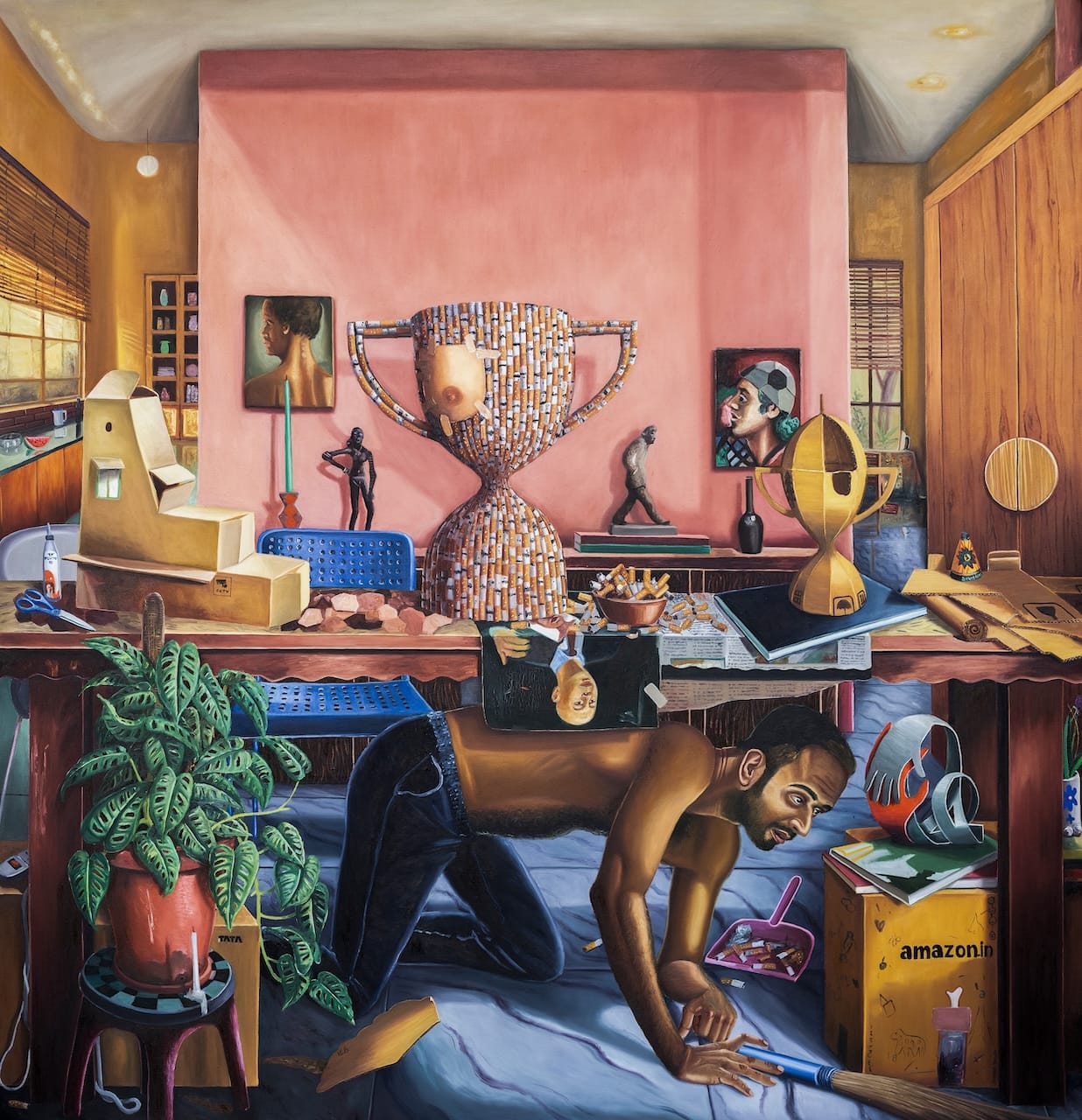
Presented at Galerie Mirchandani + Steinruecke in New Delhi, the exhibition explores how everyday objects carry histories that often remain invisible to those who acquire and use them. In the titular painting, Dis.em.Bodied H.ours (2026), a man crawls beneath a table crowded with household possessions, cardboard packaging, books and decorative objects. Above him, a striking hourglass-shaped trophy made from cigarette butts occupies the centre of the composition. Drawing on a childhood memory of collecting discarded cigarette butts from a neighbour and arranging them into different shapes with friends, Balak transforms an ordinary discarded object into a symbol of achievement. The cigarette, commonly associated with masculine bravado, takes on an unexpected form, while the man's posture suggests the emotional weight of consumerism beneath which the individual appears to buckle.
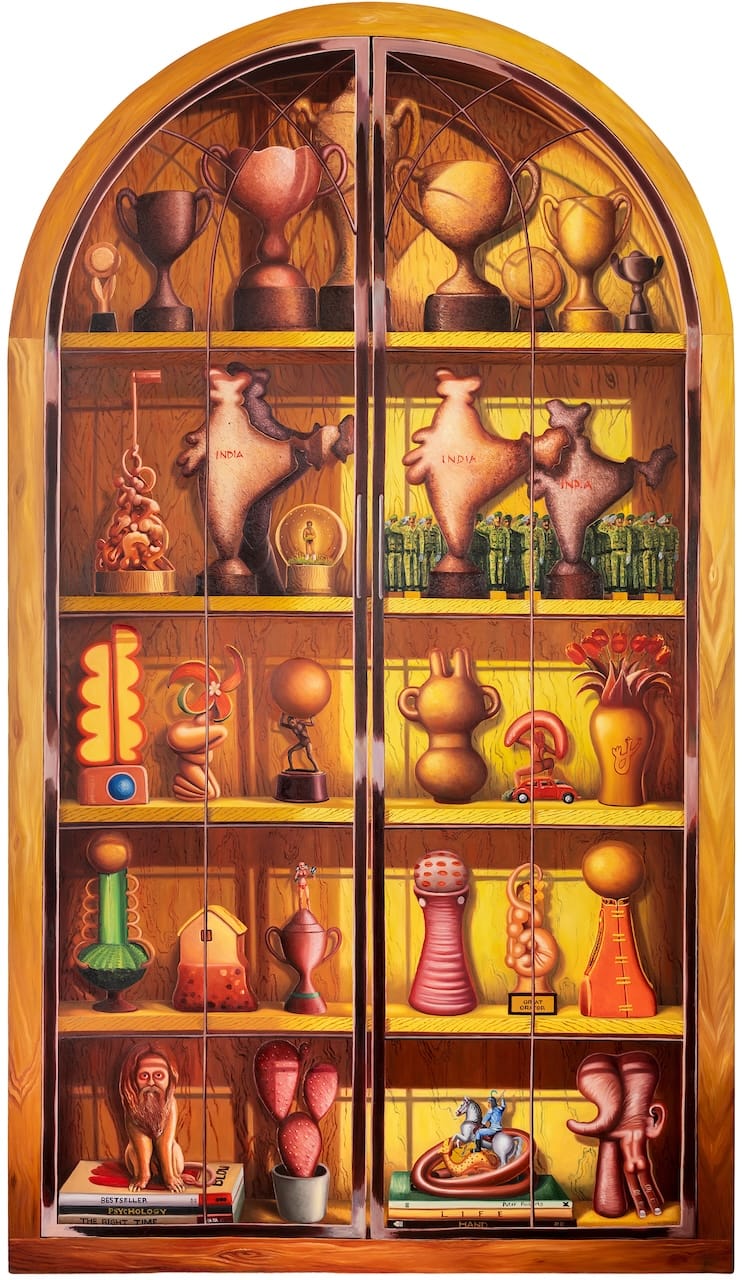
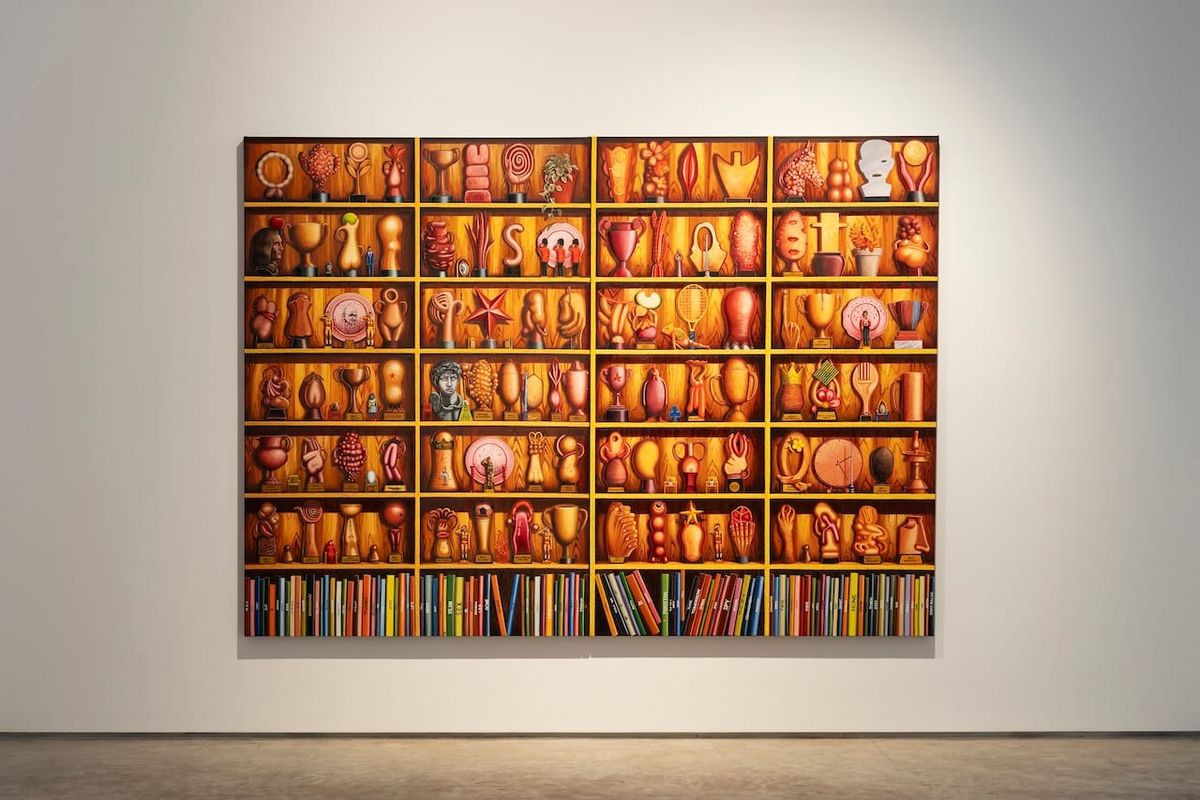
The idea of turning human behaviour into objects of display continues in Traces of Glorious Days I (2025) and Traces of Glorious Days II (2026). Resembling glass-fronted cabinets of curiosities, the paintings contain shelves of trophies, figurines and sculptural forms, some suggestive of human anatomy. Among these are awards that celebrate less flattering aspects of human behaviour, including patriarchy and narcissism. By giving these traits the appearance of achievements worthy of preservation, Balak employs satire to question the values and hierarchies that societies continue to uphold. The cabinets also invite reflection on the objects we choose to collect and the histories we preserve, turning what might ordinarily be displays of accomplishment into unsettling records of human behaviour.
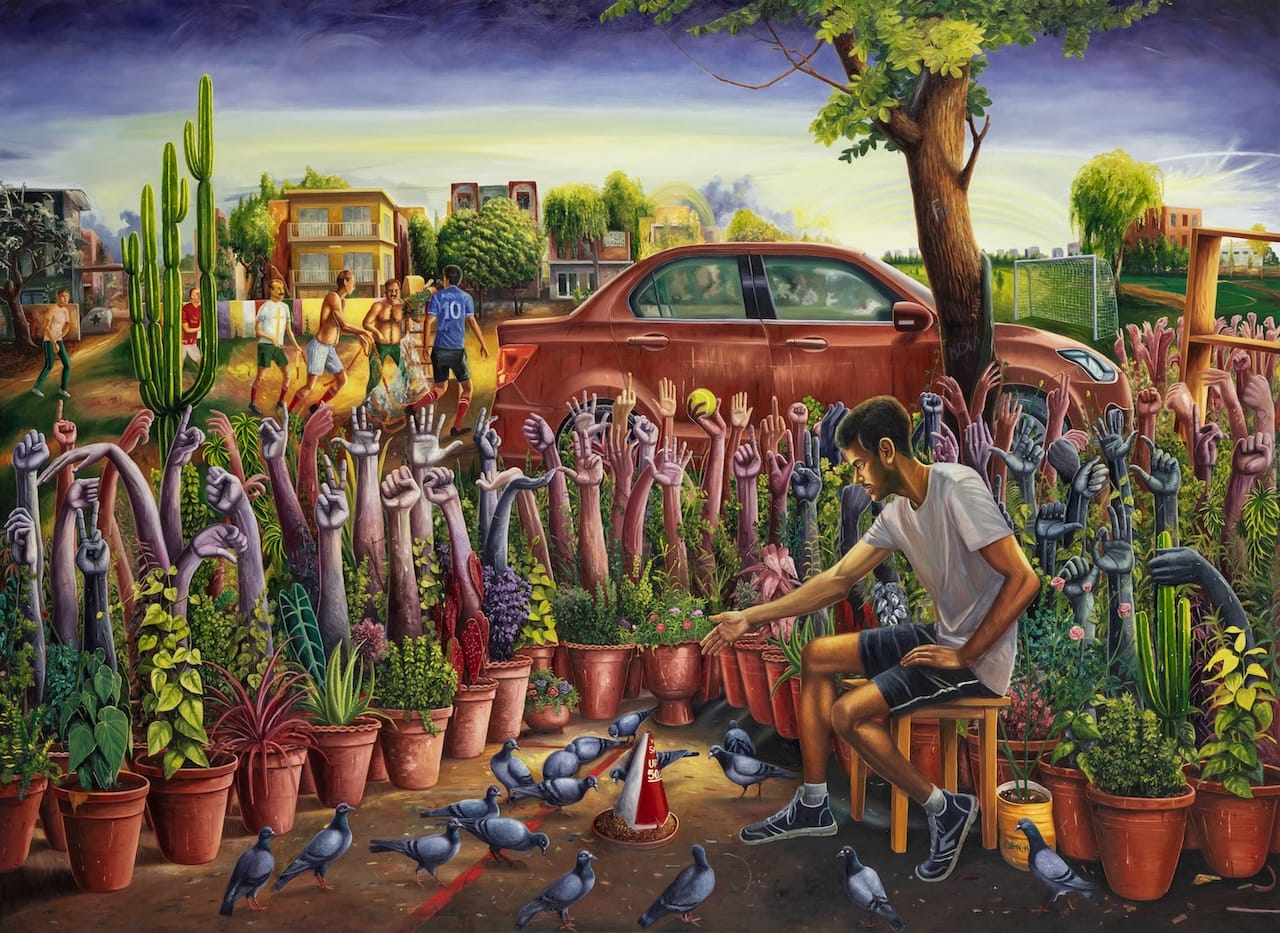
In The Garden of the Rebel (2024), the artist moves beyond the domestic interior into an urban landscape where a seated man is surrounded by potted plants, pigeons and an extraordinary proliferation of disembodied hands. Their raised and pointing gestures recall the visual language of revolutionary posters, a reference rooted in Balak's early exposure to Soviet, Russian and Chinese publications. The juxtaposition of these gestures with an otherwise familiar neighbourhood setting brings political histories into the everyday landscape, suggesting how the imagery and ideals of earlier generations continue to inhabit the present.
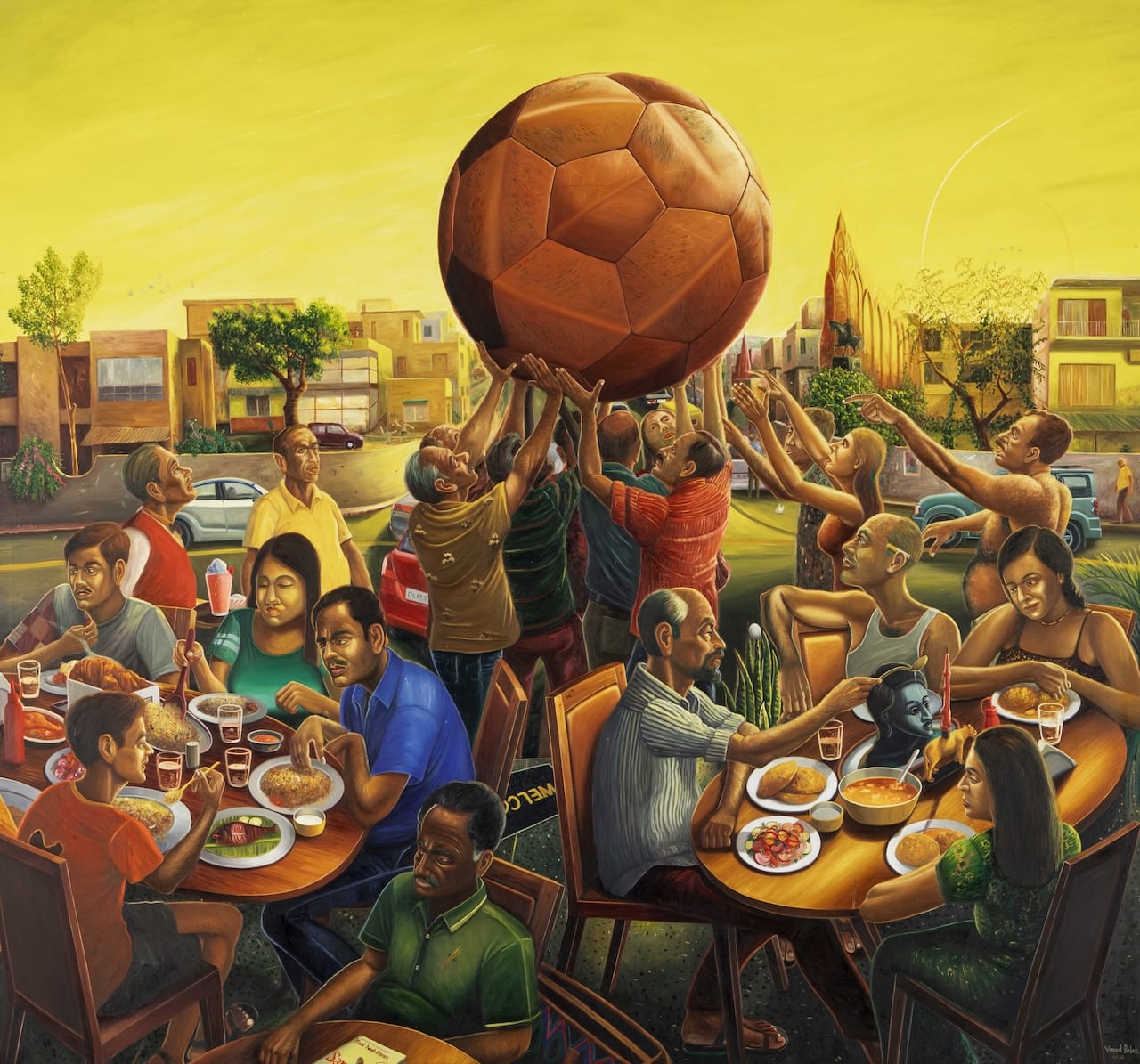
Meanwhile, When We Last Touched Each Other (2023) adopts the expansive visual language of a mural. A large football is held aloft by a gathering of people, almost like an idol, while others sit around tables eating and interacting. Drawing on shared mural traditions in Kerala and Mexico, Balak considers how physical proximity can bring people together even as caste and social divisions continue to shape their lives. The painting's title introduces another layer to this gathering, drawing attention to the significance of human touch and the contradictions between collective experience and social separation.
Across the exhibition, Balak repeatedly unsettles the boundaries between people and the objects they own. His paintings suggest that possessions are never entirely separate from the human lives and labour that bring them into existence. The everyday rituals of acquiring, displaying and consuming objects are connected to wider histories of extraction and inequality, shaped by caste, class and gender. There is also an unsettling quality to the settings in which these encounters unfold. Familiar domestic interiors and cultivated gardens become spaces of estrangement, where the ordinary gives way to unexpected and sometimes disturbing associations. The present, in Balak's compositions, carries the accumulated traces of a collective past, with its achievements, contradictions and unresolved inequalities. His densely layered paintings reward prolonged looking, revealing a world in which objects retain the marks of human experience and the boundaries between the two become increasingly difficult to distinguish.
Dis.em.Bodied H.ours is on view at Galerie Mirchandani + Steinruecke, New Delhi, until 10 December 2026.
The exhibition is also accompanied by A Conversation on Art and History, a talk by historian Manu S Pillai titled The Past is a Canvas: Tracing History through Art. The discussion will explore art as a record of human emotions, impulses and anxieties, and consider what Balak's work reveals about the present. The talk takes place on Saturday, 28 November 2026, at 11:30 am, at Galerie Mirchandani + Steinruecke, D-58, Defence Colony, New Delhi.