Kandinsky’s Das bunte Leben Returns to the Market at Christie’s
Christie’s will offer Wassily Kandinsky’s Das bunte Leben in London this October, bringing an exceptionally important early modernist painting back to market after restitution to the heirs of Hedwig Lewenstein-Weyermann following decades of museum display.

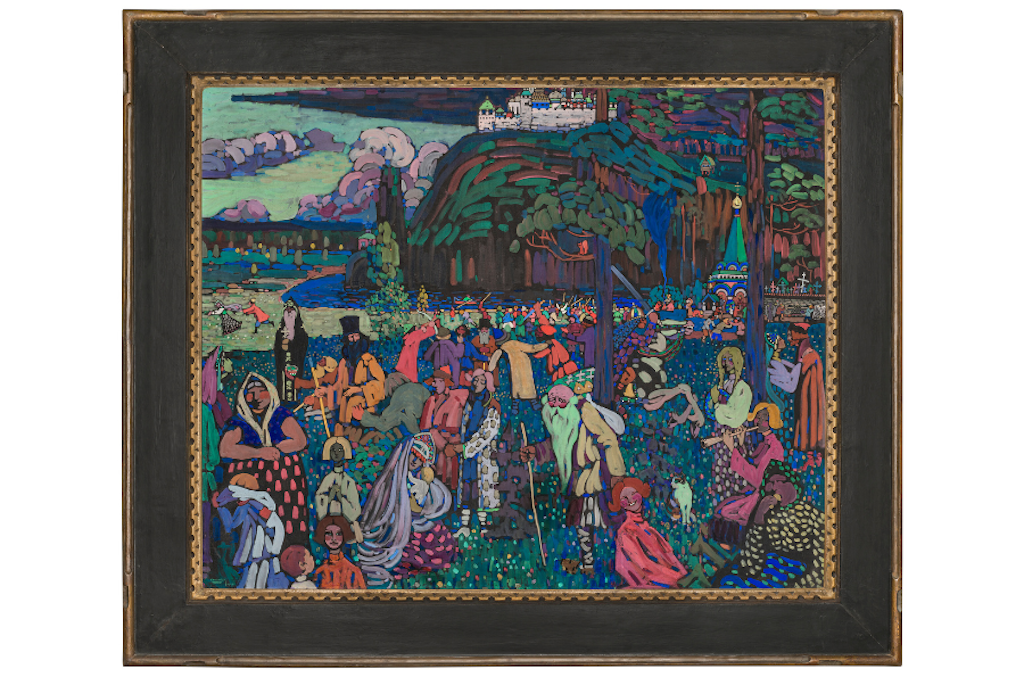
Christie’s will offer the museum-calibre 1907 painting in its London 20th/21st Century Evening Sale on 14 October, following its return to the heirs of Hedwig Lewenstein-Weyermann.
A pivotal early painting by Wassily Kandinsky is set to become one of the defining lots of London’s Frieze Week auctions. Christie’s will offer Das bunte Leben (1907) in its 20th/21st Century: London Evening Sale on 14 October, following the work’s landmark restitution to the heirs of Hedwig Lewenstein-Weyermann in June 2023.
Monumental in both scale and ambition, the 130 by 163 cm canvas is widely regarded as one of the great achievements of Kandinsky’s formative period. It was the largest painting he had attempted to that point, and appeared to acclaim at the Salon d’Automne in Paris in the year it was made. Its arrival at auction carries considerable art-market significance, not least because it has spent much of the past half-century on public view at Munich’s Lenbachhaus.
The sale comes at a moment when collectors are showing sustained appetite for canonical modern works with exceptional provenance, institutional exhibition histories and rigorous restitution narratives. Christie’s has not disclosed an estimate, but the painting’s rarity, scale and position within Kandinsky’s development place it firmly in the highest tier of the season’s offerings.
Das bunte Leben, or The Colourful Life, was painted during Kandinsky’s extended stay in Paris with Gabriele Münter. Between 1904 and 1908, the city was a crucible for new forms of painting, bringing together the optical experiments of Pointillism, the forceful colour of Fauvism and the innovations of Post-Impressionism. Kandinsky absorbed these currents without becoming beholden to a single movement, increasingly treating colour as an expressive and spiritual force rather than simply a means of description.
The painting is a richly populated, almost theatrical vision of humanity. Pilgrims, peasants, mothers, children, saints and noble figures occupy a pastoral landscape in which pleasure, grief, love and mortality sit side by side. Russian folklore and religious iconography are central to its imaginative world, while the mounted horseman among the trees anticipates the Blaue Reiter motif that would later become inseparable from Kandinsky’s identity.
For the artist, the work marked a decisive advance towards the radical pictorial language that would eventually lead to abstraction. Here, however, his experimentation remains tethered to the figure and landscape. Its mosaic-like passages of intense colour and layered narrative make visible an artist testing the limits of what painting could communicate.
The painting’s provenance is equally compelling. It was acquired in 1927 by Amsterdam businessman Emanuel Albert Lewenstein and his wife, Hedwig Lewenstein-Weyermann, whose collection included important Dutch art alongside works by leading figures of the European avant-garde. The family’s assets were confiscated following the German occupation of the Netherlands. In October 1940, Das bunte Leben, then on loan to Amsterdam’s Stedelijk Museum, was removed and sold at auction.
The work was subsequently acquired by collector Salomon B. Slijper. Bayerische Landesbank purchased it from Slijper’s family in 1972 and placed it on long-term loan to the Lenbachhaus the following year. After extensive provenance research and legal action, the heirs of Hedwig Lewenstein-Weyermann secured its restitution from Bayerische Landesbank in 2023.
Marc Porter, Chairman of Christie’s Americas, has described the return of the painting to the market as the beginning of a new chapter for a work of exceptional importance in modern art. Keith Gill, Christie’s Vice Chairman for 20th and 21st Century Art, calls it not only a turning point in Kandinsky’s oeuvre, but one of the great turning points in modern painting.
Ahead of the London sale, Das bunte Leben will travel to Christie’s Paris from 10 to 12 September, New York from 17 to 20 September, and Hong Kong from 22 to 29 September. It will be on public view in London from 8 October.
For buyers, the appeal extends beyond the opportunity to acquire an early Kandinsky of genuine art-historical consequence. This is a painting whose journey encompasses Parisian modernism, the devastation of wartime dispossession, decades of museum display and a recent return to the family from whom it was taken. At a time when provenance has become inseparable from value, Das bunte Leben arrives in London with both a formidable artistic legacy and an unusually resonant history.