Rina Banerjee: Exploring Migration, Memory and Identity
Rina Banerjee returns to India after 17 years with an exhibition bringing together 28 paintings and hybrid sculptures at Vadehra Art Gallery in New Delhi. The works explore how migration, colonial histories and cultural exchange shape perceptions of beauty, identity and belonging.

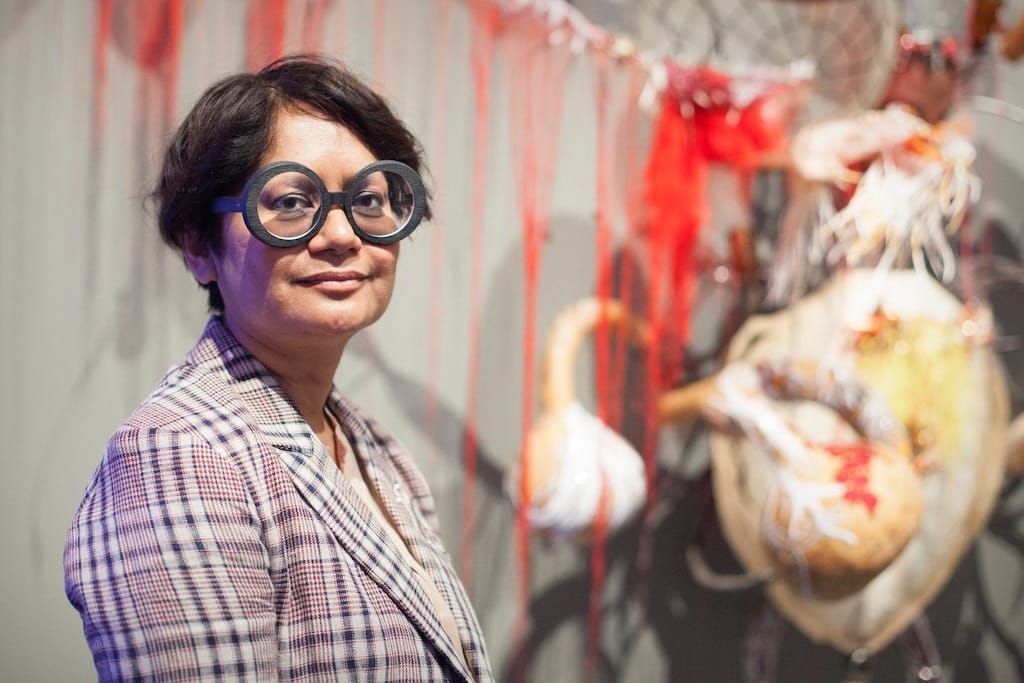
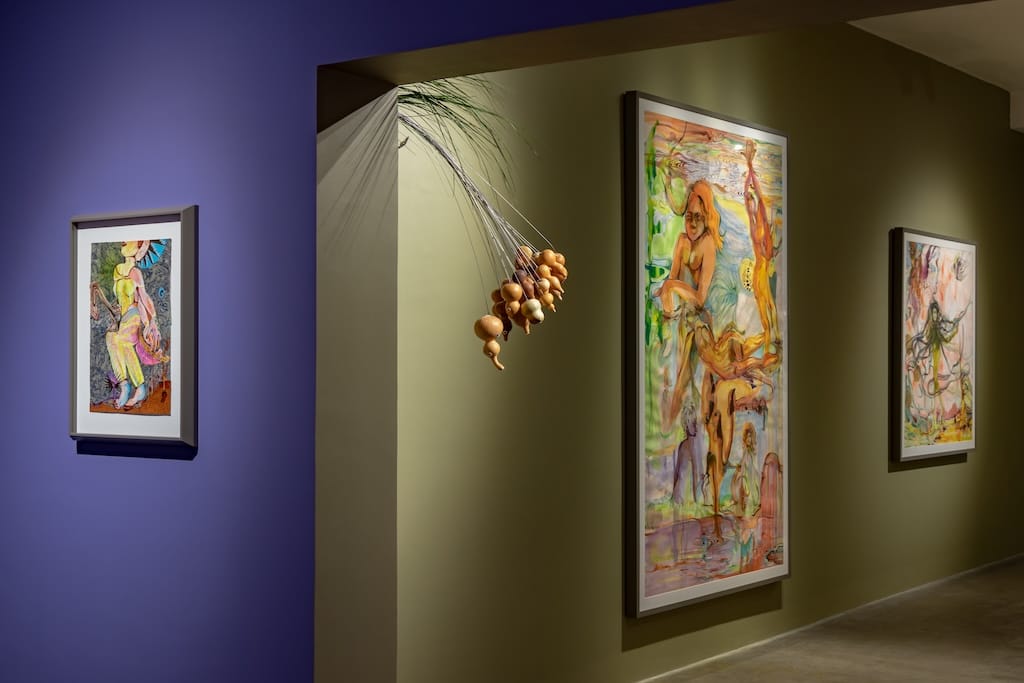
After a gap of 17 years, Indian-American artist Rina Banerjee returns to India with a major solo exhibition at Vadehra Art Gallery in New Delhi. Titled Discriminating Taste, Hallucinations of the Tongue, the exhibition brings together 28 paintings and hybrid sculptures created between 2008 and 2026, many of which are being shown in India for the first time.
Born in Kolkata in 1963 and based in New York, Banerjee has developed an internationally recognised practice that draws on histories, visual traditions and materials from across the world. Her dreamlike compositions bring together human, animal, botanical and mythological forms, creating elaborate visual worlds in which questions of migration, colonialism, gender, desire and cultural identity are explored through unexpected combinations.
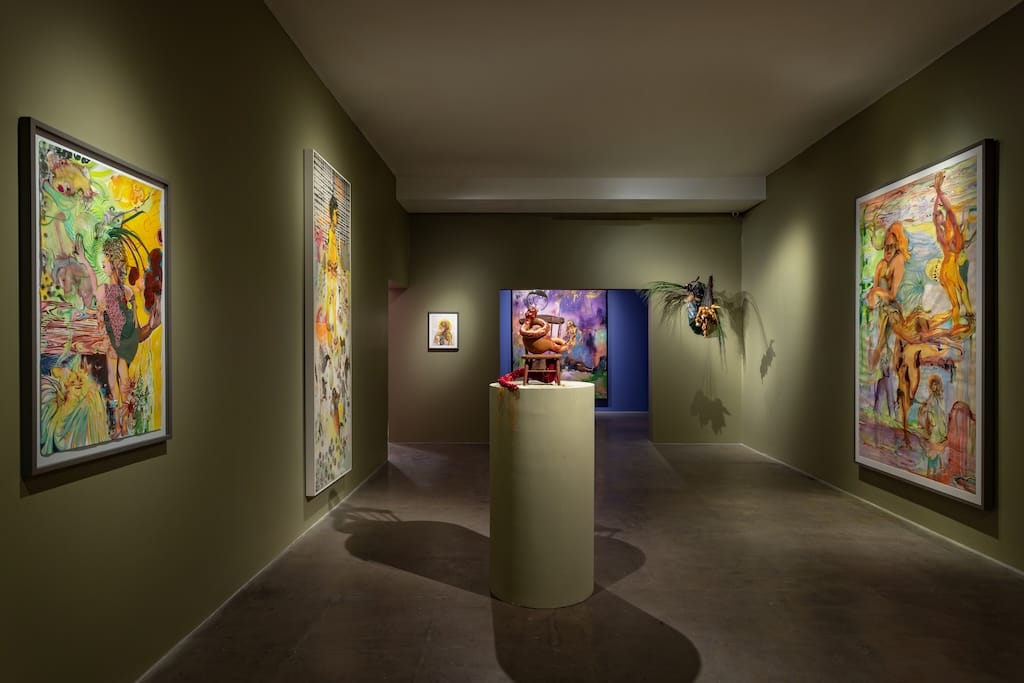
The exhibition takes its title from the idea of taste, a subject that Banerjee approaches as both a personal and political construct. What we consider beautiful, valuable or authentic is shaped by social conventions, economic structures and histories of cultural exchange. Through her paintings and sculptures, she questions how these judgements are formed and whose histories and traditions are given recognition.
Bringing Rina Banerjee Back to India
Although Rina Banerjee has built an extraordinary international practice, it has been 17 years since her work was last presented in India in a major solo exhibition. Vadehra Art Gallery took on representation of the artist approximately a year ago, as part of its wider commitment to presenting artists from the South Asian diaspora. For gallery director Roshini Vadehra, the time was right to introduce Indian audiences to the breadth and complexity of Banerjee’s practice.
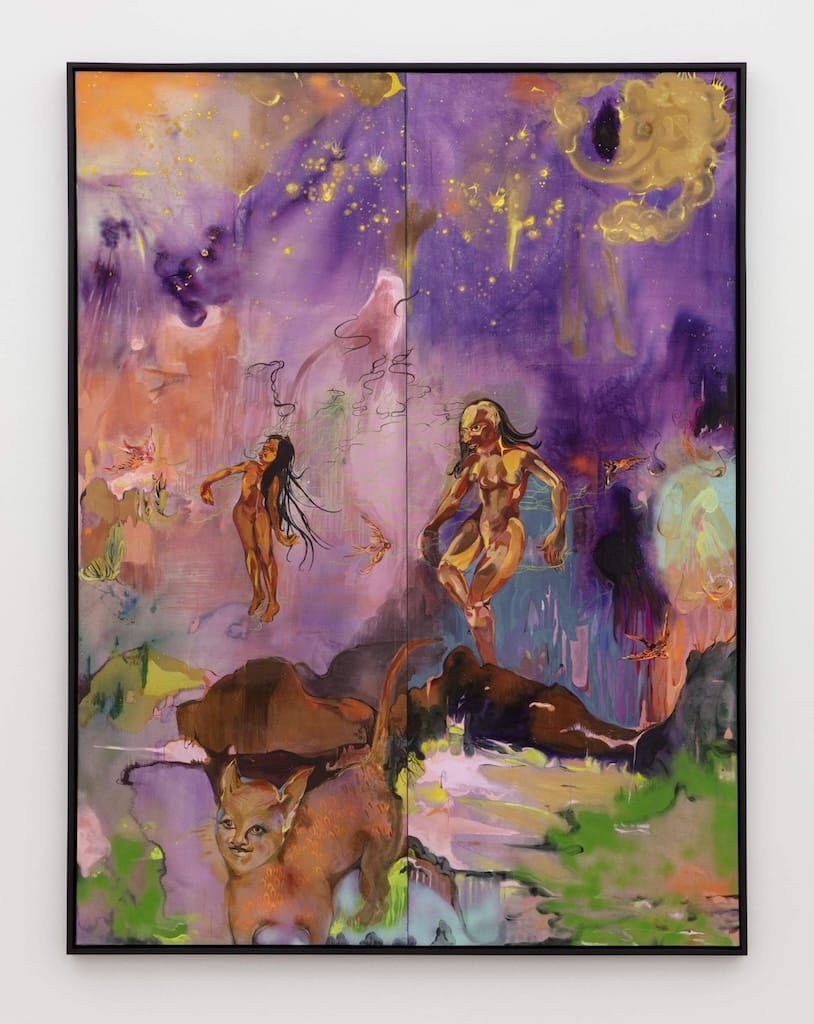
“Her work draws from multiple histories, geographies and visual traditions,” Vadehra explains. “Her sculptures and installations are layered, exuberant and often unexpected, bringing together materials and references that challenge conventional distinctions between the familiar and the foreign. I think audiences will find the work both deeply evocative and wonderfully disorienting.”
The exhibition also reflects the gallery’s belief that contemporary art should create space for perspectives that challenge established cultural narratives. Vadehra sees this as an important part of its role, particularly when presenting artists whose work questions how identity and heritage are understood.
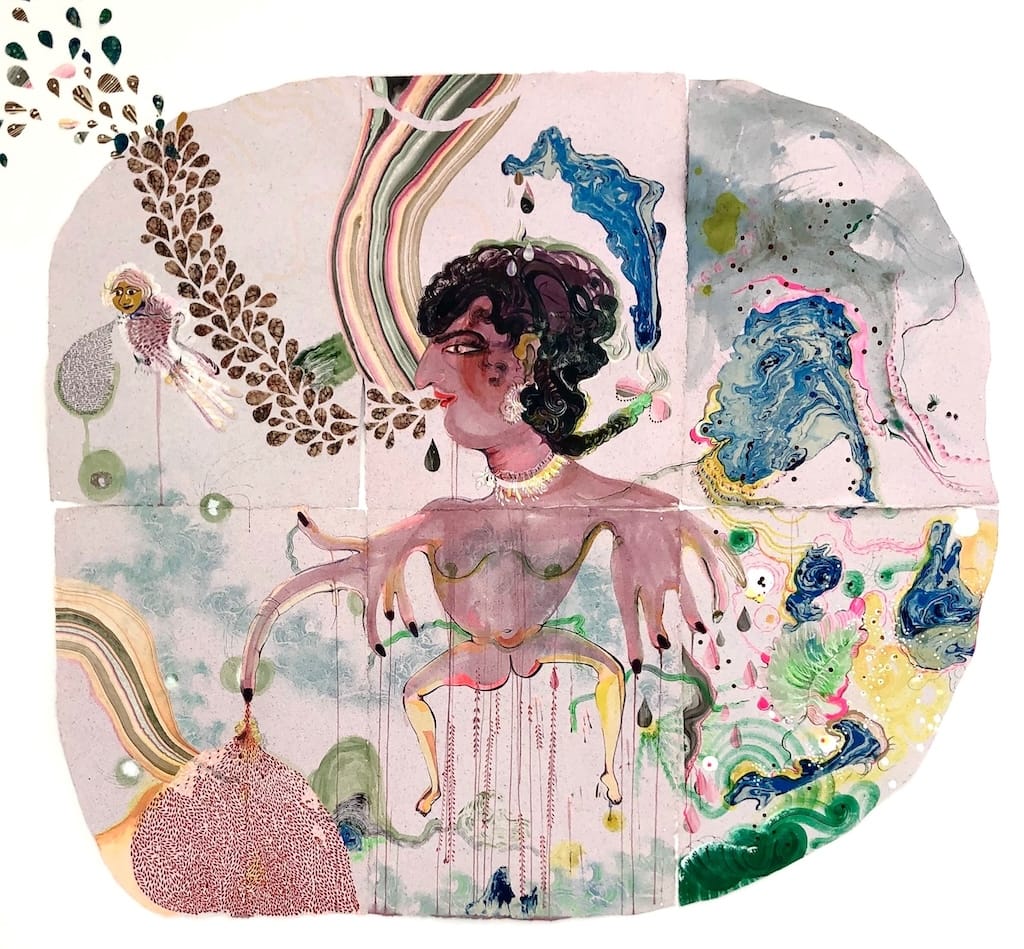
“I have always believed that a gallery's responsibility extends beyond presenting work that audiences are already familiar or comfortable with. It is equally important to create spaces for artists who question, disrupt and expand the way we understand ourselves and the world around us,” she says.
Banerjee’s practice is particularly compelling in this regard. Her use of materials and visual references from different parts of the world brings attention to the complicated histories of trade, colonialism, displacement and cultural exchange. As Vadehra observes, “It asks us to examine the ways in which cultures have influenced, borrowed from and transformed one another, sometimes through unequal relationships. I see our role as opening up these conversations rather than resolving them.”
What Does Taste Tell Us About Identity?
Taste is often treated as an individual preference, but Banerjee is interested in the social and economic structures that determine what is considered desirable, sophisticated or authentic. Ideas of taste can establish hierarchies between different forms of culture, influencing how objects, traditions and people are valued.
“When we talk about taste, we often naturalise our impulse to create hierarchies between high and low culture, between what is valued and what is marginalised. Taste is also connected to economics and socialisation, and to ideas of authenticity – what we consider the ‘real’ or ‘essential’ India, and how that idea changes for those living in India and those living elsewhere in the world and diaspora,” Banerjee explains.
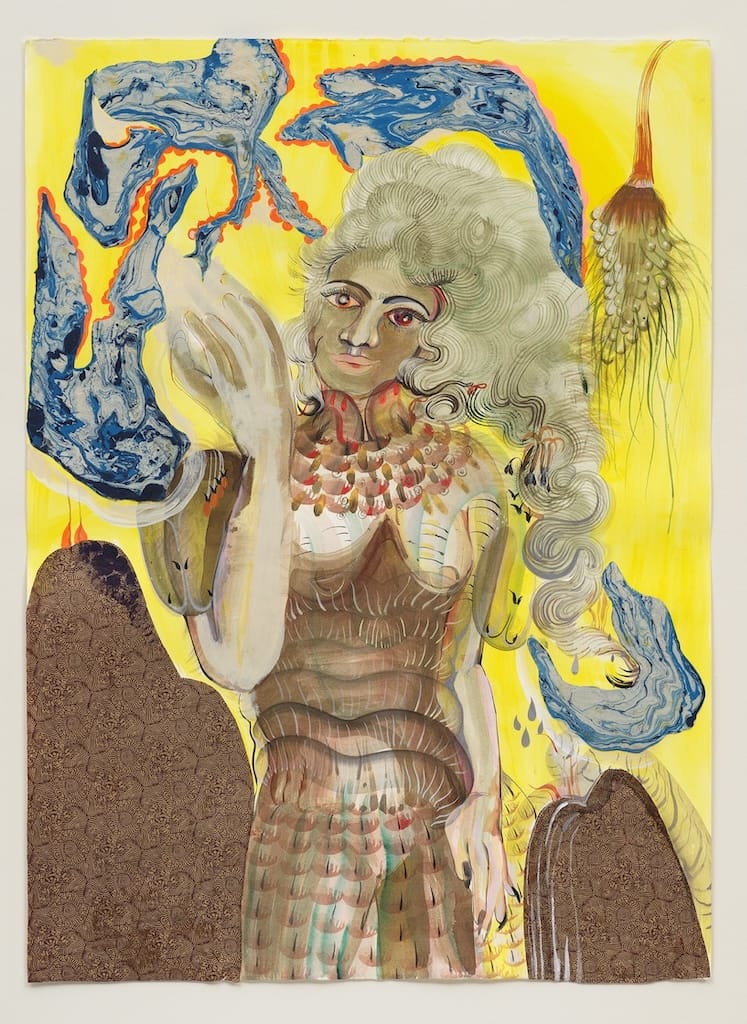
Her observation raises questions about who gets to define cultural authenticity and how these definitions are shaped by geography, memory and social expectations. The idea of India experienced by someone living within its borders may differ considerably from that of someone who has grown up elsewhere or belongs to its diaspora.
Fantastical Worlds and Entangled Cultural Histories
Banerjee's visual language draws from a wide range of artistic and cultural traditions. Indian miniature painting, Chinese silk paintings, Aztec drawings and visual references from Asia and North Africa appear alongside contemporary materials and everyday objects. Her figures often combine human, animal and botanical features, creating forms that seem to belong simultaneously to different histories and imagined worlds.
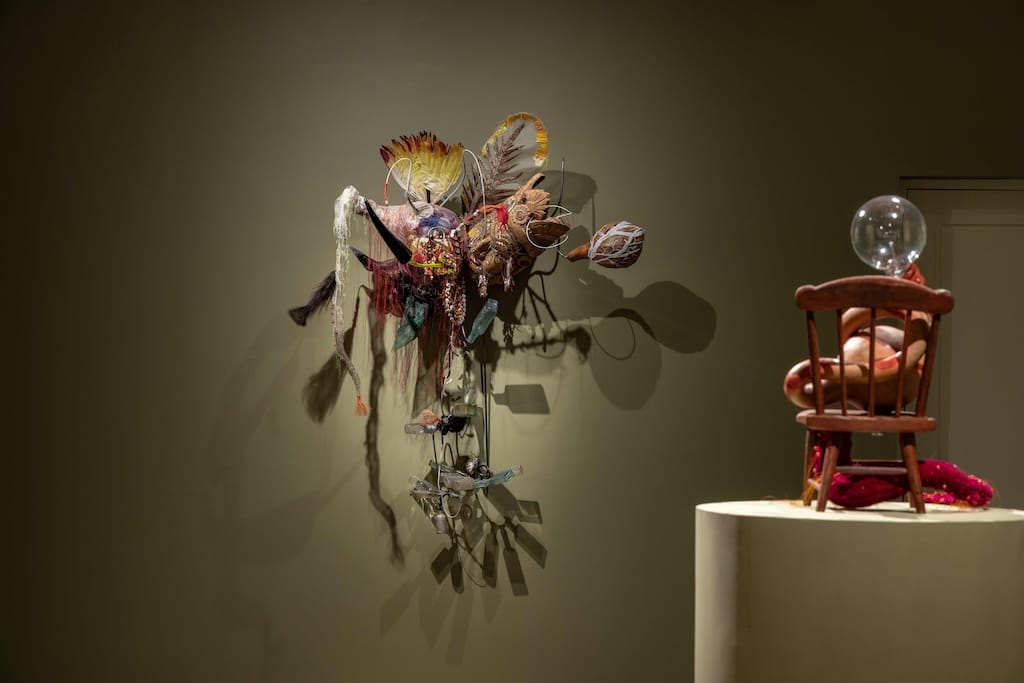
These combinations are not always spontaneous. Banerjee describes a process that can involve extensive research, including the examination of primary sources and academic archives. The research may broaden the subject she is exploring or lead her towards a more specific historical narrative. The resulting works bring together visual references that might otherwise remain separated by geography, chronology or conventional art-historical categories.
One particularly compelling example emerges from her research into Bengali migration to the United States. For the 2017 Prospect.4 Biennial in New Orleans, Banerjee drew inspiration from Vivek Bald's book Bengali Harlem and the Lost Histories of South Asian America, which documents the largely overlooked histories of South Asian immigrants in the United States.
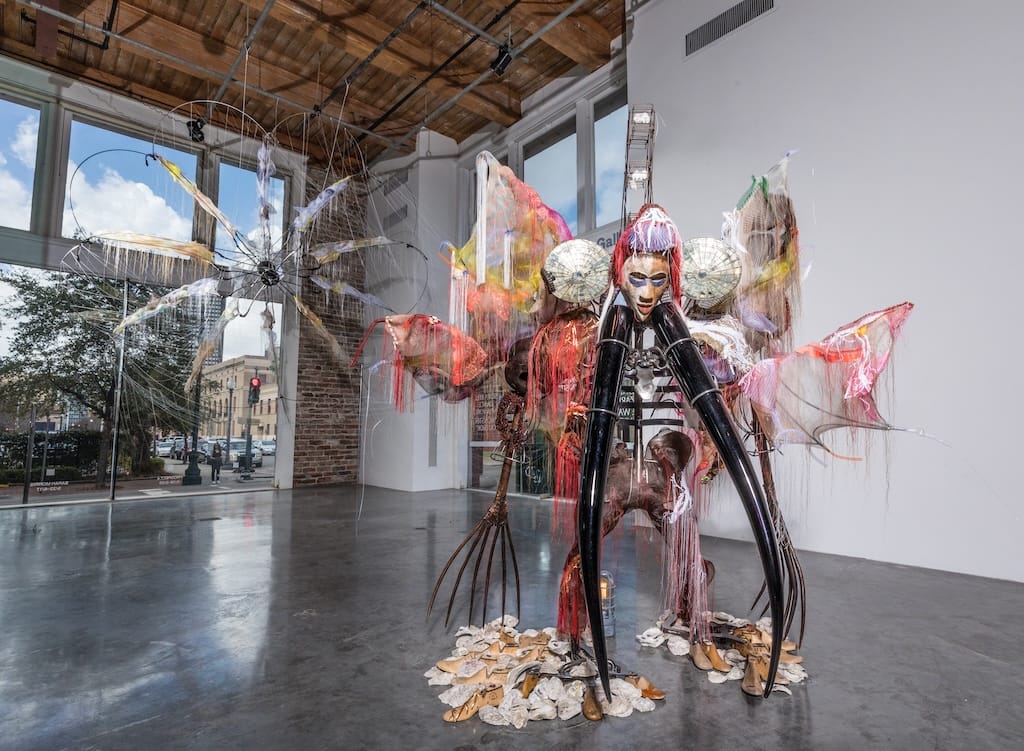
Her research led her to stories of Bengali men who settled in the country and married newly freed Black women during the period of racial segregation. Black churches also played an important role in helping immigrant communities establish themselves. Among the historical figures Banerjee encountered was a woman named Viola, who settled in New Orleans with her husband Abdul in the 1860s.
Banerjee created a sculpture in response to Viola's story, imagining her as a survivor and a figure of extraordinary resilience. The work brings together a wedding dress, cloth wings, trade beads, a dome made from silk thread, hand-carved Indian rakes used as arms, and a Yoruba mask. Its glass-pink head, Ferris wheel, oyster shells and sand add further layers to an elaborate composition that draws on different histories and material traditions.
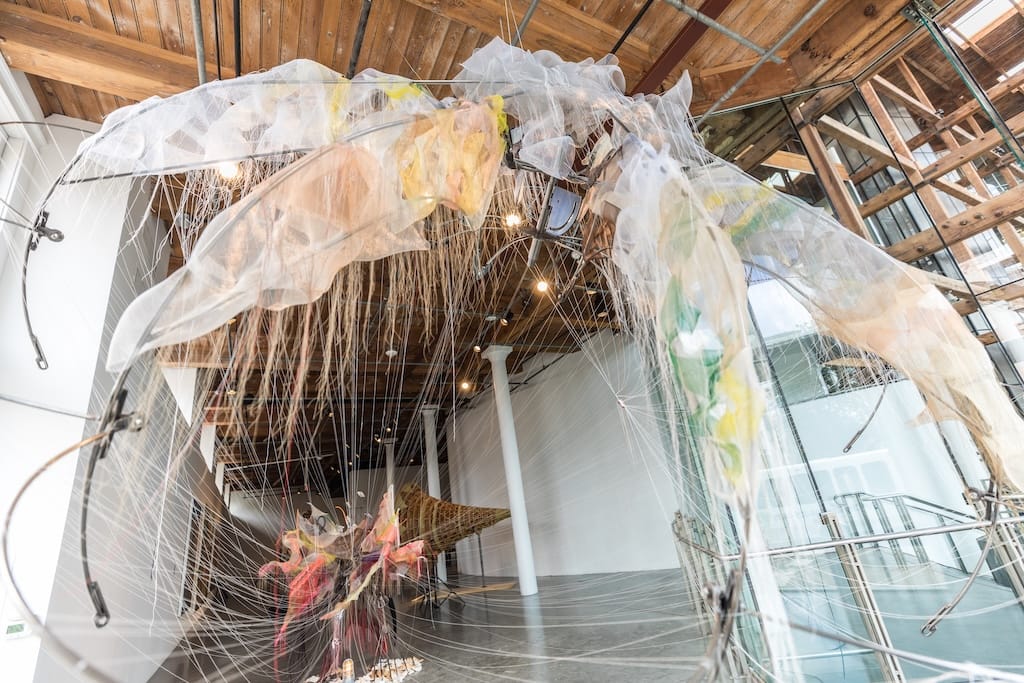
The sculpture presents Viola as an individual whose life cannot be understood through a single cultural category. She becomes, in Banerjee's imagination, a survivor, a deity and a force of human nature. The work is now in the collection of the Pennsylvania Academy of the Fine Arts in Philadelphia.
Banerjee's historical investigations also lead her to confront the continuing consequences of colonialism. She rejects the idea that the encounters described as trade were necessarily equal exchanges, pointing instead to the violence, coercion, debt and taxation that accompanied colonial expansion. Her analogy is striking: colonialism, she says, remains active, behaving like Pac-Man, the video-game character that devours everything in its path.
Reimagining Womanhood, Marriage and the Politics of Desire
The representation of women is another recurring concern in Banerjee's work. Her female figures frequently challenge conventional ideas of beauty and the expectations placed on women's bodies. They may appear captivating, fantastical or even intimidating, resisting the idea that the female figure exists simply to be admired or possessed.
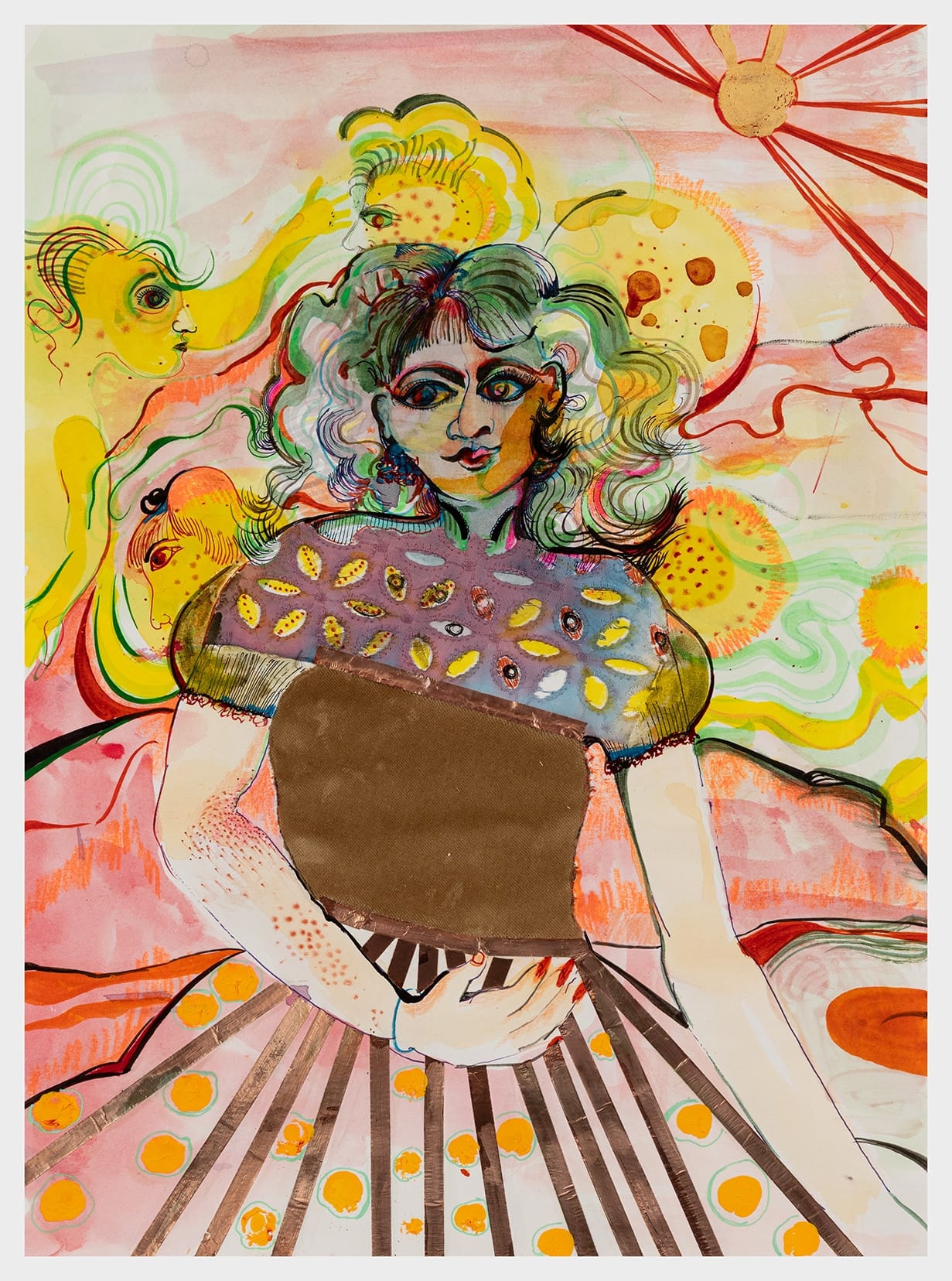
Marriage is a particularly important subject in this context. Banerjee approaches it not only as an expression of romantic attachment but also as a social and economic institution, shaped by family expectations, gender roles and the exchange of status and security.
In Take My Hand in Marriage, she explores the handshake as a ritual through which an agreement between families is sealed. The gesture becomes a symbol of the social contract surrounding marriage, including the expectations placed on a woman to demonstrate devotion and produce an heir.
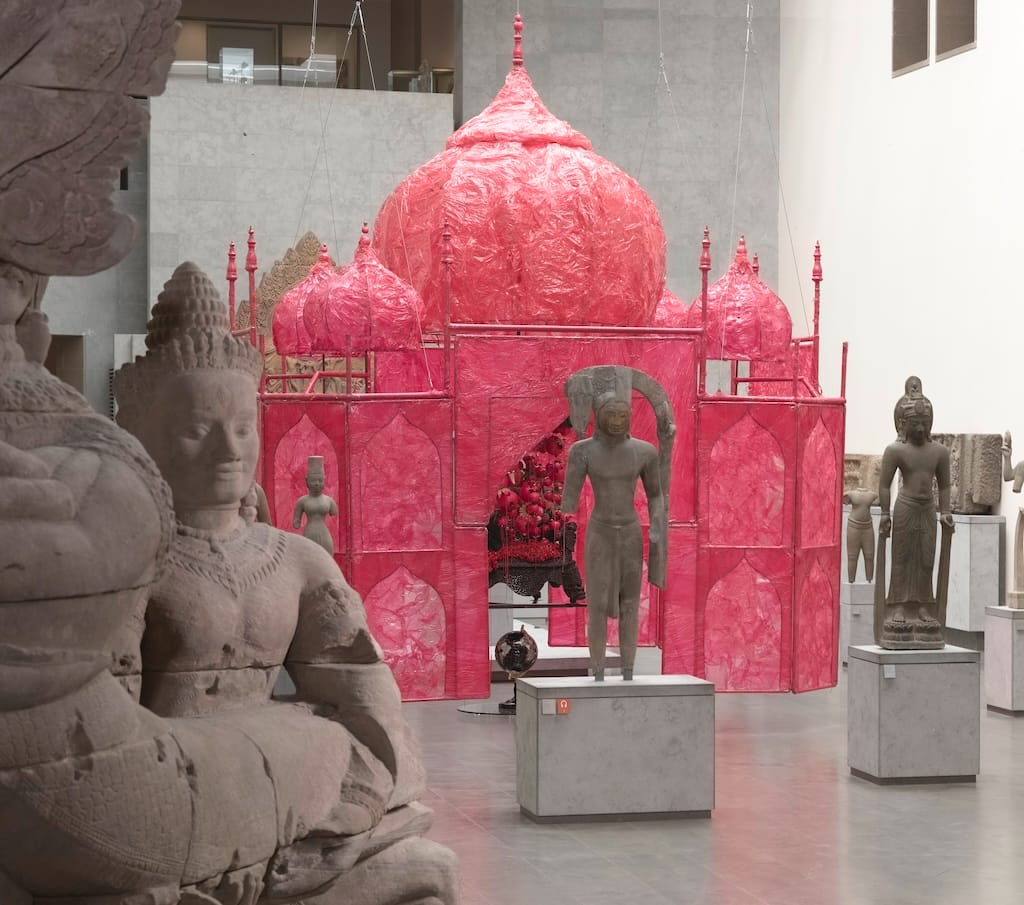
Another sculpture draws on the romantic mythology surrounding the Taj Mahal, while questioning the conventions through which love and marriage have historically been represented. Banerjee's interest lies in the complicated relationship between romantic ideals and the social structures that govern women's lives.
Her more recent wedding-dress sculpture develops these ideas through an elaborate assemblage of materials and symbols. Based on a vintage beaded wedding dress from Hong Kong weighing approximately ten pounds, the work incorporates garnet stones that delineate the reproductive organs. The embellishment draws attention to the expectations placed on women's bodies, particularly the pressure to produce a male heir.
Cowrie shells, once used as currency, appear alongside images of US currency, a green card, a passport and a property deed. A frying pan forms a halo, while incandescent light bulbs are arranged like jewels in a mala. Flashing eyes and wedding bells add to the sculpture's visual complexity. Its arms incorporate rakes and bangles, while its feet are made of white netting, with no legs visible.
Vulnerability, Love and the Uncertain Position of the Female Figure
Alongside her critique of gender expectations, Banerjee is interested in vulnerability as a condition that can make emotional connection possible. She describes genuine vulnerability as a willingness to confront one's fears, recognise the different selves within us and remain open to love and the wider natural world.
For her, vulnerability is not a weakness. It involves acknowledging the complexity of human experience and recognising that our inner lives are connected to something larger than ourselves. She also sees love as an important counterpoint to the influence of capitalism, describing it as a form of connection that remains difficult to protect in a world increasingly organised around material value.
Banerjee also reflects on envy and jealousy as emotions that can take different forms. Envy, for example, might encourage someone to learn a skill from a neighbour whose garden they admire. It can become destructive, however, when it turns into resentment. Her interest is in how people respond to these emotions and whether they can become opportunities for reflection.
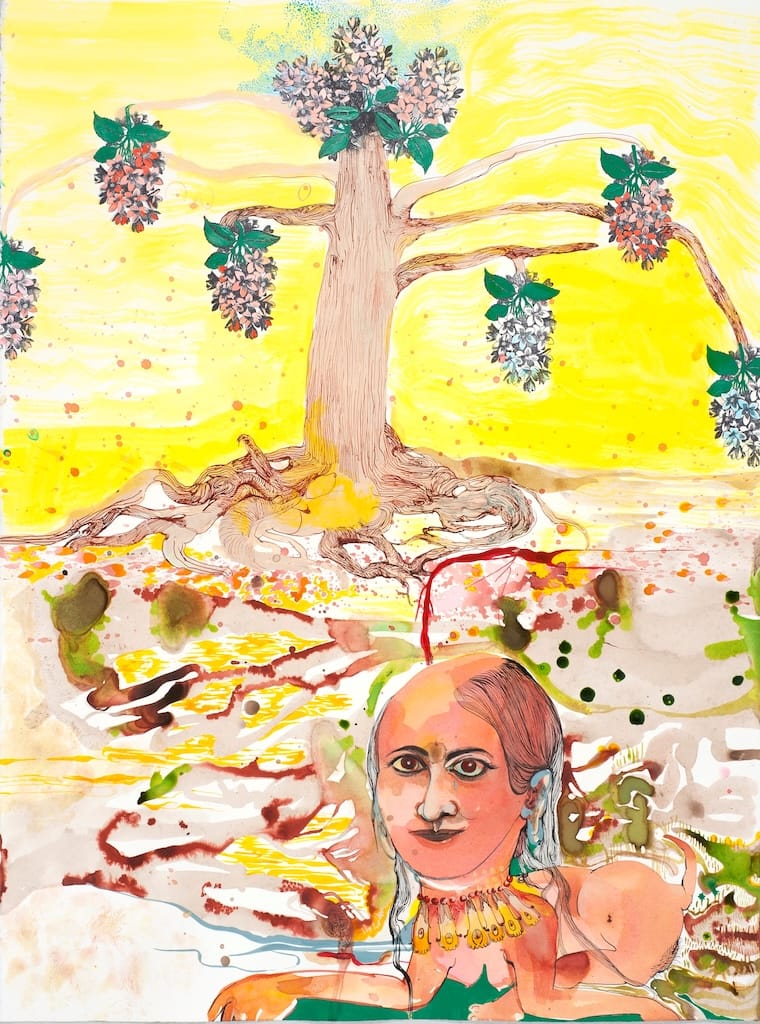
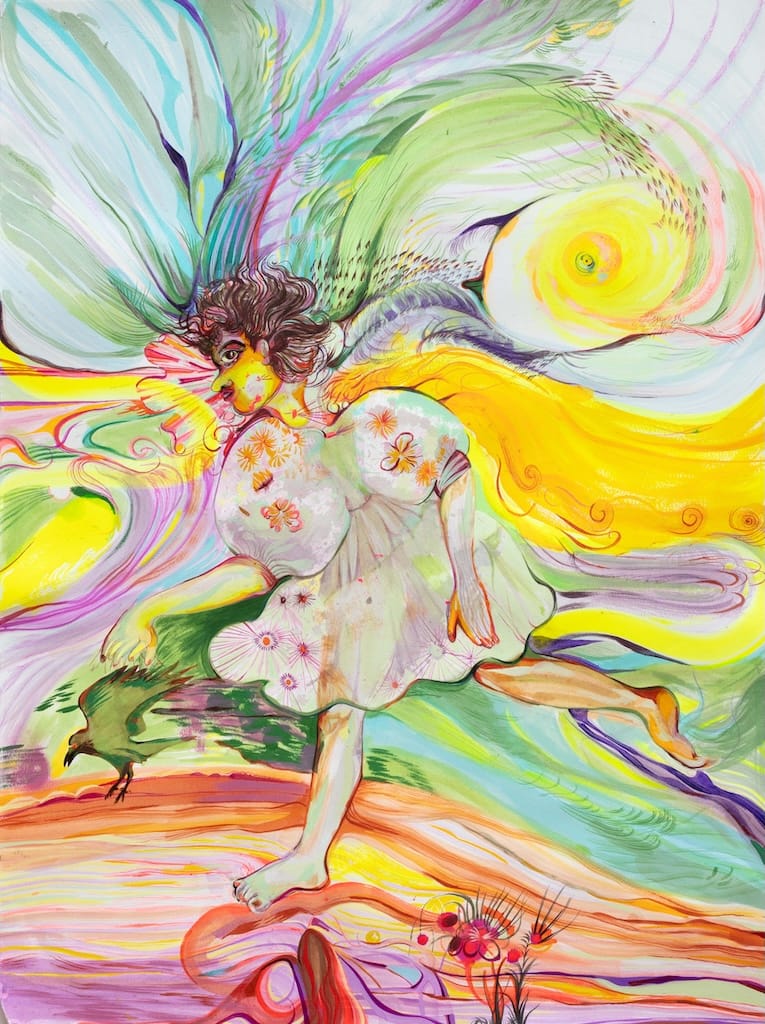
These ideas find expression in paintings such as The Tree Flowered [...] (2012), which depicts a sphinx-like woman beneath a flowering tree. The image evokes beauty, abundance and desire, while also raising questions about the relationship between a woman who possesses power and one who becomes the object of another's desire. The landscape surrounding her carries further suggestions of conflict, trade and extraction.
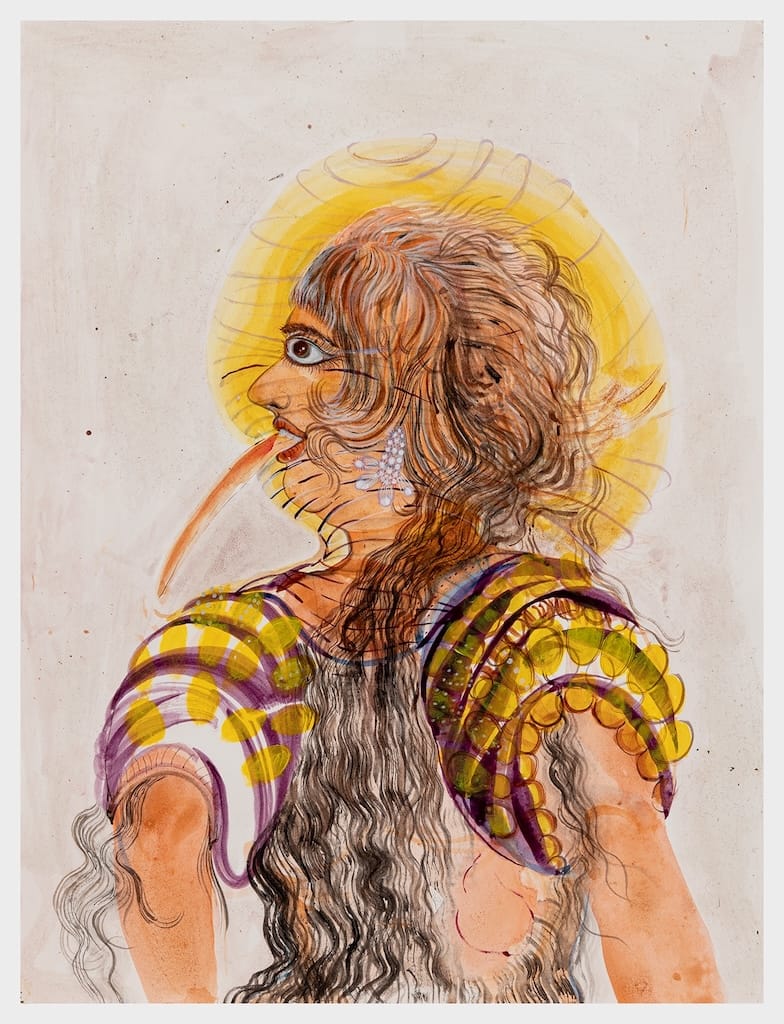
In Sing Signs to the Willfully Free in Likeness to Me [...] (2026), a female figure extends her tongue, giving her an almost amphibian quality. The tongue becomes a sensory organ through which she experiences and tastes the world. Banerjee also connects the act of singing with the release of words into the world. Once spoken, words cannot be retrieved, although they may continue to exist through memory and feeling.
Hybrid Sculptures
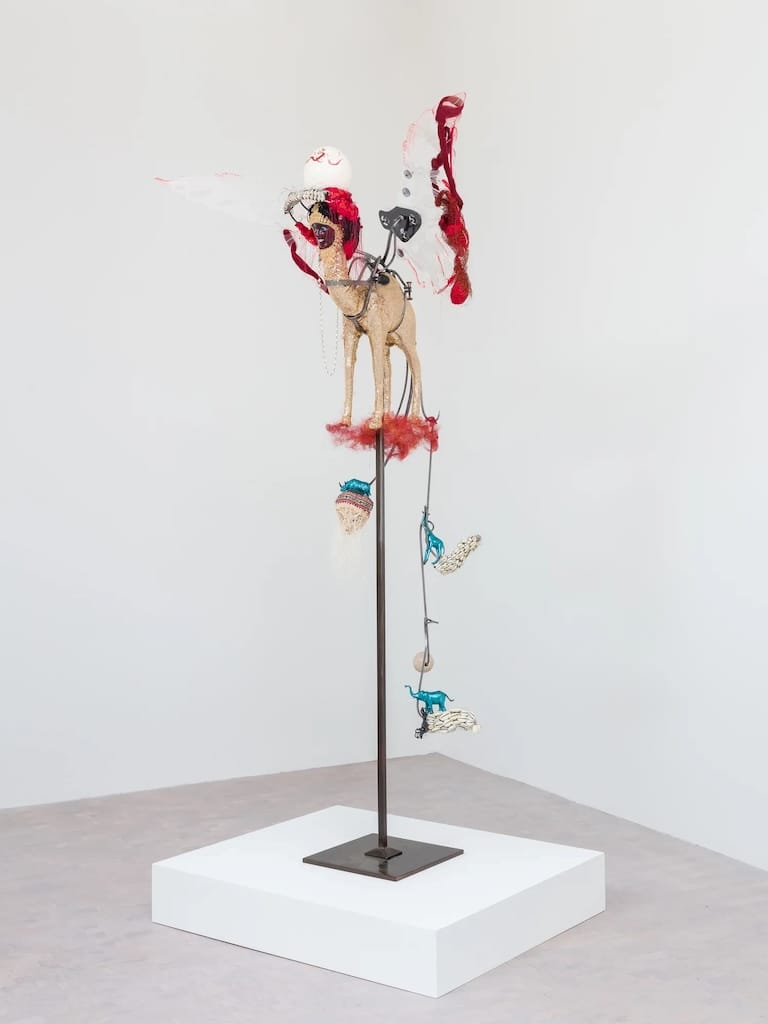
Banerjee's sculptures are notable for their physical intricacy and the variety of materials they bring together. Beads, textiles, shells, domestic objects, metalwork and manufactured components are assembled into forms that often appear to have emerged from an imagined natural world.
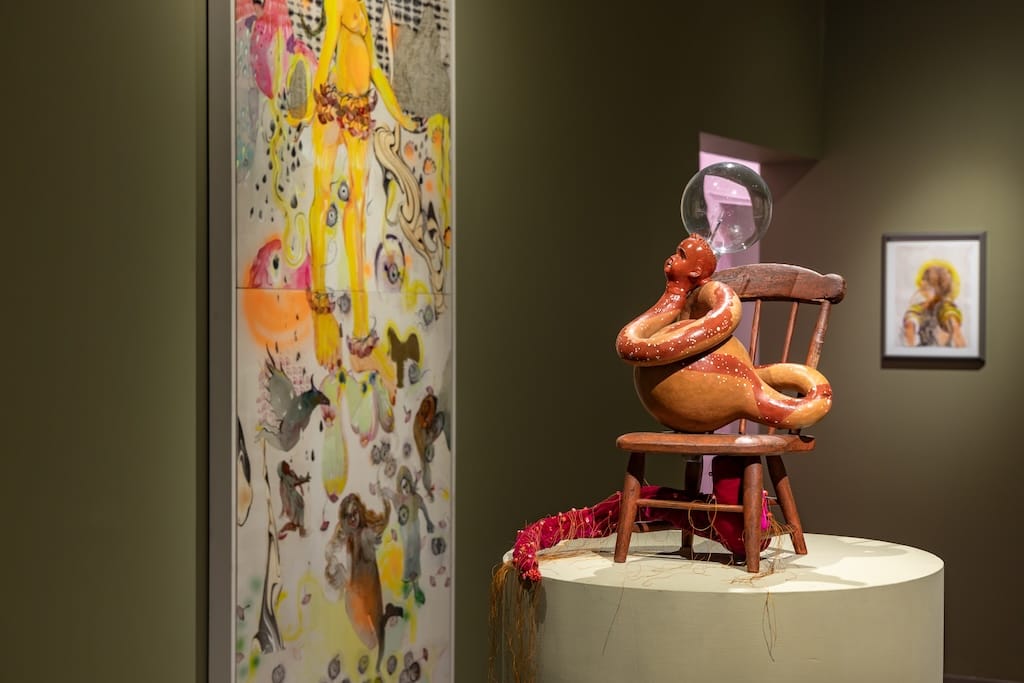
The materials carry their own histories and associations. A wedding dress, a household utensil or a decorative object may suggest domestic life, while currency, passports and other institutional symbols point towards systems of exchange, ownership and mobility. Their combination allows Banerjee to construct objects that are visually abundant while remaining open to more difficult interpretations.
Hiding Her Silken Tales offers a particularly revealing example of this approach. Its reclining form combines the familiar outline of a chair with a creature-like body, a doll's head and a long, richly decorated tail. The light bulb worn as a hat introduces an industrial object into an otherwise fantastical composition, while the beads and threads draw attention to the labour and detail involved in its making.
Migration, Diaspora and the Idea of Belonging
Banerjee's return to New Delhi has also prompted reflections on the city and the experience of encountering a place through a different perspective. She says she has been delighted by its vegetation, parks, architecture, animals and birds, as well as by the curiosity and politeness of the people she has met.
Her observations extend to the wider question of how people move through cities and across borders. Banerjee advocates more accessible forms of public transport, including trains, electric trams and pedestrian-friendly streets, alongside greater access to water and shared public spaces. She also imagines the value of a museum dedicated to textiles and Indian fashion, one that could examine the history of clothing and its relationship to ethnic identity, racial representation and taste.
These reflections connect with Banerjee's broader interest in how identity is formed, represented and understood. She is wary of borders and fixed definitions of belonging, arguing for greater freedom of communication and movement. She also speaks candidly about the pressures of conformity and alienation, particularly in the United States, where she sees intimacy and human connection being threatened by racism and white supremacy.
Her perspective is shaped by gratitude towards the mentors, friends and strangers who have offered her support and acceptance. She remains interested in the complexity of the self and the capacity of people to recognise something of themselves in others. The untidy quality of her visual world is intentional, inviting viewers into a reality that cannot be neatly organised or reduced to a single identity.
For Banerjee, the ability to remain open to life, despite its difficulties, is perhaps the most important form of resistance. As she puts it:
“I am not afraid of the bullies. I care too much about life to have it taken away.”
The exhibition is on view at Vadehra Art Gallery, New Delhi, until 18 November 2026.