When Technology Becomes Nature: Simon Heijdens and A.A.Murakami at NMACC
At Second Nature in Mumbai, Simon Heijdens’ weather-responsive Lightweeds and A.A.Murakami’s mist-filled New Spring explore transience, entropy and what happens when artists surrender control to nature.

Technology is often imagined as a means of imposing order: measuring, predicting and controlling the world around us. On the third floor of Second Nature, the major immersive exhibition at the Nita Mukesh Ambani Cultural Centre (NMACC) in Mumbai, that relationship is turned on its head. Here, technology becomes a means of introducing uncertainty back into the gallery.
Bringing together works by Simon Heijdens and A.A.Murakami, Floor Three moves away from the conventional screen and towards systems that behave more like living things. They grow, respond, drift and disappear. Weather conditions outside the building alter what happens within it. Air currents determine the movement of an artwork. Visitors do not simply look at these works but become participants in the systems they activate.
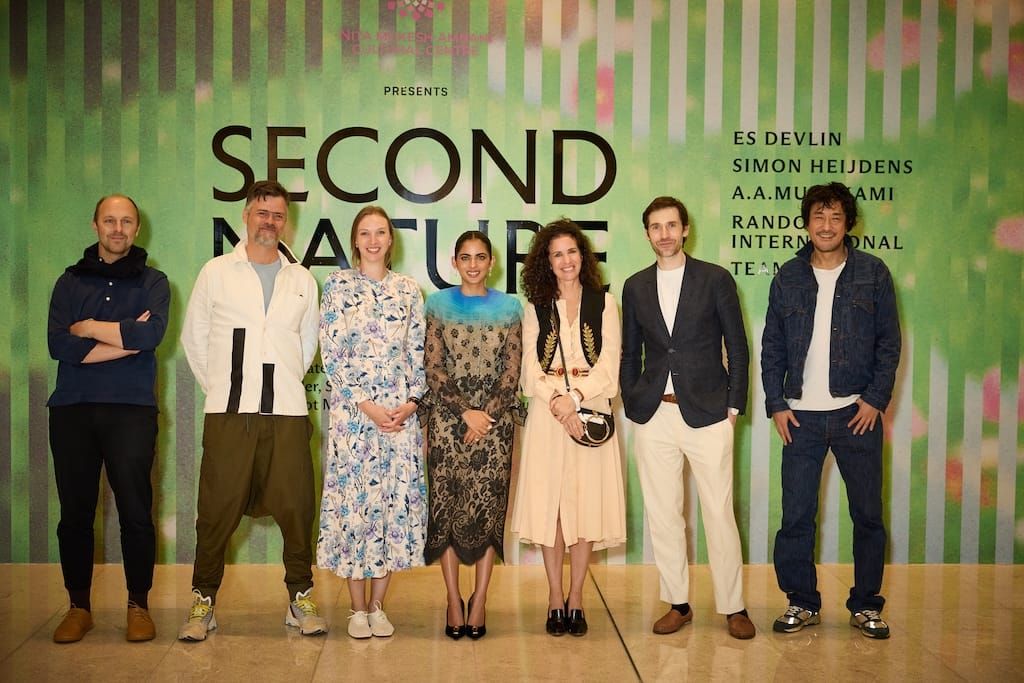
Presented across all four floors of the Art House from 3 July 2026 to 10 January 2027, Second Nature brings together nine large-scale installations by Random International, teamLab, A.A.Murakami, Simon Heijdens and Es Devlin. Curated by Superblue co-founder Mollie Dent-Brocklehurst and Head of Curatorial Margot Mottaz, the exhibition considers an increasingly porous boundary between humans, technology and the natural world.
That enquiry becomes particularly physical on Floor Three.
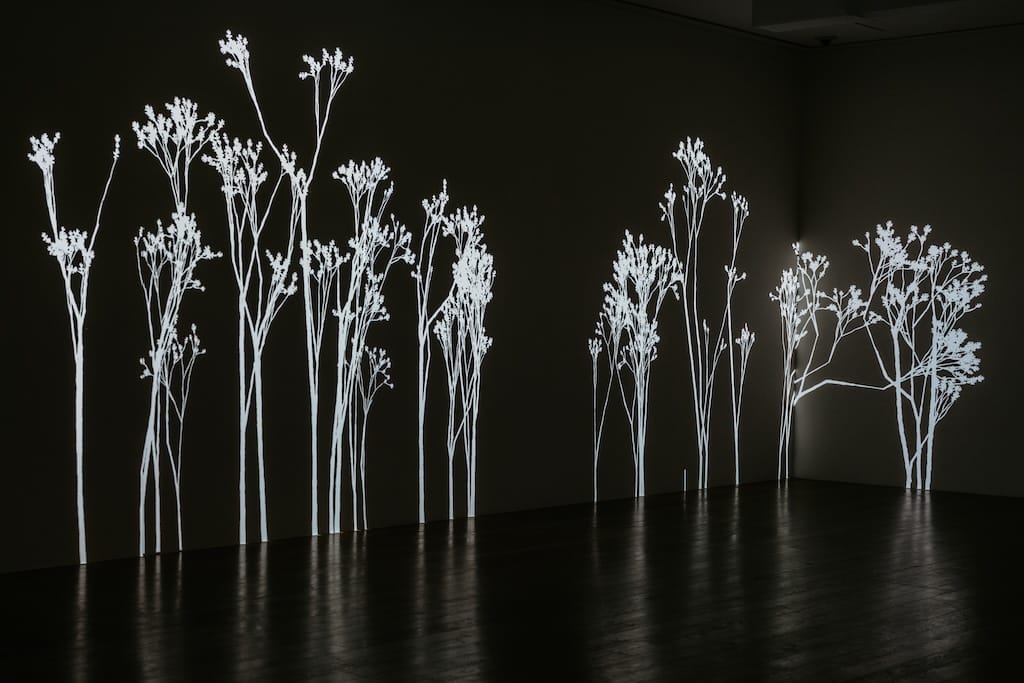
In Simon Heijdens’ Lightweeds (2005–ongoing), an ecosystem of projected plants inhabits the architecture of the gallery. Yet the plants do not follow a predetermined animation. Weather sensors outside the building feed real-time conditions into the work, allowing the environment beyond the gallery walls to determine how this artificial vegetation grows and behaves. Movement within the space further disturbs the ecosystem. In Mumbai, Lightweeds therefore acquires a character particular to Mumbai: a technological work shaped continuously by the climate and people surrounding it.
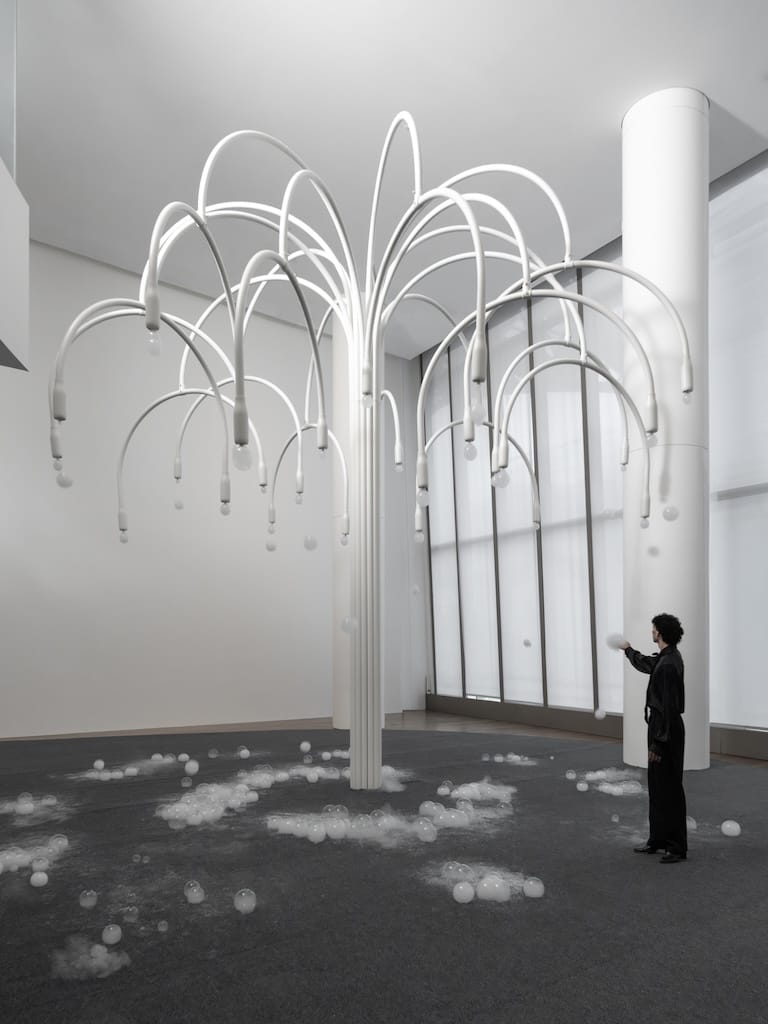
Nearby, A.A.Murakami’s New Spring (2017–ongoing) gives technological form to an altogether more fleeting phenomenon. A tree-like sculpture produces delicate bubbles filled with mist, blossoms that float briefly through the air before bursting when they encounter human skin. Their beauty depends upon their inability to last.
The two works approach time differently. For Heijdens, duration allows an artwork to reveal itself gradually. A person might encounter Lightweeds, return days later and only then recognise that the plants have changed, before eventually discovering their relationship with the weather outside. For A.A.Murakami, by contrast, time is compressed into the lifespan of a bubble. Its disappearance is not the failure or conclusion of the artwork but an essential part of its meaning.
Yet both practices arrive at a similar proposition. The artist can construct the system, but cannot entirely dictate what happens within it.
“We engineer very precise systems that ultimately let nature take over,” says Alexander Groves of A.A.Murakami. Heijdens describes his own works as being “like seeds rather than like stones”, mechanisms that depend upon their surroundings in order to become fully themselves.
Their practices raise questions that extend well beyond the technology used to create them. Can an artwork be alive without being allowed to change? What becomes of artistic authorship when weather, gravity, air currents and visitors determine the outcome? And at a moment when art is increasingly encountered through photographs and videos on screens, what remains distinctive about standing in front of something that is happening only here, only now, and may never happen in precisely the same way again?
Serenade speaks with Simon Heijdens and Alexander Groves of A.A.Murakami about inventing new artistic mediums, relinquishing control, experiencing art beyond the screen and treating time itself as a material.
Simon Heijdens: Art That Grows With Its Environment
Both of your practices involve inventing new artistic languages rather than simply adopting existing technologies. Simon, you develop bespoke materials and systems to reveal hidden narratives, while A.A.Murakami describes its practice as “Ephemeral Tech”. What motivates the need to create entirely new mediums for your ideas?
I tend to work from a concept, a narrative, and search for methods and materials that could tell that story best. Materials that seamlessly integrate with the narrative they convey. For every work, I like to create not just the movie, but also the TV that it plays on, from the ground up.
It is a very slow process, which perhaps shows in the level of output of my practice over the years, but I like it, to find perfect junctions of medium and message.
The work in this exhibition, Lightweeds, is about the loss of natural flux and coincidence in the urbanising, homogenising world. The formal language of plants seemed appropriate, coded to grow and behave according to actual weather conditions and therefore forever evolving, projected to become part of a space. So I learned to write code for this work, simply because it seemed the most appropriate way to tell this story. I have also made works with similar narratives in completely different mediums, like ceramics or glass.
One of my works that I think succeeded best in joining medium and message is Shade, a sunlight-filtering glass installation commissioned by the Art Institute of Chicago.
Another reason I perhaps like experimenting with new mediums is that it is an interesting tool in conveying a narrative. A few years ago, I created a work with ink-like drawings temporarily appearing and disappearing in the middle of a body of water, and it was very powerful to see how that materiality, which did not exist before, caught every viewer off guard and brought them into an almost child-like sense of wonder, which is an interesting state of mind in which to start a story.
Neither of your installations depends on conventional digital screens. Instead, you work with light, climate, mist, bubbles and movement. Do you think audiences are beginning to crave physical experiences that cannot be replicated online?
Yes, I do. In the 22 years I have exhibited this work almost 100 times, I have always shied away from overexposing it online, simply because I feel the work, as an experience of space and light, does not translate well to online photo and video. It’s essential for viewers to see it in person.
Perhaps, after a period in which culture has been consumed on phones more than anywhere else, and photo and video of a work have moved from referencing documentation to the actual work itself, people are starting to realise that seeing a work on Instagram is not seeing a work.
Both of your practices blur the boundaries between art, science, engineering and design. Do you still see yourselves primarily as artists, or have those distinctions become less meaningful over time?
I have never felt any requirement to give a title to what it is I am doing, and I don’t think any of these titles, including artist, are particularly relevant from a creator’s perspective, at least not in the way I experience my practice. I guess it’s all of these to some extent.
Simon, Lightweeds has continued to evolve for more than two decades, while A.A.Murakami’s work often exists only for a few moments before disappearing. How do each of you think about time as a material in your practice?
Time and evolution are essential in my work. I am fascinated by the way we relate to things that move in time, as opposed to static things. For example, the difference in how you relate to a static object and how you relate to a child, or a friend, or a plant: things that grow and evolve in character over time, and continuously ask you different questions.
I am also interested in the role time plays in the exposure to a work. Besides classic ways of consuming visual art, like waking up on a Saturday, going to a museum, spending a minute or so in front of a painting or sculpture and leaving it again, besides that brief exposure, I find it so interesting to embed works in an environment that slowly reveal themselves over time, that don’t immediately demand full attention or fully reveal themselves. Things that live in the corner of the eye instead of on a pedestal.
My favourite installations for this work have been public situations, where someone first passes the work, then maybe a day later passes it again and notices the plants are moving, then maybe a week later passes it again and sees they have grown, and even later that there is a correlation between actual weather and the artwork.
Both of your works invite visitors to become active participants rather than passive observers. At what point do you feel an artwork is truly complete: when it is installed, or only when people begin interacting with it?
All of my works need their eventual environment to become what they are. In my work, I don’t try to capture my idea of beauty into a static shape, but to create mechanisms that reveal qualities of an existing situation.
Like seeds rather than like stones, evolving rather than static, the works need their environment. They are shaped and defined by it.
Your works are now part of major museum collections around the world, yet they resist being reduced to static objects. How do you preserve works that are fundamentally based on change, interaction and impermanence?
Preserving and continuing this work is a challenge as computers have evolved so much over the decades. I wrote this code in a time before iPhones, for example, and the computers required to run the work were massive, buggy and always too slow.
Now the code literally has to be throttled down because computers have become orders of magnitude faster and the plants would grow too quickly. Also, computers in general have moved from being wide open for experimentation to increasingly closed and limited for security and corporate strategy reasons, and it is an ongoing challenge to keep everything running.
A.A.Murakami: Ephemeral Tech and the Beauty of Disappearance
Both of your practices involve inventing new artistic languages rather than simply adopting existing technologies. Simon develops bespoke materials and systems to reveal hidden narratives, while A.A.Murakami describes its practice as “Ephemeral Tech”. What motivates the need to create entirely new mediums for your ideas?
For us, “ephemeral” means something that physically comes into being and then genuinely disappears. It’s fragile, unstable, subject to real forces like gravity and airflow. To make phenomena that behave that way, we have to custom-engineer everything ourselves, because we’re working directly with physical matter and the way it actually moves.
We think of it as existence itself becoming the material.
Your works make invisible forces visible, whether changing weather patterns in Lightweeds or the fleeting, mist-filled blossoms of New Spring. What draws you to phenomena that exist only briefly before disappearing?
Transience is where the meaning concentrates. There’s a reason cherry blossom moves people. You’re aware that you and the blossom are sharing this moment and that it will never come again.
A mist-filled bubble carries that same awareness. The brevity isn’t a limitation of the work; it’s the subject of it.
Neither of your installations depends on conventional digital screens. Instead, you work with light, climate, mist, bubbles and movement. Do you think audiences are beginning to crave physical experiences that cannot be replicated online?
Very much so. There’s something increasingly rare about encountering a phenomenon that’s real and impermanent while you’re in the same room, breathing the same air, sharing the same moment as it comes into being and passes.
That kind of shared physical presence is something people seem to be seeking out again, even when they can’t quite name why.
Your works respond to forces beyond your direct control, from real-time weather conditions to the unpredictable actions of visitors. Has embracing uncertainty changed the way you think about authorship as artists?
We engineer very precise systems that ultimately let nature take over. Once a bubble is formed, gravity and airflow decide its path, not us.
So authorship becomes about building the conditions and then surrendering control. The work is really co-authored with physics and with the audience.
Both of your practices blur the boundaries between art, science, engineering and design. Do you still see yourselves primarily as artists, or have those distinctions become less meaningful over time?
Yes, we do see ourselves as artists. We don’t really see ourselves as conventionally technical; our background is material and tactile, Azusa in architecture and myself in fine art.
We design the experience, hold a clear vision of it, and find the right people to help realise it. So much of the actual work of art is administration, having a vision and then delivering that vision, and the science and engineering are simply how we get there.
Simon’s Lightweeds has continued to evolve for more than two decades, while A.A.Murakami’s work often exists only for a few moments before disappearing. How do you think about time as a material in your practice?
We treat time itself as a material, and really what we’re working with is entropy. That gradual unfolding is how we experience time at all, and it’s the same force that causes both life and death.
There’s a paradox in that: we long to hold onto a beautiful moment, but to freeze it you’d have to freeze entropy, and freezing entropy would stop the thing being alive at all.
You have to die in order to live, and live in order to die. Each bubble is that whole cycle in physical form. It comes into being, and its bursting is already inevitable. We know it’s coming, we’re expecting it, and somehow we get to enjoy it with hope anyway.
Both of your works invite visitors to become active participants rather than passive observers. At what point do you feel an artwork is truly complete: when it is installed, or only when people begin interacting with it?
The audience completes it. With New Spring, the blossoms burst on contact with skin, so the timing of the people in the room is what finishes each moment.
It’s a shared social choreography, and the work is only fully alive when it’s being witnessed.
Your works are now part of major museum collections around the world, yet they resist being reduced to static objects. How do you preserve works that are fundamentally based on change, interaction and impermanence?
You hold onto the engineering, the instructions and the intent, the capacity to summon the phenomenon again, rather than an object on a plinth.
The impermanence is the content, so what a collection really preserves is the means to bring it briefly back to life. That’s the memento mori at the heart of it.
Second Nature is on view at the Art House, Nita Mukesh Ambani Cultural Centre, Mumbai, until 10 January 2027.