Gulammohammed Sheikh’s Hidden Printmaking Legacy Comes into Focus at TRI Art & Culture
A major retrospective at TRI Art & Culture explores seventy years of Gulammohammed Sheikh’s printmaking, revealing a remarkable parallel practice that spans little magazines, traditional printmaking techniques and pioneering experiments with digital image-making.

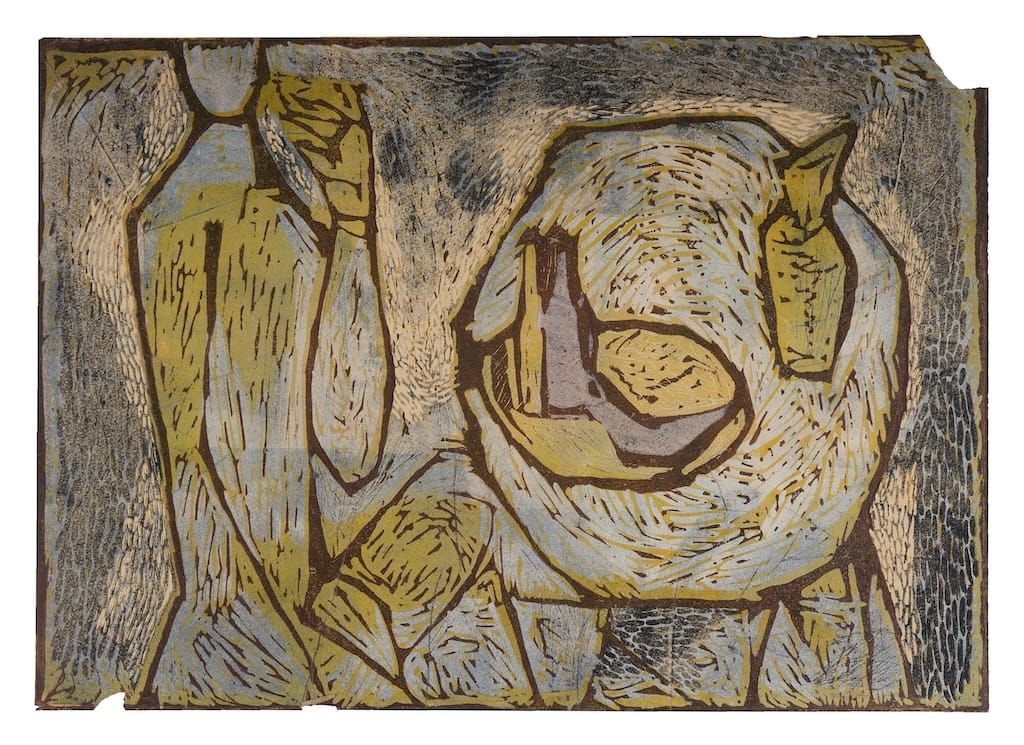
For more than seven decades, Gulammohammed Sheikh has occupied a singular position within Indian art. Celebrated as a painter, poet, art historian and teacher, he has shaped generations of artists while building a body of work that draws together literature, history, religion, cinema and personal memory. Yet one important aspect of his practice has remained comparatively overlooked: printmaking.
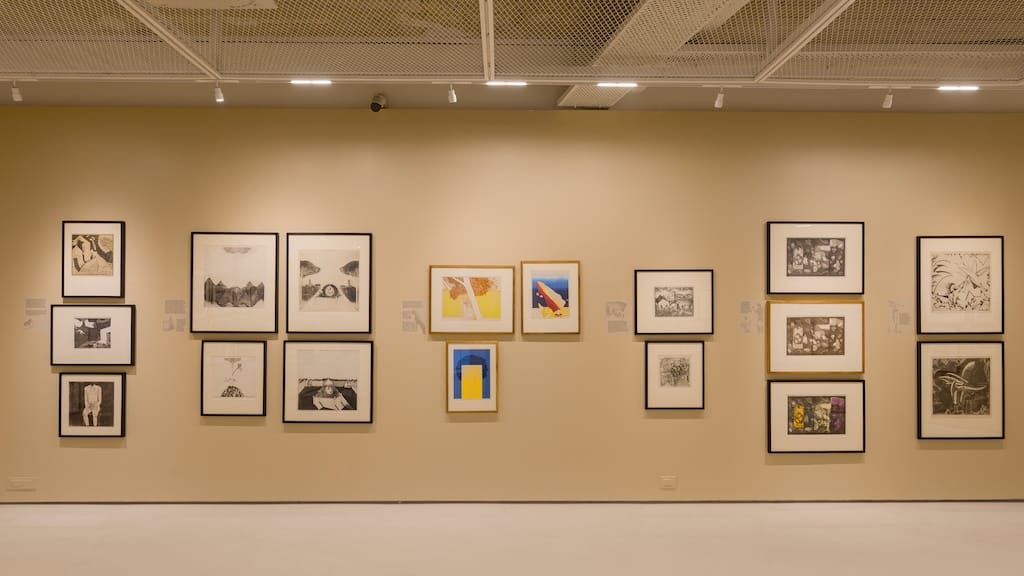
Now, Hand Prints / Mind Prints, a major retrospective at TRI Art & Culture in Kolkata, brings that lesser-known dimension of Sheikh’s career into focus. Curated by artist and curator Pushpamala N. and presented in association with Vadehra Art Gallery, the exhibition surveys seventy years of printmaking, from student linocuts made in Baroda during the 1950s to ambitious digital works produced in recent decades.
The exhibition did not begin as a retrospective. According to Pushpamala, the idea emerged unexpectedly during a conversation with Sheikh in Bangalore in 2023.
“The retrospective came about very organically,” she recalls. “When Sheikh was visiting Bangalore in 2023, Premilla Baid of Gallery Sumukha invited him to have a show at her gallery. He said that that would be difficult as he had just had a major show of paintings. As we were chatting, I suggested that he could show his prints instead.”
What initially appeared to be a modest proposal soon revealed itself to be something much larger. As research progressed, Pushpamala discovered that Sheikh had preserved works dating back to his student years and had built a substantial printmaking practice that had never been exhibited comprehensively.
“We found that Sheikh had preserved his prints from his student days in the Baroda Faculty of Fine Arts till the present day and had a huge body of work which was unknown,” she says. “So this was a ‘secret’ body of work, a parallel practice, which no one knew about.”
That discovery became the foundation of an exhibition that has travelled through multiple venues and now arrives in Kolkata in its fourth iteration.
Hand Prints and Mind Prints
The retrospective is divided into two distinct but interconnected sections. Hand Prints explores Sheikh’s engagement with traditional printmaking techniques including woodcut, linocut, lithography, silkscreen and etching-aquatint. Mind Prints focuses on the digital works he began producing in the early 2000s.
Pushpamala explains that this structure emerged directly from her research process.
“I went twice to Baroda for research in 2023 and 2024 and stayed with the Sheikhs, when Sheikh pulled all his work and showed them to me. It was overwhelming.”
As she examined the material, it became clear that the two bodies of work represented fundamentally different modes of thinking.
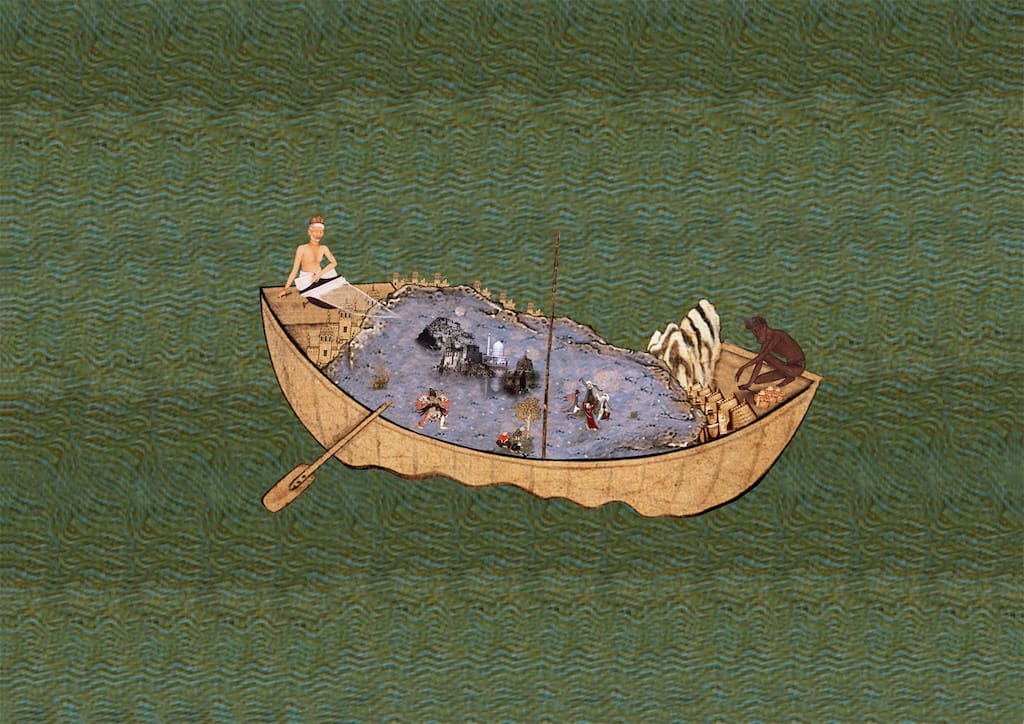
“While the traditional prints which he called Hand Prints grew basically from his interest in drawing and were made by hand using traditional tools, the digital prints he called Mind Prints grew out of his interest in quotation and montage,” she says. “They are completely different ways of working. So we decided not to mix up the two and made them into different sections.”
The distinction is more than technical. It reveals how Sheikh has consistently reinvented his artistic language while remaining committed to the possibilities of print as a medium of communication and experimentation.
Print as a Democratic Space
One of the exhibition’s most engaging aspects is its treatment of magazines and publishing projects. Alongside prints, visitors encounter materials from Pragati, Kshitij and Vrishchik, publications that played an important role in shaping cultural discourse in post-Independence India.
For Pushpamala, these magazines were the key to understanding Sheikh’s broader relationship with printmaking.
“I love the little magazines,” she says. “They were my entry into his work.”
Rather than treating printmaking solely as a fine-art practice, she became interested in how Sheikh used printed matter to circulate ideas, build communities and encourage dialogue.
“I think all his interests in literature, art history, art and activism, and propagating these, come together in the little magazines.”
The story begins with Pragati, a handwritten and illustrated literary magazine produced while Sheikh was still a schoolboy in Surendranagar. Though not strictly a printmaking project, it reveals an early fascination with publishing and public engagement.
“Though it does not involve printmaking, it is so youthful and charming and a precursor to his later interests,” Pushpamala notes.
The exhibition then follows Sheikh’s involvement with Kshitij, the influential Gujarati literary journal edited by Suresh Joshi. As a young artist, Sheikh developed a method for printing original linocuts directly through letterpress production, allowing art to circulate widely rather than remaining confined to galleries.
Later came Vrishchik, the influential art journal he founded with Bhupen Khakhar.
“Vrishchik was an art magazine, where they extended the uses of printing original works by artists, adding pull-outs, with issues on Bangladesh and Vietnam, a public discussion on the workings of the Lalit Kala Akademi, and posted them free to cultural figures and institutions.”
To recreate the spirit of these publications, Pushpamala introduced a library-style reading table containing reproductions of the magazines.
“This was the most popular part of the show where school and college kids, artists and visitors, would spend hours reading,” she says. “So instead of remaining a historical or pedagogical show, the retrospective became alive and contemporary.”
Building a World of References
Sheikh’s art is renowned for its extraordinary network of references. Persian literature, Kabir’s poetry, Mughal painting, Renaissance art, cinema, mythology and autobiography all coexist within his visual universe.
Presenting this complexity to contemporary audiences required a curatorial approach that balanced scholarship with accessibility.
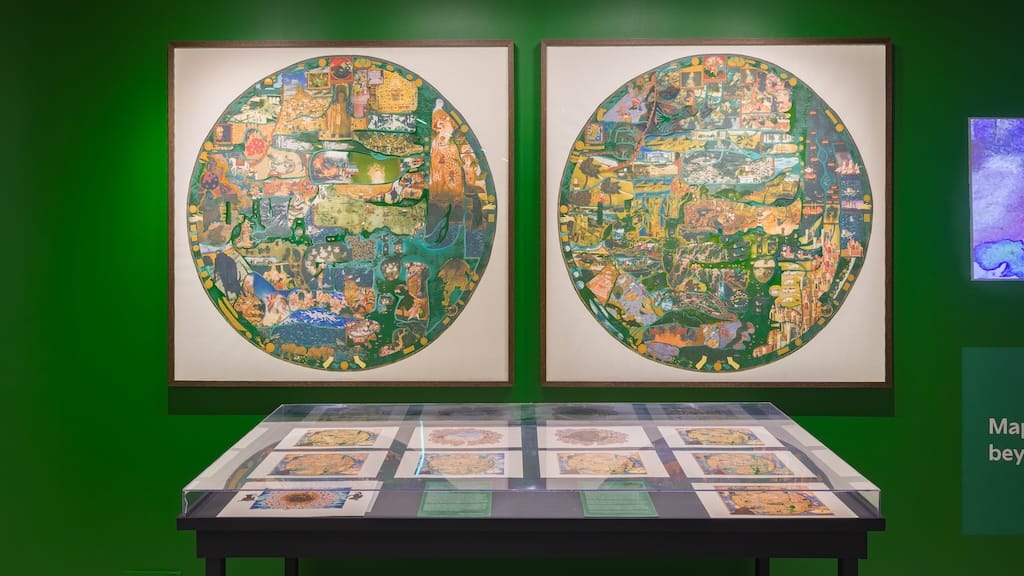
“I created clusters of the work and wrote extensive notes, like a museum show,” Pushpamala explains.
The accompanying texts situate individual works within larger narratives, revealing the personal experiences, intellectual influences and historical events that shaped them.
“I actually listed all the quotations used in one work, which ranged across centuries and geographies, to give an idea of the richness of metaphor.”
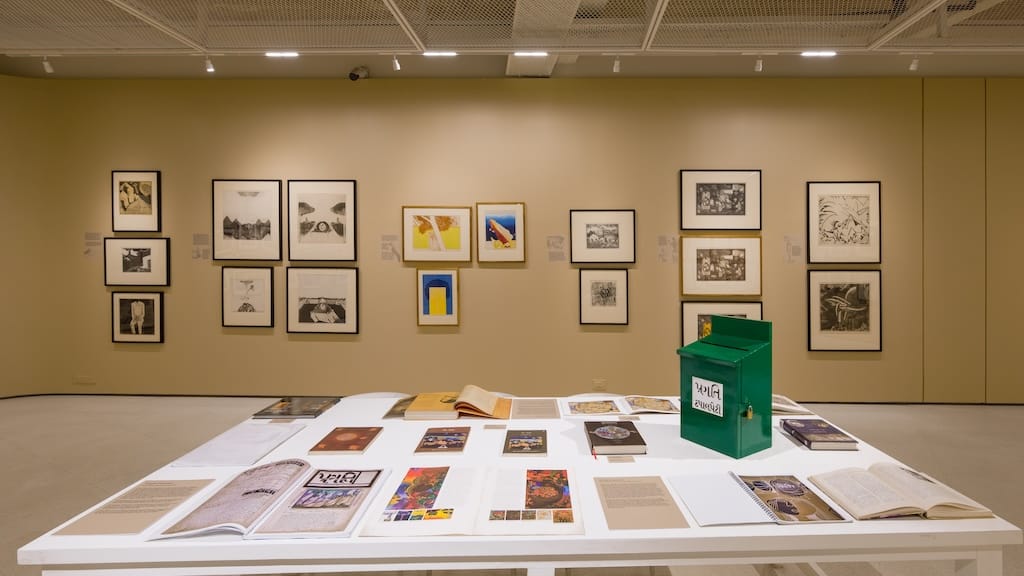
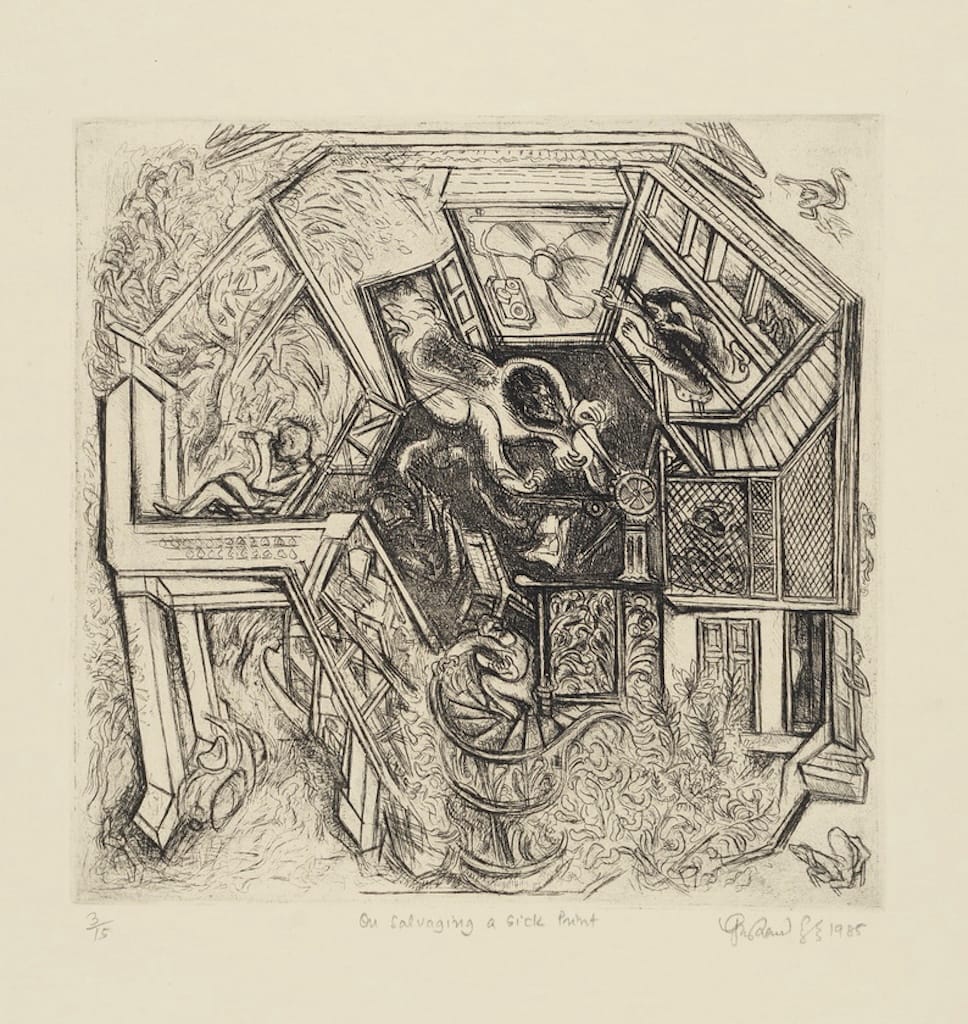
This attention to context becomes particularly important in works dealing with communal violence, memory and identity. Prints such as Riot and later works responding to political upheaval demonstrate how Sheikh has repeatedly turned to visual history in order to make sense of contemporary events.
Crisis as Transformation
One of the most fascinating insights offered by Pushpamala concerns the relationship between personal crisis and artistic innovation in Sheikh’s career.
“I found something interesting in his print practice,” she says. “Whenever he faced a crisis in his life, his work expanded. He discovered new technologies, new subject matter, new inspirations, a new language.”
She points to the communal riots in Gujarat during 1969 as a particularly significant moment.
“The riots shook him deeply. But it was around the same time that he discovered the Hamzanama paintings, new wave cinema, learned the new techniques of etching and aquatint, started writing his autobiography, and all these things entered his work.”
The result was a profound shift away from his earlier modernist vocabulary towards the layered, narrative-rich language for which he later became known.
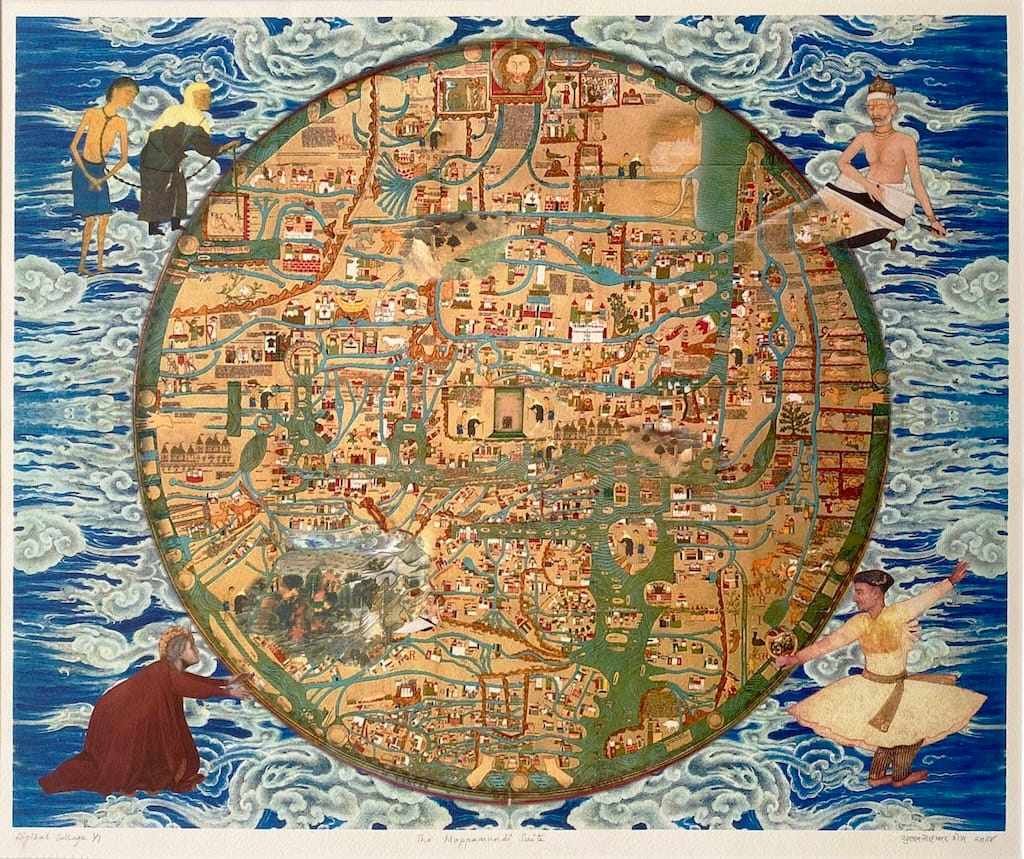
A similar process occurred decades later when Sheikh encountered digital technology. During a period of displacement following the violence of 2002, he discovered the medieval Ebstorf Mappamundi and began experimenting with digital printmaking.
“The mappamundi became the matrix to create his own worlds, montaged with innumerable references from across history and geography,” Pushpamala explains.
Reinventing Digital Printmaking
The second half of the exhibition examines Sheikh’s pioneering engagement with digital technologies. Long before digital art became commonplace, he recognised the medium’s potential to transform image-making.
Pushpamala believes the significance of this work lies in Sheikh’s ability to invent a highly personal approach rather than simply adopting new technology.
“He has invented his own way of working with a technology he finds ‘easy’ compared to painting and traditional printmaking,” she says.
Rather than treating digital tools as substitutes for existing methods, Sheikh combined scanning, collage, painting and digital manipulation to create hybrid works that occupy a space between print and painting.
“His works are in-between painting and print, which is interesting,” she notes.
The vibrant colours of works such as the Mappamundi Suite, the Portraits of Artists and the Kaavad series reveal possibilities unavailable within traditional printmaking.
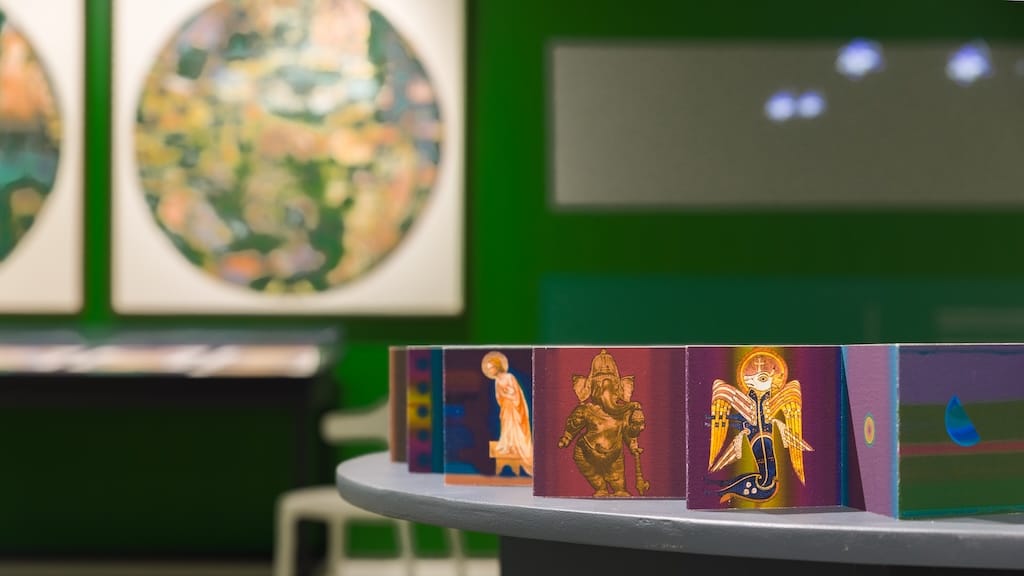
“He also expands them into different forms,” Pushpamala says. “Accordion books, an animation film, a sensor animated travellator in the airport. Few printmakers venture beyond edition prints, so these are unusual and innovative.”
Collaborations Across Time
As an artist whose own work frequently engages with archives and visual histories, Pushpamala found herself particularly drawn to Sheikh’s ability to create unexpected conversations between people, places and periods.
“I enjoyed the civilisational breadth of his quotations, where his career as an art historian comes into play,” she says.
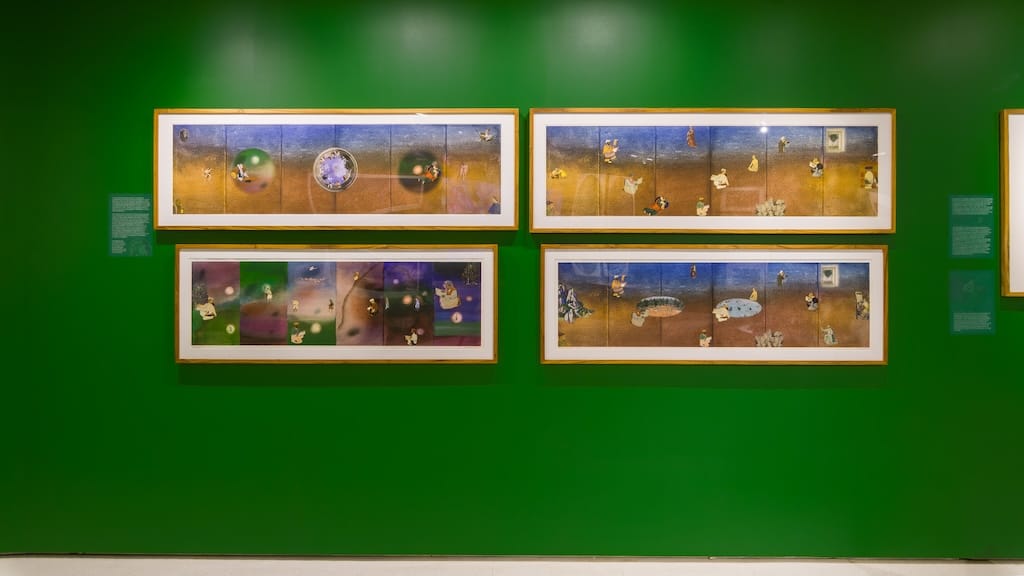
Across the exhibition, viewers encounter a cast of figures. “He creates collaborations across time and space,” Pushpamala observes. “Mary Magdalene, Majnu, Kabir, medieval European, Persian and Mughal artists, his artist colleagues, become fellow travellers in the worlds that he creates.”
These imagined communities reveal one of the defining characteristics of Sheikh’s practice: a refusal to see cultures, histories or identities as isolated from one another.
A Life of Continuous Learning
Hand Prints / Mind Prints is not only a survey of printmaking. It is also a portrait of intellectual curiosity sustained across seven decades. For Pushpamala, this may be Sheikh’s most important legacy.
“He is a protean figure who is very inspiring,” she says. “People were amazed at seeing this huge body of unknown work.”
What impressed her most was the sheer breadth of his activities and interests.
“Here is a man who is an accomplished painter, poet, fiction writer and art historian, while also practising as a printmaker and running magazines, while he had a full-time job teaching in the art school.”
That restless curiosity runs through every section of the exhibition, from the youthful pages of Pragati to the expansive digital worlds of the Mappamundi Suite.
“His curiosity and zest for life are amazing,” Pushpamala concludes. “His contribution is his endless desire to learn and his belief in the transformative power of art.”
Seen together, the works in Hand Prints / Mind Prints reveal not a secondary practice but an essential one. They show how printmaking enabled Sheikh to experiment, communicate, collaborate and continually reinvent himself. More importantly, they reveal an artist who has spent a lifetime building connections between images, ideas and people, demonstrating the lasting capacity of art to create new ways of seeing the world.
Hand Prints / Mind Prints: Gulammohammed Sheikh – A Retrospective of 70 Years of Printmaking is on view at TRI Art & Culture, Kolkata, through 2 August 2026.