Tracing Lineage in Thread: Chanakya School at Experimenter, Kolkata
At Experimenter Kolkata, Chanakya School’s debut solo in India unfolds textile as archive, memory, and monument, foregrounding women’s labour and generational knowledge through layered embroidery, stone sculpture, and immersive installation.

Experimenter presents Trace, the debut solo exhibition in India by the Chanakya School, led by Karishma Swali. Rooted in sustained engagement with indigenous textile traditions, material research, and inherited knowledge systems, the collective’s practice bridges contemporary thought with ancient processes. In doing so, it positions textile not merely as medium, but as memory, archive, and living testimony.

Textile as Archive and Lineage
Textile is among the most intimate of human inventions. Across centuries and cultures, cloth has absorbed both the personal and the collective, becoming a palimpsest upon which stories accumulate and endure. In Trace, thread is treated as lineage. Each line follows an unbroken chain of knowledge, mapping histories that bind land to body and individual to community.
The exhibition explores interconnected textile histories while attending to the subtle residues of the human hand embedded in fibre over time. To trace a line of thread is to follow a physiological and chronological archive of shared memory.
Women, Weaving, and Inherited Knowledge
Central to this inquiry is the recognition that women have long carried these lineages. Their shared histories are encoded into weave structures, embroidery techniques, and preparatory processes that often remain unacknowledged. Fundamentally women centred in its pedagogy, the Chanakya School works collaboratively with both female and male practitioners, foregrounding women’s agency while responding to the erosion of traditional practices.
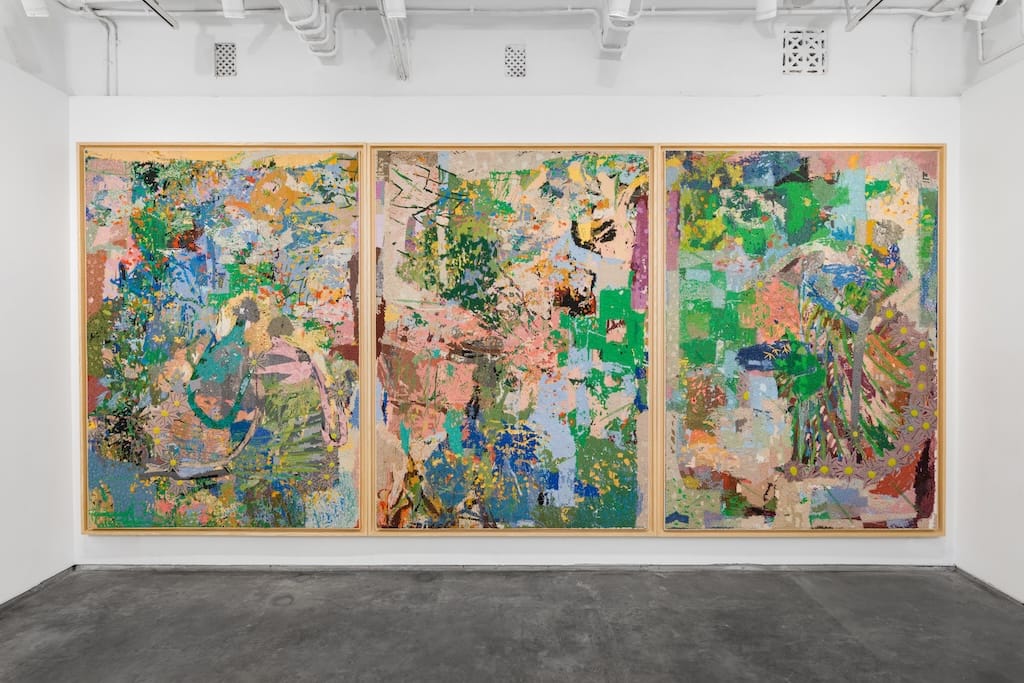
The works return to elemental gestures of mark making and remembrance, insisting that craft is neither static nor nostalgic, but a thinking and evolving language.
Monumental Weaves
A monumental triptych, Trace III–V, anchors the exhibition. Composed of cotton and silk embroidery layered with glass and seed beads, the work unfolds as a continuous abstract landscape. Surfaces are built gradually, sometimes reaching twelve layers in depth. Thread and bead accumulate like sediment, retaining a stone like materiality while preserving the suppleness of textile.
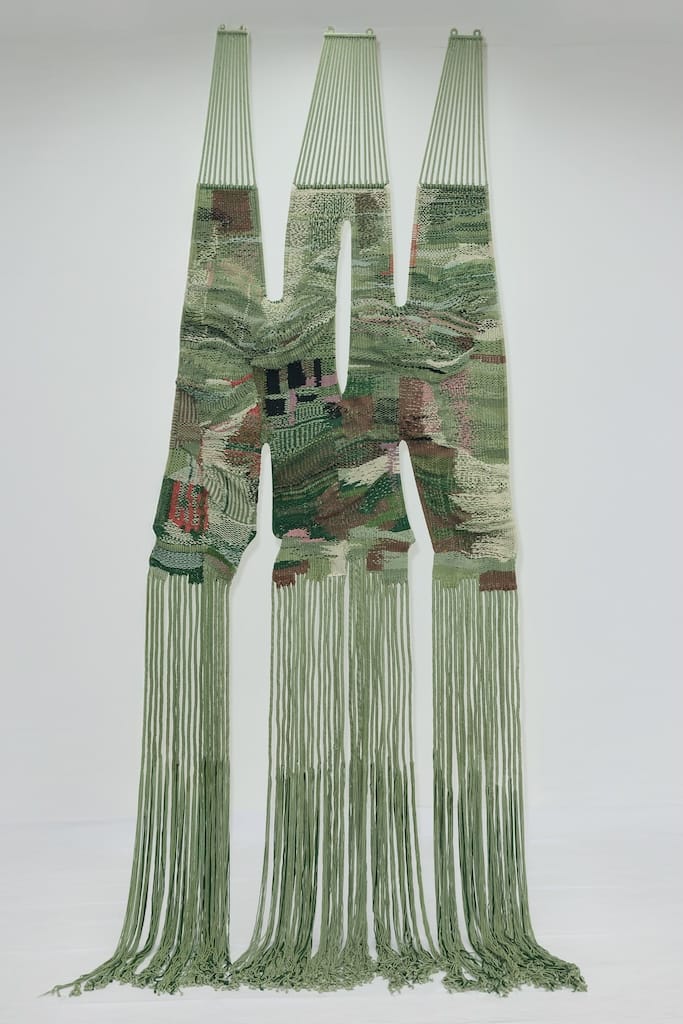
Gesture and intuition are translated into form, and the work dwells in contemplative enquiry, inviting slow looking.
Stone and Thread
Adjacent woven panels, also titled Trace, further illuminate the collective’s immersion in weaving, spinning, dyeing, and embroidery. Anthropomorphic forms emerge within these textiles, echoing early stone carvings that functioned as portraiture. Here, they appear softened and fluid, often holding abstracted floral offerings rendered in grey glass beads.
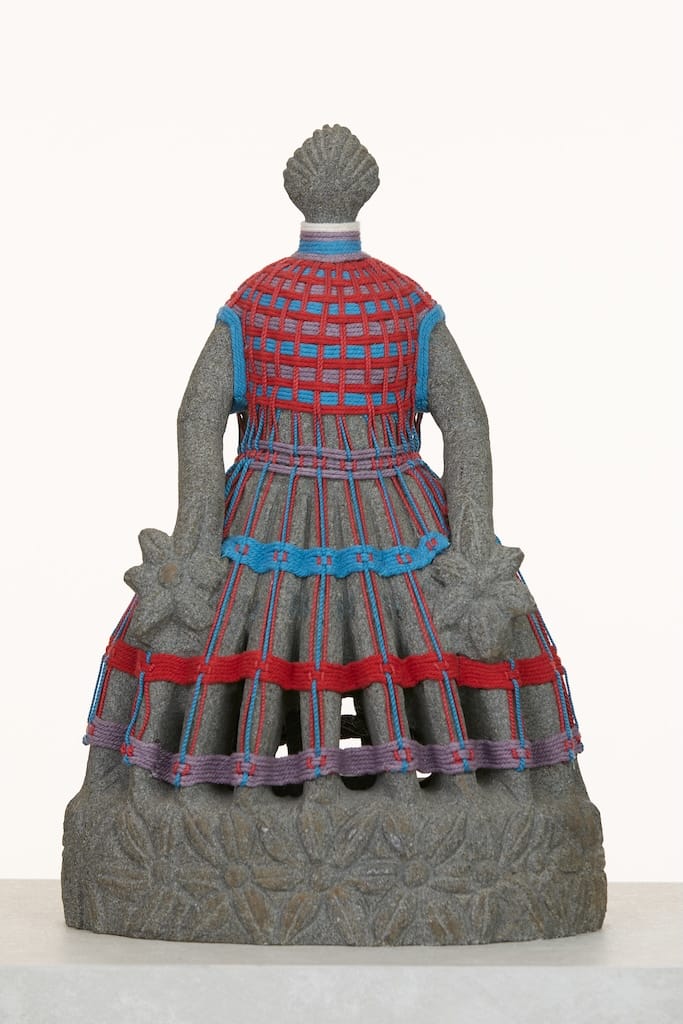
In dialogue with these panels stand black stone sculptures titled Form II–V, hand carved and bound with organic thread. Textile and stone establish a conversation between permanence and pliancy, monument and memory.
Honouring Invisible Labour
A significant thread within the exhibition foregrounds overlooked labour, particularly the preparatory work of shuttle wrapping carried out by women in weaving communities. Smaller works under the title Flowers in the Night isolate and honour these gestures.
Created on Saori looms and drawing on herringbone, basket weave, and chevron structures, the panels employ hand dyed cotton, linen, and jute to trace a continuum from early loom technologies to contemporary practice. Fractures, joins, and inconsistencies remain visible, refusing polish in favour of honesty. Hand embroidery extends this enquiry, with recycled seed and glass beads stitched in deliberate layers using cotton and silk thread.
Immersion and Installation
Hanging sculptures such as Flowers in our Forest and Opening Sky evoke elemental references of forest, sky, and sun, with human forms emerging from dense constellations of thread.
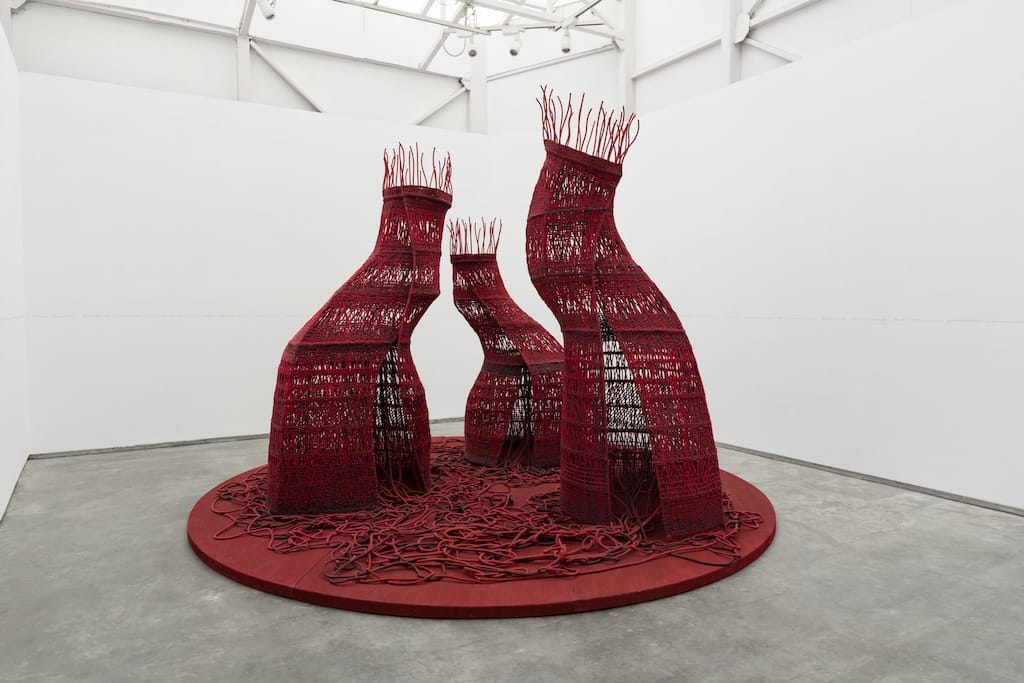
In the gallery’s vaulted space, the immersive installation Dwelling reimagines deconstructed Bhunga forms from Kutch. Traditionally sites of social exchange, the bhunga is here abstracted into standalone textile structures resembling women gathered in intimate circles. Dyed with madder root and suspended within natural light, the installation gestures toward collective authorship. Cords extend outward like lifelines, suggesting both womb and network, fragmentation and solidarity.
Surrounding woven panels titled Field Notes present technical experiments and material juxtapositions, while the hanging tapestry Sediment consolidates these investigations into a robust textile presence.
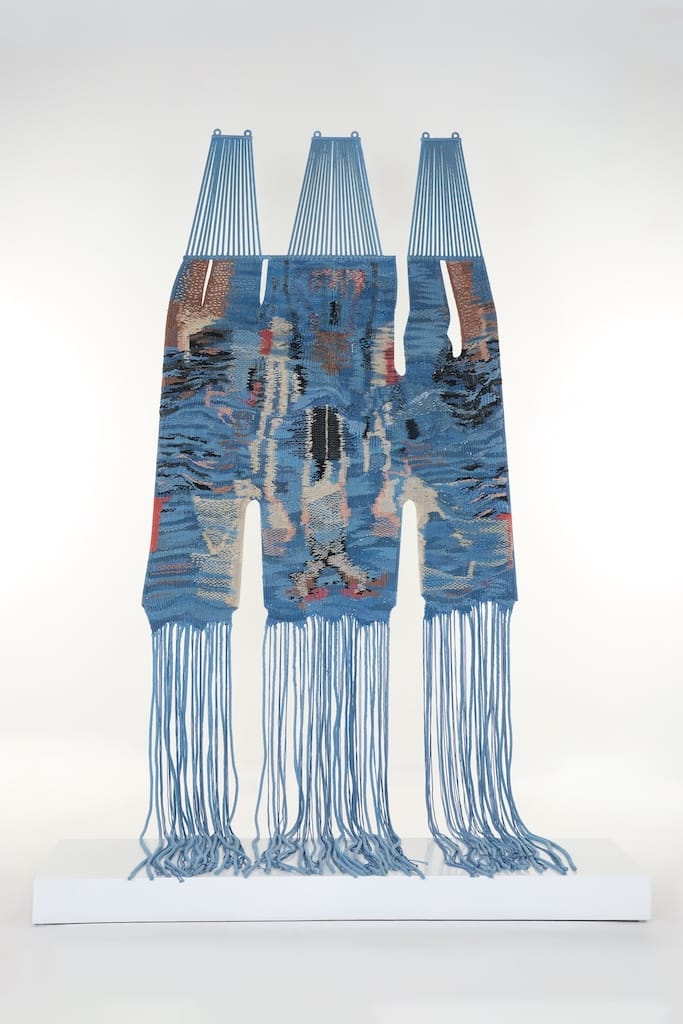
Collective Authorship and Contemporary Craft
Across beadwork, weaving, embroidery, stitching, stone carving, and installation, Trace underscores the collective’s distinctive textile language. Organic thread, natural dyes, recycled beads, and hand carved stone converge in a body of work that examines the human condition through the lens of women’s agency and generational transmission.
Layer builds upon layer, weave upon weave, bead upon bead, knot upon knot. The works accumulate impressions over time, rooted in the rhythms of the natural world and the arc of lived experience.
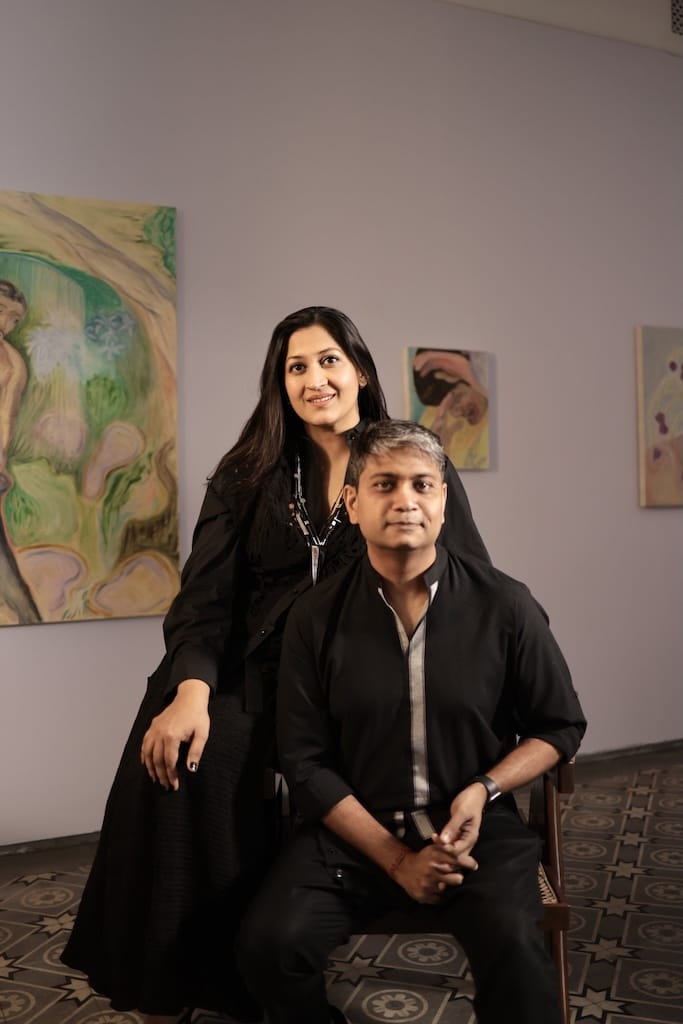
Founded in 2016 in Mumbai, the Chanakya School extends the legacy of Chanakya International and integrates education, research, and material exploration within a shared practice. Drawing on more than 300 embroidery and weaving traditions, it places intergenerational knowledge and women’s practices at the centre of cultural enquiry.
With Trace, the collective offers a resonant meditation on continuity and care, on invisible labour that sustains tradition, and on textile as a vessel of collective memory.
Trace is on view at Experimenter, Ballygunge Place, Kolkata, until 21 March 2026.