The Neuroscience of Visual Learning
Neuroscience reveals why images shape memory, attention and emotion so powerfully. This article explores how visual learning transforms cognition and why art education remains essential in an image saturated culture.


There is something quietly astonishing about the fact that we can look at a painting for a few seconds and retain its emotional charge for years. A colour field can unsettle us. A line drawing can clarify a complex idea more effectively than a paragraph of text. A photograph can alter our political or ethical understanding in an instant. Visual learning is not simply a pedagogical technique. It is deeply wired into the architecture of the human brain.
In recent decades, neuroscience has provided compelling insights into why visual material is so powerful. For those working in the visual arts, art education, photography and design, these findings offer more than scientific curiosity. They offer a framework for understanding why images matter, and how they shape cognition itself.
The Visual Brain
Nearly half of the human cerebral cortex is involved in visual processing. The journey begins in the retina, where light is converted into electrical signals, and continues through the optic nerve to the primary visual cortex in the occipital lobe. From there, information is distributed across specialised networks that analyse colour, movement, depth, form and spatial relationships.
The brain does not passively receive images. It actively constructs them. What we see is a negotiation between incoming sensory data and prior knowledge stored in memory. This is why a seasoned art historian can detect compositional references that a novice viewer might miss. Perception is informed by experience.
Two major pathways are often described. The ventral stream, sometimes called the what pathway, helps us identify objects and recognise faces. The dorsal stream, or where pathway, processes spatial orientation and movement. Together, these systems allow us to interpret a painting not just as pigment on canvas, but as representation, narrative and intention.
For artists and educators, this is significant. Visual engagement activates distributed neural networks rather than a single centre. It is cognitively rich.
Why Images Enhance Memory
One of the most robust findings in cognitive psychology is the picture superiority effect. People consistently remember images better than words. When text is paired with relevant imagery, recall improves dramatically.
This has neurological foundations. Visual information is encoded in both verbal and non verbal systems. According to dual coding theory, when we process an image, we create two memory traces. One is visual and the other is linguistic if we attach meaning to it. This redundancy strengthens retrieval.
In practical terms, a student who studies architectural history through floor plans, photographs and diagrams is likely to retain more than one who relies solely on written description. A viewer who encounters an artwork in person engages spatial and sensory memory in ways that deepen encoding.
Emotion also plays a role. The amygdala, which is central to emotional processing, interacts closely with memory systems in the hippocampus. When an image provokes awe, discomfort or curiosity, it becomes neurologically privileged. It is more likely to be consolidated into long term memory.
This is why certain artworks remain with us for decades. They are not just seen. They are felt.
Attention in the Age of Saturation
If visual information is so powerful, why do we feel increasingly distracted? Neuroscience again offers a clue. The brain is highly responsive to novelty and contrast. Bright colours, movement and unexpected juxtapositions trigger attentional networks.
Digital environments exploit this system. Endless scrolling feeds are engineered to capture the orienting response, a reflexive shift in attention towards sudden stimuli. However, sustained attention requires something different. It demands depth rather than constant novelty.
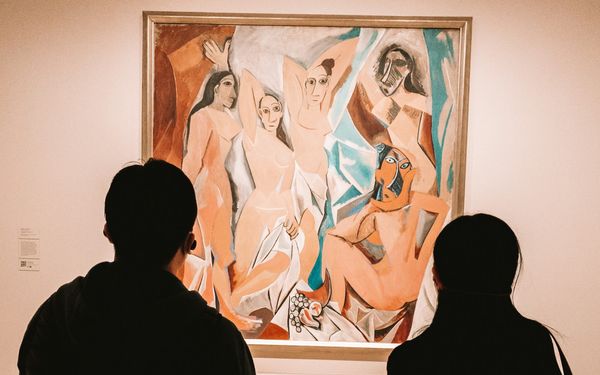
Art, at its best, slows perception. A carefully constructed composition guides the eye. Negative space allows cognitive rest. Subtle tonal shifts encourage prolonged viewing. In gallery contexts, viewers often spend far more time with a single artwork than they would with a digital image.
This difference matters educationally. Deep visual engagement strengthens neural pathways associated with focus and reflection. It fosters what some cognitive scientists describe as elaborative processing, in which information is connected to prior knowledge and integrated into broader frameworks.
In this sense, art is not merely decorative. It trains attention.
Visual Learning in Art Education
For educators in the arts, neuroscience affirms long held intuitions. Studio based learning is not simply about technical skill. It is about perceptual refinement.
Drawing from observation, for instance, enhances sensitivity to proportion, shadow and spatial relationships. Brain imaging studies suggest that trained artists show distinct activation patterns when viewing complex forms. Practice appears to recalibrate perceptual networks.
Critique sessions also engage higher order cognition. When students articulate why a composition succeeds or fails, they integrate visual analysis with language and abstract reasoning. This cross modal processing strengthens neural connectivity.
Importantly, visual learning is inclusive. For students who struggle with purely text based instruction, images provide alternative entry points into understanding. Diagrams, mind maps and visual metaphors can reduce cognitive load by organising information spatially.
This has implications beyond art schools. In interdisciplinary education, visual tools can clarify complex scientific, historical or philosophical concepts. The brain is adept at detecting patterns. When information is presented visually, relationships become more apparent.
The Role of Embodiment and Space
Neuroscience increasingly recognises that cognition is embodied. Perception is linked to movement, posture and spatial orientation. When we navigate an exhibition, our bodies participate in meaning making.
Scale alters perception. A monumental installation engages peripheral vision and physical proximity. A miniature drawing invites intimacy. These spatial experiences activate sensorimotor networks that enrich interpretation.
In photography and film, framing directs embodied attention. The cropping of an image can induce a sense of confinement or expansiveness. Such responses are not purely conceptual. They are physiological.
For curators and exhibition designers, this underscores the importance of spatial choreography. The arrangement of works, lighting conditions and sight lines shape neural experience.
Creativity and Neural Plasticity
Another compelling dimension is plasticity. The brain remains adaptable throughout life. Engaging in creative visual practice appears to support this adaptability.
Art making involves iterative problem solving. Artists constantly evaluate, adjust and refine. This process recruits executive functions associated with the prefrontal cortex, including planning and cognitive flexibility.
There is growing evidence that sustained engagement with creative activity can support mental wellbeing. While neuroscience should not be used to instrumentalise art, it is notable that visual practice can reduce stress markers and enhance mood regulation.
The act of making is cognitively integrative. It links perception, emotion, memory and motor coordination. Few activities engage so many systems simultaneously.
Implications for the Contemporary Visual Culture
We inhabit an image saturated culture. Billboards, screens, interfaces and immersive installations compete for attention. Yet understanding the neuroscience of visual learning encourages discernment rather than cynicism.
It reminds us that not all images are equal. Some are designed to fragment attention. Others cultivate depth and reflection. The difference lies in how they interact with our neural architecture.