Olivia Fraser: Painting the Inner Geometry of the World
In this conversation, Olivia Fraser reflects on the miniature painting tradition that shaped her practice, the meditative discipline of slow painting, and the inner journey that informs her geometric works inspired by Tantric philosophy and sacred geometry.
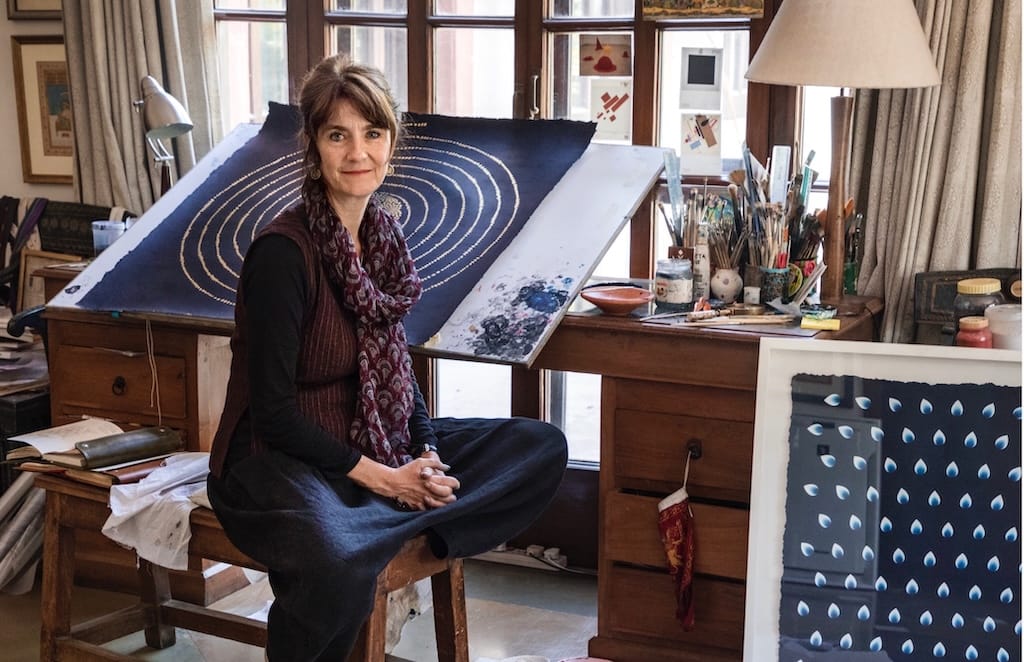
At the British Council gallery in New Delhi, Nature Morte presents The Journey Within, a solo exhibition of new works by Olivia Fraser, currently on view until 25 March 2026. Fraser, who has been based in India since the early 1990s, is known for her contemporary interpretation of the Indian miniature painting tradition. Working with seventeenth-century techniques and stone-ground pigments learned during her apprenticeship with master painters in Rajasthan, she creates meditative geometric compositions inspired by Tantric philosophy, sacred geometry, and the history of modern abstraction.
The exhibition is accompanied by an immersive soundscape by sound artist Jason Singh, who uses biosonification to translate the electrical impulses of plants, trees, and fungi into music. Inspired by the pioneering research of Jagadish Chandra Bose, the collaboration invites viewers to experience Fraser’s works not only visually but also as part of a wider sensory environment that reflects the rhythms and interconnectedness of the natural world.
In this conversation, Fraser reflects on the influence of the miniature tradition, the contemplative discipline of her practice, and the inner journey that continues to shape her work.
Nikhil Sardana: Your practice is rooted in the techniques of 17th-century Indian miniature painting, yet your compositions speak strongly to modern and contemporary abstraction. How do you negotiate the dialogue between historical discipline and contemporary sensibility in your work?
Olivia Fraser: I am influenced by the world around me, by my own history of being born and brought up in the UK, and by the places where I have lived, as well as by the artists and art movements that I admire. Having lived the majority of my adult life in India, the layers of artistic endeavour here never cease to amaze me. It is the miniature painting tradition, in particular, that excites me and has deeply influenced all my work.
When I first encountered the monumental miniature paintings from Maharaja Man Singh’s Nath-guru-influenced reign in early nineteenth-century Jodhpur, it felt as though the borders between East and West and between the historical and the contemporary became porous and merged. The metaphysical depictions of Nath philosophy, with their astonishing abstract images of the Absolute and the cosmic oceans and their dream-like rhythms and intensity, seem almost to prefigure twentieth-century artists such as Rothko, Howard Hodgkin, Bridget Riley, or Sol LeWitt. It therefore felt entirely natural for me to try to cross-fertilise these ideas within my own art.
NS: Having apprenticed under master painters in Rajasthan, what aspects of that traditional training continue to shape your daily studio practice, both technically and philosophically?
OF: My art practice follows very closely the traditional training I received in Rajasthan. The process is slow. The materials are sourced locally and are handmade and hand-ground. I work in a traditional layered manner, burnishing each layer with an agate stone in order to fuse and polish the surface.
I work from macro to micro, moving from large colour-filling brushes to minute fine-line brushes where each tiny brushstroke is placed with deliberate attention, rhythm, and precision. “Work is worship” is one of the beautiful principles I learnt from my teachers, and it continues to shape how and what I paint.
I am deeply drawn to Indian philosophy and poetry that explore the sacred and the abstract. There is a wonderful third-century Buddhist text which describes yoga as the painting of pictures by the mind using the brush of meditation: “The actions of the mind, like a painter, paint images in the sphere of immateriality.”
I am also inspired by my own practice of yoga and its visualisations in dhyana. Using the traditional iconographic language that I learned all those years ago, I bring this idea of yoga into the physical realm of painting, grappling with the challenge of depicting immateriality on paper, inspired by an ever-deepening engagement with this painting tradition.
NS: The title of this exhibition, The Journey Within, suggests an inward, contemplative movement. What does this inner journey represent for you at this stage of your artistic life?
OF: I began in my early twenties as a travel painter, painting in a very Western manner from life. I painted the historical buildings around me and the people I encountered. I was fascinated by how light fell on flesh or architecture, and I was thrilled by the colours and patterns surrounding me.
In 2005 I joined a traditional gurukul in Delhi. When I said that I wished to paint a banana leaf and asked whether I should go outside and sketch one from life, I was told to look within. There was only one way to paint a banana leaf and it required an inner perception. That was the beginning of my journey within.
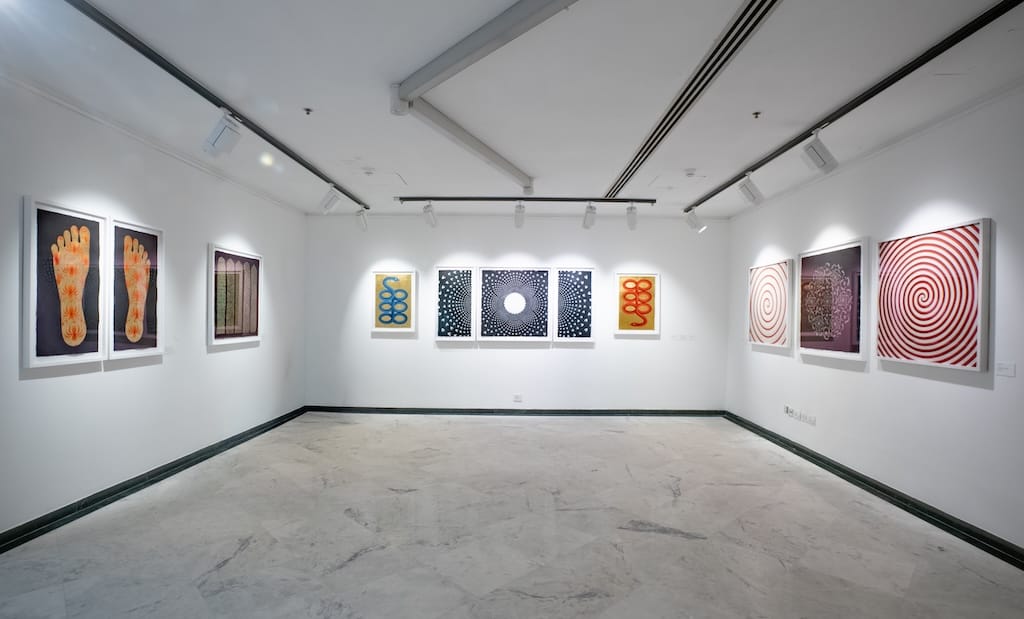
It has been rather like learning a language. One builds a vocabulary, expands it initially in a fairly traditional way, and gradually begins to make it one’s own. For this exhibition I am showing works created over the last few years that explore breath and our connections to the world around us. Imagery associated with the garden becomes a tool for breathing and for meditation.
The paintings themselves require a form of deep concentration, almost a kind of meditative breathwork, in order to achieve the fine line and the sense of flow. This is echoed in the subject matter itself. I find that this slow art form and this inner journey offer a wonderful antidote to the speed, noise, and stresses of the outside world.
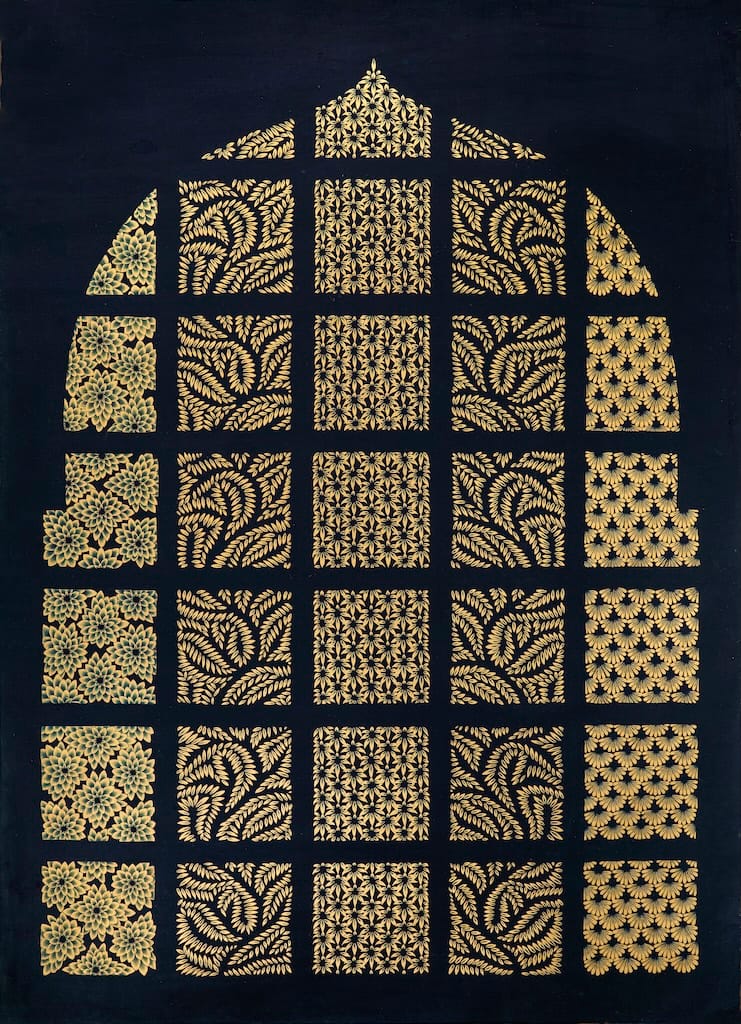
NS: Your geometric compositions are deeply informed by Tantric philosophy and sacred geometry. How do you approach these spiritual frameworks without slipping into illustration, and instead allow them to remain experiential and meditative?
OF: The very act of painting these works is one of meditation and slow contemplation. If I am in a hurry or overstimulated by the noise of the world outside, the work simply does not function.
I have to enter fully into this world of colour, form, and rhythmic patterning. Inspired by the multiple philosophical and sacred meanings associated with these forms, I try to clarify the image, pushing back the noise and striving for something as pared down and essential as possible.
NS: There is an intriguing resonance between your work and the history of European and American geometric abstraction in the twentieth century. Do you see your paintings as part of that lineage, or as a parallel but distinct trajectory?
OF: There are three twentieth-century Western art movements that I particularly admire: abstraction, pioneered by the visionary Swedish artist Hilma af Klint; Surrealism, with my great-aunt Eileen Agar’s portholes into the playgrounds of the subconscious; and Op Art, with Bridget Riley’s pulsating abstract minimalism focused on sensation.
All of these artists and movements engaged with abstraction in different ways, and they have certainly influenced my work. However, working as I do within the very distinct tradition of Indian miniature painting perhaps makes my connection to them less immediately obvious.
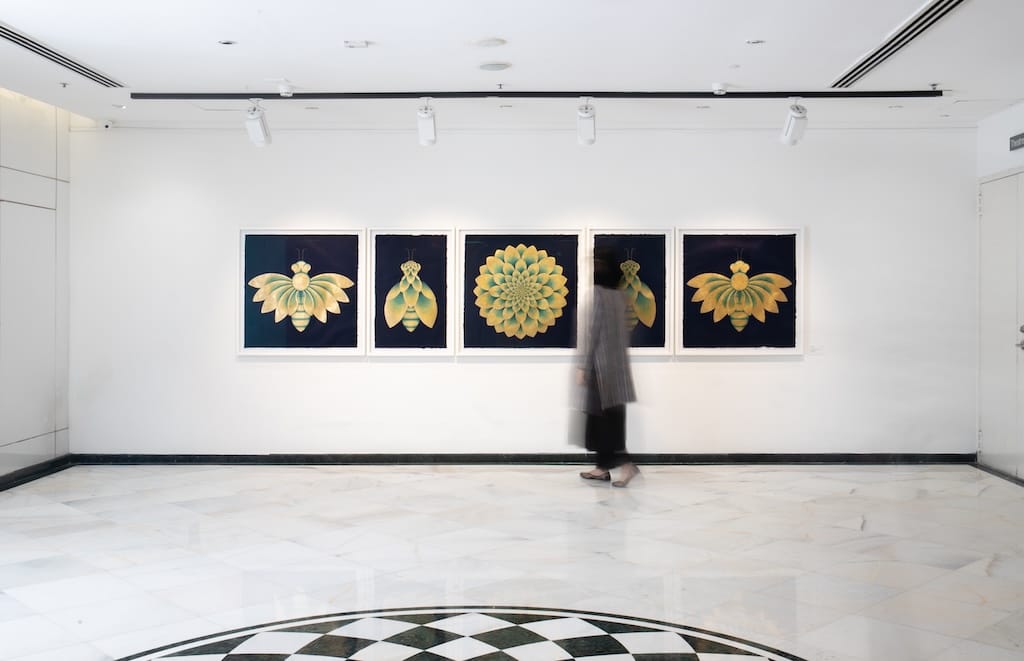
NS: Stone-ground pigments and traditional materials demand patience and precision. In an era of speed and digital production, does this slow, devotional process function as a form of resistance?
OF: More than resistance, I feel that it functions as a form of healing. It is about the tactile, the sensory, and the real. It is about remembering our interconnectedness, seeing what unites rather than what divides us, and recalling the wonder of the world around us.
NS: This exhibition incorporates an immersive soundscape by Jason Singh, including biosonification of plants inspired by Jagadish Chandra Bose’s discoveries. How did this collaboration reshape your understanding of the relationship between art, nature, and consciousness?
OF: What Jason does, and what drew me to his work, is that he makes the invisible audible. Through biosonification, attaching sensors to plants and translating their electrical impulses into music, he reveals the plant composing. That is exactly what I have been trying to paint.
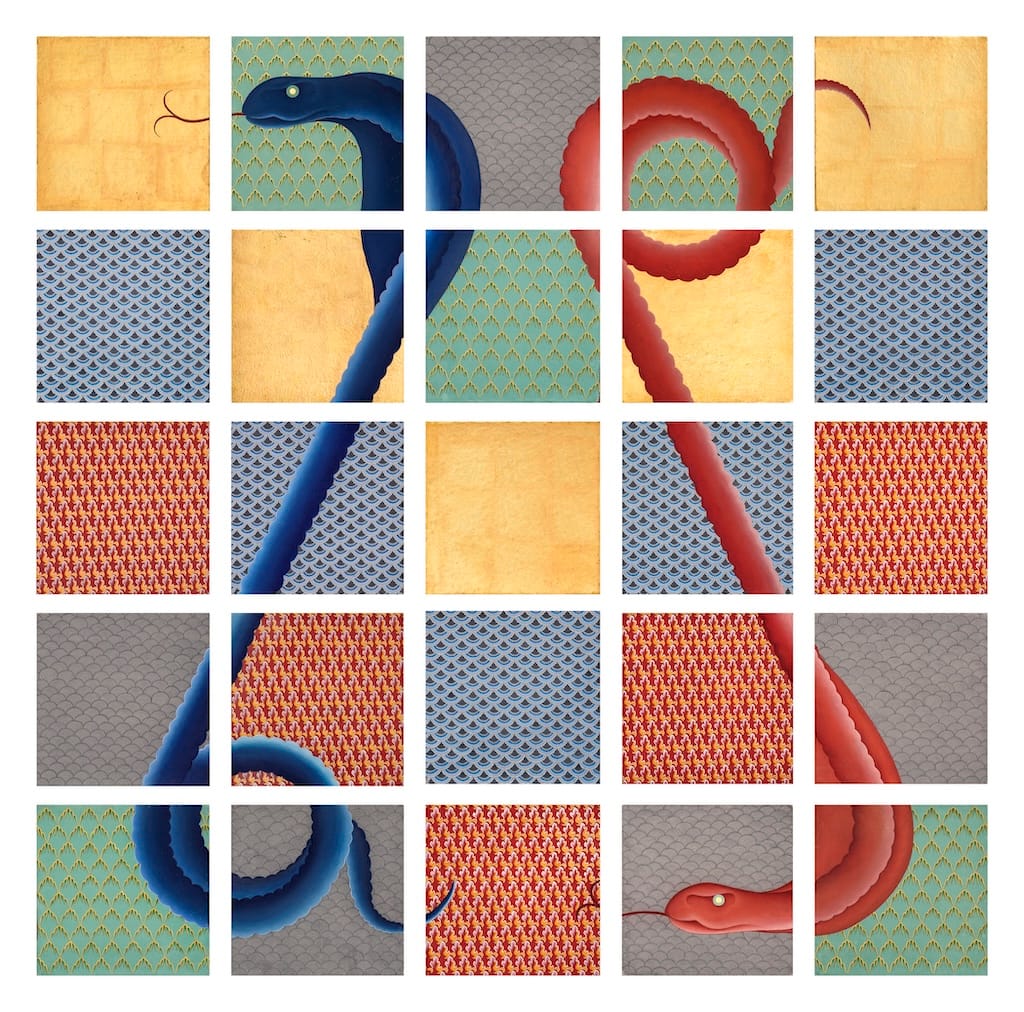
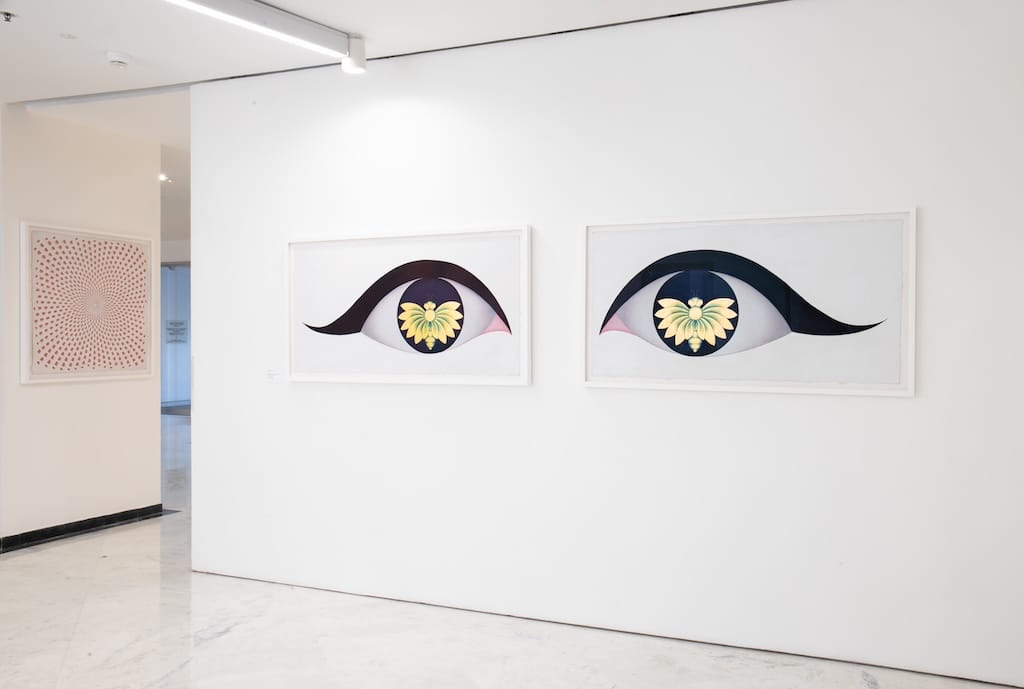
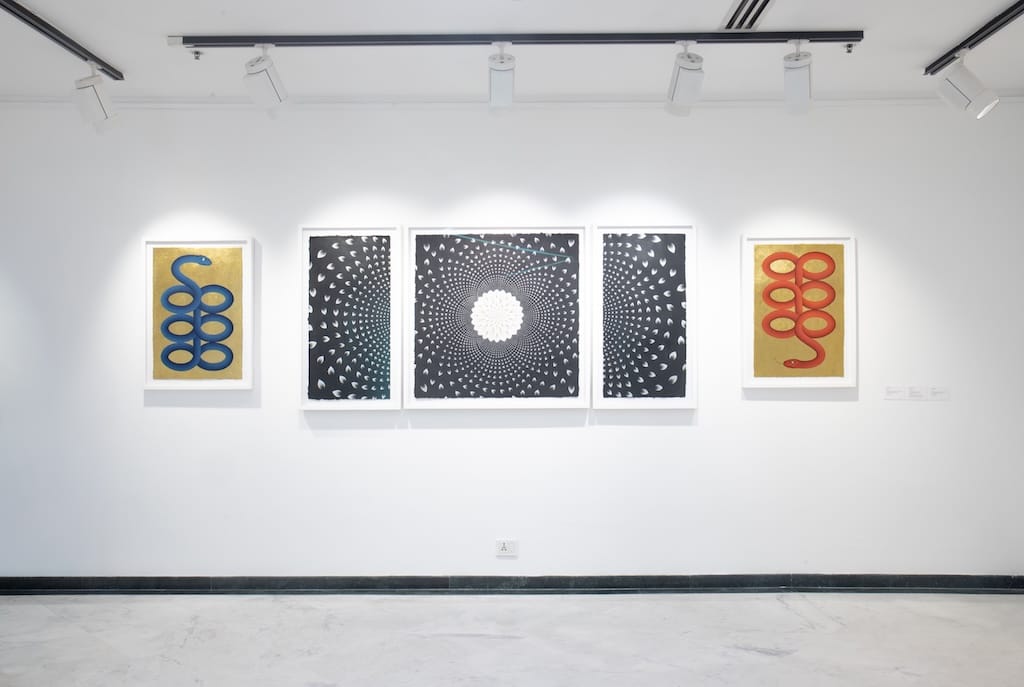
When I take a lotus, a bee, a leaf, or a serpent and multiply it, radiate it, or enlarge it, I am trying to reveal the energy, pulse, and breath beneath the surface. Jason makes you hear the hidden life of things. I am trying to make you see the pulse and breath of form.
Prana is not a metaphor. It is a physical reality moving through every living thing. Jason and I are both creating a contemplative space of interconnection where the rhythms of my iconography meet the rhythms of sound so that the person in that space may realise they are part of the same pattern: I am that.
NS: You have lived in India since the early 1990s while being born and raised in the UK. How has this long cross-cultural experience influenced your sense of artistic identity and belonging?
OF: I feel that time builds new layers on all of us. We grow multiple skins, one on top of the other, reflecting our experiences and the places where we live. Rather than being defined by one particular place, we accumulate identities.
We are all hybrid beings, even if we never move from one side of the world to the other as I did. I think my artwork reflects who I am, composed of multiple layers drawn from both East and West.