Girl with a Pearl Earring: Was She Real?
Was Vermeer’s Girl with a Pearl Earring a real person or an imagined ideal? This article explores the mystery behind the iconic painting, separating historical evidence from fiction and examining why her identity still fascinates viewers today.

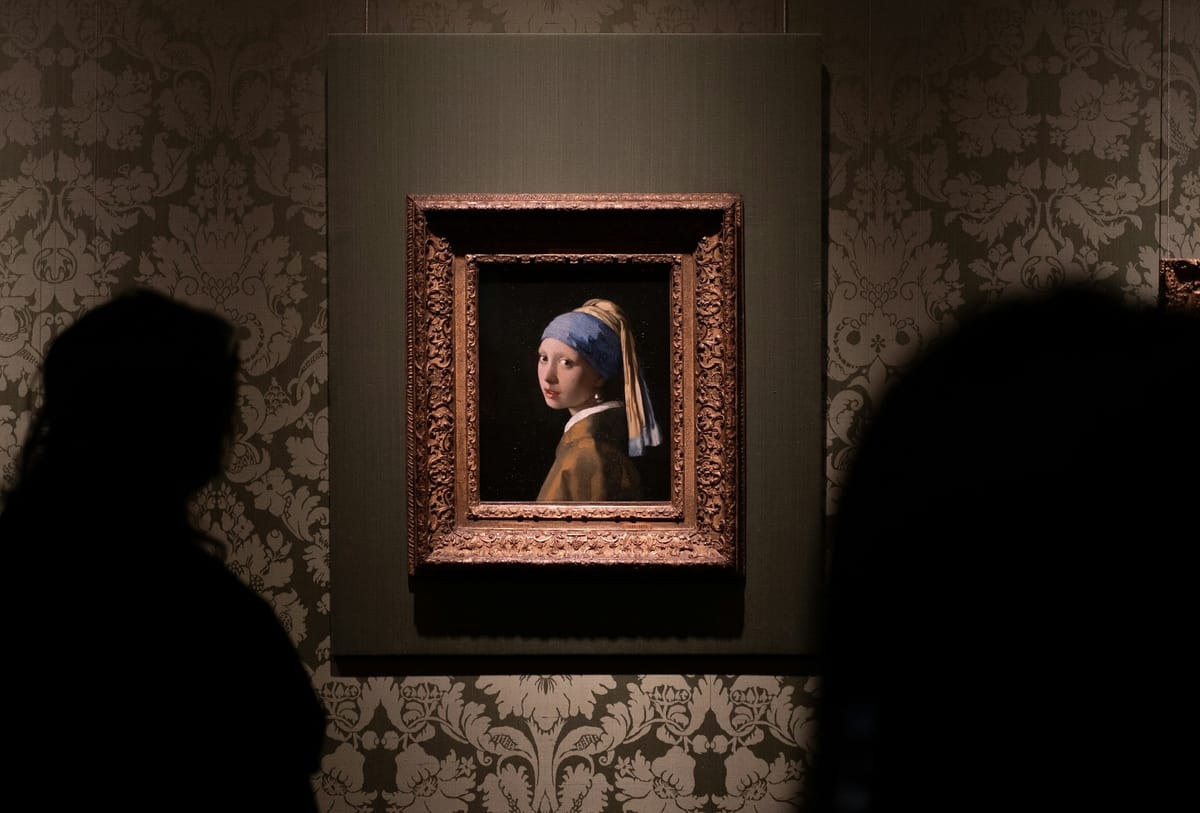
Few paintings have achieved the quiet magnetism of Girl with a Pearl Earring. Created around 1665 by the Dutch master Johannes Vermeer, the small canvas has become one of the most recognisable faces in Western art. She turns towards us, lips slightly parted, eyes luminous, a large pearl suspended from her ear. The background is dark, almost void-like, which makes her presence feel immediate and intimate.
And yet, for all her familiarity, we know almost nothing about her.
The question that continues to fascinate viewers, scholars, and novelists alike is deceptively simple: was she real?
A Portrait or Something Else?
At first glance, the painting appears to be a portrait. The girl’s expression feels individual, almost candid, as though we have interrupted her mid-thought. But art historians are cautious. The work is not a conventional portrait but what is known in Dutch as a tronie.
A tronie was not intended to depict a specific person. Instead, it was a study of character, expression, or costume. Seventeenth-century Dutch artists frequently painted such works as exercises in light and physiognomy. They allowed for imaginative freedom. Exotic clothing, unusual headgear, and dramatic lighting were all permissible because the aim was not likeness but effect.
The blue and yellow turban, for example, would not have been typical attire for a young woman in Delft. It signals theatricality rather than biography. If the painting is a tronie, then the girl may not represent any identifiable individual at all.
Yet the psychological immediacy complicates this tidy explanation. Her gaze does not feel generic. It feels personal.
Vermeer’s Circle
To approach the question of her identity, we must consider Vermeer’s life. Born in 1632 in Delft, he lived and worked there for most of his life. He married Catharina Bolnes and had fifteen children, eleven of whom survived infancy. His household was busy, domestic, and by most accounts financially strained.
Unlike many of his contemporaries, Vermeer produced relatively few paintings. Around thirty-five to thirty-seven works are generally accepted as authentic today. This small oeuvre has intensified scrutiny of each canvas.
Some scholars have suggested that the girl could have been one of Vermeer’s daughters. Maria, his eldest, would have been around twelve or thirteen in the mid-1660s, roughly the apparent age of the sitter. However, there is no documentary evidence to support this theory. No letters, no contracts, no family records mention such a painting or identify a model.
Others propose that she might have been a maidservant. Domestic staff often appear in Dutch genre paintings. Yet again, this remains speculation. The painting’s lack of documented provenance in its early years leaves us without firm ground.
What we are left with is an image detached from biography. The absence of certainty may be precisely what sustains the painting’s allure.
The Pearl That May Not Be a Pearl
One of the painting’s most striking features is the earring itself. The luminous drop catches the light with astonishing simplicity. But was it truly a pearl?
Technical analysis suggests that the object lacks the detailed surface reflections one would expect from a natural pearl. It may be glass, polished tin, or even an imaginative exaggeration. In fact, the earring is rendered with just a few decisive strokes of paint.
This economy of means is characteristic of Vermeer. He was less concerned with descriptive precision than with the effect of light. The pearl becomes less an object and more a focal point, a device that anchors the composition.
If the earring is partly illusion, what does that imply about the girl? She, too, may be less a person than a meditation on perception.
Light, Intimacy, and the Unfinished Moment
Vermeer’s mastery lies in his treatment of light. The soft illumination falling across the girl’s face creates a sense of three-dimensional presence. Her moist eyes and parted lips suggest breath, speech, life. Yet the moment feels suspended, almost incomplete.
Unlike formal portraits of the era, there are no attributes indicating status, profession, or wealth. No background details situate her in a specific interior. The dark backdrop isolates her from context.
This isolation heightens the viewer’s engagement. We are not distracted by narrative. Instead, we confront a face.
The painting’s scale contributes to this intimacy. At roughly 44 by 39 centimetres, it is modest in size. Encountering it in person at the Mauritshuis in The Hague can feel surprisingly personal. It does not overwhelm. It draws you closer.
The proximity invites speculation. Who was she? What was she thinking? Why does she look as though she has just turned towards us?
Fiction and the Power of Imagination
The question of the girl’s reality gained renewed attention with the publication of Girl with a Pearl Earring by Tracy Chevalier in 1999. The novel imagines the sitter as Griet, a young maid in Vermeer’s household. This fictional narrative, later adapted into a film, provided a compelling story that many readers embraced as quasi historical.
Yet Chevalier herself has acknowledged that the novel is an act of imagination. It fills the gaps left by historical silence. The popularity of the book illustrates how deeply audiences desire a story behind the image.
But perhaps the absence of fact is the point. The painting resists definitive interpretation. It invites projection.
The Seventeenth Century Context
Seventeenth-century Dutch art was shaped by a burgeoning middle class and a thriving market for paintings. Works were often produced speculatively and sold through dealers rather than commissioned by aristocratic patrons. In this context, a tronie would have appealed to buyers interested in expressive studies rather than formal portraiture.
Vermeer’s relative obscurity during his lifetime and the subsequent dispersal of his works complicate matters further. After his death in 1675, his reputation faded. It was not until the nineteenth century that he was rediscovered and elevated to canonical status.
By the time scholars began to catalogue his works seriously, documentation had long been lost. The girl’s identity, if ever recorded, had vanished into history.
Was She Real?
In a literal sense, of course, a model must have existed. Even if the painting is a tronie, Vermeer likely used a live sitter to achieve such convincing light effects. The tilt of the head, the moist gleam of the eye, the delicate shadow beneath the chin all suggest observation.
Yet the painting transcends its source. The girl is not presented as a documented individual but as an archetype. She embodies youth, curiosity, and quiet presence. She is both specific and universal.
The enduring fascination with her identity may reveal something about our relationship with art. We seek connection. We want to believe that behind every painted face lies a story waiting to be uncovered.
But some works resist closure. They thrive on ambiguity.
The Art of Not Knowing
In an age saturated with information, there is something refreshing about uncertainty. Girl with a Pearl Earring does not offer explanatory labels within the image itself. It provides no narrative cues. It simply presents a face caught in luminous stillness.
Whether she was a daughter, a servant, or a composite invention may ultimately matter less than the experience of looking. The painting’s power lies in its ability to create intimacy without biography. The girl may have been real in the studio. But in art, she becomes something else entirely. She becomes a moment of light, a study in colour and form, and an enduring enigma.
And perhaps that is the true answer. She was real enough to be seen. Yet she remains unknown enough to be imagined.